
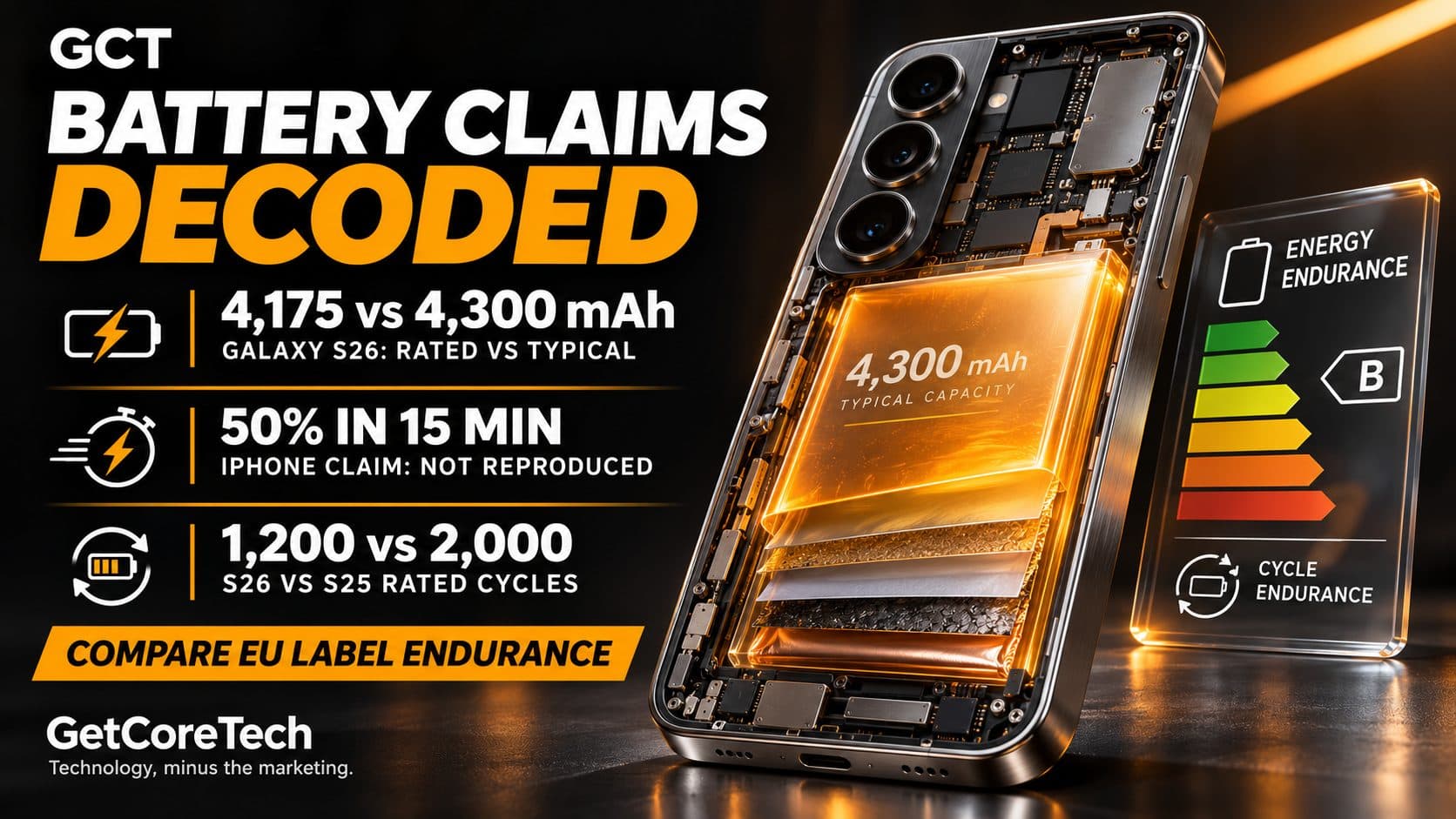
A phone battery’s three headline numbers, capacity, charging power and cycle life, each describe a maker’s test, not an owner’s day. Samsung’s EU label lists the Galaxy S26 at 4,175 mAh rated capacity,1 while marketing uses 4,300 mAh.2 Apple’s “50% in about 15 minutes” for the iPhone 18 Pro comes from drained preproduction phones on a 60W adapter sold separately.3 The EU label’s standardised endurance test is the one figure a buyer can compare across models; treat the rest as rung 4 claims.
The status board places each battery claim on the maturity ladder; for devices, rung 5 means a product on sale whose claims an independent lab has tested.
| Name | Rung (1-5) | Best evidence | As of |
|---|---|---|---|
| EU label: battery endurance per cycle | 5 | Mandatory on every model sold in the EU since 20 June 2025, from a standardised test, with a public product database4 | read 2026-11-08 |
| iPhone 18 Pro “50% in about 15 minutes” | 4 | Apple’s claim, from drained preproduction phones3; GSMArena could not reproduce it at the 15-minute mark5 | 2026-09-15 |
| Galaxy S26 rated for 1,200 cycles to 80% | 4 | Declared on pre-launch EU labels; the S25 series was rated 2,0001 | 2026-02-24 |
| Silicon-carbon cell life (Xiaomi: 80% after 1,600 cycles) | 2 | Xiaomi’s own claim; no independent cycle test found6 | read 2026-11-08 |
| Galaxy S26 Ultra 60W charging gain | 4 | Samsung’s lab figure of 0 to 75% in 30 minutes, via a leaker7; Notebookcheck says it barely beats its S25 Ultra result8 | read 2026-11-08 |
Every figure below was checked against a source dated or opened within the last six months, except the Apple cycle rating and the PhoneArena charging guide, which are older and flagged where they appear.
Capacity in mAh leaves out the voltage
Reported iFixit argues that mAh omits a battery’s nominal voltage and recommends watt-hours, calculated as mAh times nominal voltage divided by 1,000.9 The EU’s own efficiency index follows the same logic, dividing battery endurance by nominal voltage times rated capacity.10 Two phones with the same mAh but different cell voltages store different energy.
Reported The EU product information sheet lists the Galaxy S26, S26+ and S26 Ultra at 4,175, 4,755 and 4,855 mAh,1 while Samsung’s marketing figures are 4,300 mAh for the S262 and 5,000 mAh for the Ultra.11 Both gaps come to about 3%. The EU’s cycle-life definition is built on rated capacity, the lower of the two numbers.4
Compare the rated figure, and compare it in watt-hours when you can.
Bigger capacity does not scale endurance
Reported Silicon-carbon anodes add silicon to the graphite used in conventional cells. Silicon can store far more lithium in theory, but the gain in a finished cell is smaller: Electronics For You calls the energy-density increase over graphite modest,12 and Memeburn, quoting Pacific Northwest National Laboratory, puts silicon-based approaches at roughly 20 to 40% higher overall energy density.6 The same article reports 91mobiles’ tracking, in which phones with 6,000 mAh or larger batteries went from 10% of global sales in January 2025 to 29% in January 2026, and average runtime in its tests rose from about 13 to 15.5 hours.12 The article does not state the test method.
Reported On the pre-launch EU labels, the S26 with 4,175 mAh lasted 51 hours and the S26 Ultra with 4,855 mAh lasted 55 hours.1 That is 16% more capacity for 8% more hours, although the two phones differ in chip and screen. Capacity is stored energy, and endurance depends on what draws it down.
Reported Xiaomi says the 10,000 mAh battery in the global Redmi Note 17 Pro Max uses 16% silicon and retains at least 80% capacity after 1,600 charge cycles.6 That is a maker’s claim on a shipping product. I found no independent cycle test of a silicon-carbon phone battery with a stated method.
Charging speed is a peak rating and a time to 50%
Reported Apple says the iPhone 18 Pro and Pro Max reach 50% in about 15 minutes by cable, but only with a 60W-capable USB PD 3.1 adapter that supports Adjustable Voltage Supply and a 60W cable. It tested drained, preproduction phones and timed from the Apple logo at startup, and the adapter is sold separately.3 The wireless claim is 50% in 30 minutes over MagSafe with a 35W or higher adapter.3 Both are times to half a charge, and charging slows as the battery fills.
Measured GSMArena did not reach 50% in 15 minutes in its iPhone 18 Pro test. The phone was marginally faster than the iPhone 17 Pro at the 15-minute mark and pulled further ahead at 30 minutes.5 The maker’s figure and the lab’s figure sit close together, but they are not the same number.
Reported A higher wattage rating does not guarantee a proportionally shorter charge. Samsung raised the Galaxy S26 Ultra’s wired rating from 45W to 60W, a 33% increase on paper. A leaker’s report of Samsung’s own controlled test put 0 to 75% at 30 minutes,7 and Notebookcheck says that changes very little against its S25 Ultra results.8 By contrast, PhoneArena’s method times 1% to 100% with the included charger,13 and its OnePlus 15 reached 100% in 25 minutes in a guide dated about March 2026, older than six months.13
Cycle-life ratings come from makers, with the EU setting a floor
Reported Apple’s support document says iPhone 15 and later batteries are designed to retain 80% of original capacity at 1,000 complete cycles under ideal conditions, double the 500 cycles for iPhone 14 and earlier.14 Coverage of that document dates from 2024, and I did not open Apple’s page itself. The 1,000-cycle figure is a design target, and the same document says exact results depend on how a phone is used and charged.14
Reported The EU sets a floor of 800 cycles at 80% of initial capacity, and its label states each model’s cycle rating against rated capacity.4 The Commission’s page does not say an independent lab tests every model before sale. Suppliers calculate the figures under the regulation’s Annex IV method, and national authorities verify them in market checks.4
Reported Declared figures move between generations. The pre-launch labels show the Galaxy S26 series at 1,200 cycles against 2,000 for the S25 series, about 40% lower on paper,11 and Android Authority said it was skeptical until the labels went live.1 PhoneArena reported Google’s Pixel 10 Pro XL at 1,000 cycles on its label.2 No source I read explains the Samsung change.
The same model can ship with a different battery by market
Reported Stuff tested the 7,800 mAh version of the vivo X500 Pro Max and says its results skew above what European buyers can expect.15 Gizchina notes that vivo’s international storefront lists 5,300 mAh for the X500 Pro, while its China site lists 6,510 mAh.16 A review’s endurance figure applies to the capacity that reviewer held. On EU models, the rated capacity in the product database is the number to check.4
A battery-spec decoder
Each row pairs a headline claim with what it measures and a check that needs no lab.
| Claim | What it measures | How to check it |
|---|---|---|
| “5,000 mAh” | Charge capacity, either rated or “typical” | Compare watt-hours; for EU models, read rated capacity on the product sheet19 |
| “100W charging” | Peak input from a maker’s charger | Find independent 0-50% and 0-100% times that name the charger13 |
| “50% in 15 minutes” | Time from drained, in the maker’s lab | Check the adapter and cable requirements, then compare independent 15- and 30-minute readings35 |
| “80% after 1,000 cycles” | A maker’s design target | Treat as unaudited; for EU models, compare the label’s cycle figure414 |
| “Up to X hours” | One workload | Compare the EU label’s endurance per cycle across models4 |
Opinion A figure that names its test conditions can be compared across phones, and one that does not should be discounted.
What would move it up a rung
Charging claims reach rung 5 when an independent lab publishes time to 50% and 100% for the same phone on the maker’s named charger and on a standard one, beside the maker’s figure. PhoneArena’s published method already describes the measurement.13 The first candidates are reviews of the iPhone 18 Pro that name the adapter used.
Cycle-life ratings move up when a lab cycles retail cells and publishes capacity at 800 or 1,000 cycles, which would test both the Apple and the EU-label figures. The Commission must review its smartphone regulation by September 2027, a date worth watching for any change to how those cycle figures are verified.4
The silicon-carbon claim moves from rung 2 to rung 3 when someone other than the maker reports cycle data for a shipping cell such as Xiaomi’s.

Comments