
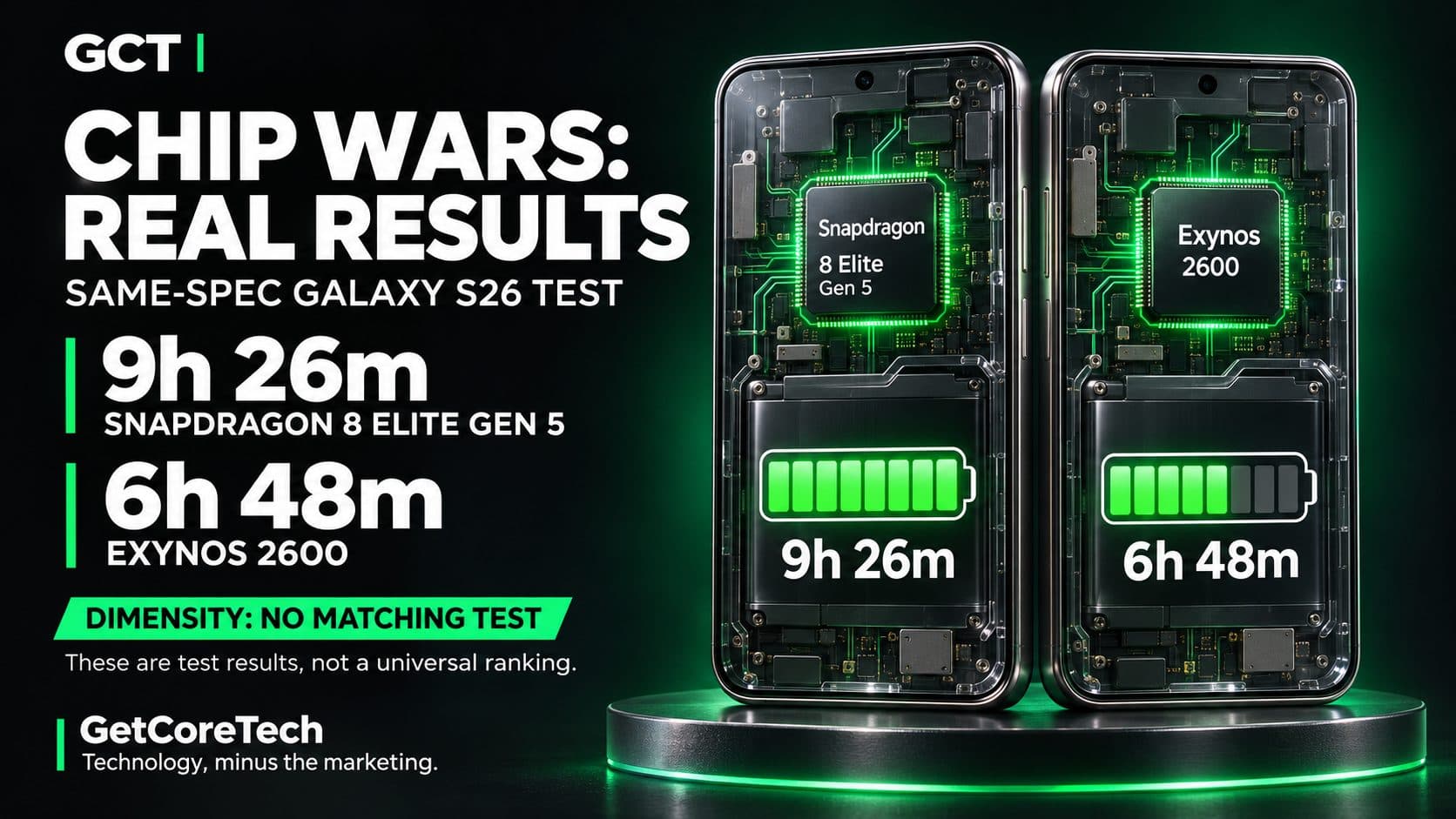
No independent test I found ranks Snapdragon, MediaTek and Exynos on one measure that predicts what a buyer gets. The clearest measured gap sits inside Samsung’s own range: two same-spec Galaxy S26 units lasted 9 hours 26 minutes on the Snapdragon 8 Elite Gen 5 and 6 hours 48 minutes on the Exynos 2600.1 Qualcomm’s 37% and MediaTek’s 61% efficiency claims for their new 2nm chips are each measured against the maker’s own previous chip. That puts them at rung 4, on sale in limited markets with no independent confirmation yet.23 A model-level test with stated conditions settles more than the chip name does.
The status board places each chip family on the maturity ladder; for devices, rung 5 means a product on sale whose claims an independent lab has tested.
| Name | Rung (1-5) | Best evidence | As of |
|---|---|---|---|
| Snapdragon 8 Elite Gen 6 and Extreme Gen 6 | 4 | Qualcomm claims 37% better CPU power efficiency than Gen 5 and says results vary by OEM2; first phones launched, with the Extreme chip reaching the US in November4 | read 2026-11-08 |
| Dimensity 9600 Pro | 4 | MediaTek claims 61% lower multi-core power3; one reviewer measured 55% stability in a stress test on the vivo X500 Pro Max5 | 2026-09-15 |
| Snapdragon 8 Elite Gen 5 | 5 | Lasted 9 h 26 min against 6 h 48 min for the Exynos in a same-spec Galaxy S26 pair1 | 2026-03-31 |
| Exynos 2600 | 5 | Same pair test1; Notebookcheck’s lab test measured about two hours less battery than the Galaxy S25+6 | 2026-03-31 |
| Exynos 2700 | 2 | Samsung internal tests, reported by Korean press and unverified7 | 2026-10-25 |
The Galaxy S26 battery tests date from March 2026, which is older than six months, and the text flags them where they appear.
The chip in the box depends on where you buy the phone
Reported Samsung confirmed the split at the Galaxy S26 launch. The S26 and S26+ carry the Exynos 2600 in most markets, the United States, China and Japan get the Snapdragon 8 Elite Gen 5 instead, and the S26 Ultra uses the Snapdragon chip everywhere.8 A review of “the Galaxy S26” therefore describes one of two phones, and a buyer has to check which variant the reviewer held and which one the local market receives.
Qualcomm now splits its own flagship line too. The standard Snapdragon 8 Elite Gen 6 claims 10% more CPU performance than Gen 5,2 and the 8 Elite Extreme Gen 6 claims 13%, along with 44% more GPU performance and a 50% larger shared-memory pool for the NPU.9 Both are 2nm parts. The phone maker picks the tier: Xiaomi put the standard chip in the 18 Pro and the Extreme in the 18 Pro Max.4
Each efficiency claim is measured against the maker’s own last chip
Reported Qualcomm’s product brief states that every comparison is against the Snapdragon 8 Elite Gen 5 and that results vary with OEM implementation. For the standard Gen 6 it claims 37% better CPU power efficiency and 40% better GPU power efficiency.2 The only test condition the brief spells out is for Wi-Fi: internal iperf runs at 1 Gbps against previous-generation 2x2 160 MHz products.2 The CPU efficiency figure carries no stated workload.
Reported MediaTek’s release claims a 61% reduction in multi-core power consumption for the Dimensity 9600 Pro,3 and launch coverage reports that its 17% single-core and 15% multi-core gains are measured against the Dimensity 9500.10 Qualcomm’s 37% and MediaTek’s 61% use different baselines, different workloads and different companies’ labs, so the two numbers cannot be ranked against each other. Wccftech also reported that MediaTek’s slides lowered the Dimensity 9500’s own scores by 8.5% to widen the generational gap.10 That is one outlet’s reading, and I did not check it against the slides.
A percentage with no workload attached is a marketing figure until a lab reruns it.
The phone’s cooling and tuning decide what the chip delivers
Reported MediaTek credits its Dimensity Scheduling Engine with allocating compute, power and memory resources so that background applications keep running smoothly.3 Software tuning therefore sits inside the efficiency story the maker tells. Qualcomm’s brief says the same thing in a footnote: results vary with OEM implementation and other factors.2 A percentage on a slide describes silicon at one load, while cooling design, clock limits and battery size belong to the phone maker.
Measured The same Dimensity 9600 Pro behaves differently from phone to phone. Trusted Reviews found that the vivo X500 Pro Max, which shares its chip and GPU with the Oppo Find X10 Pro Max, appeared to be throttled aggressively under sustained load.11 Tech Edition recorded 55% stability for that phone in 3DMark’s Steel Nomad Light Stress Test.5 Both are single-unit reviews, and I found no matching stability figure for a Snapdragon 8 Elite Gen 6 phone, so neither result ranks the chips.
Battery capacity also varies by market. Stuff tested the 7,800 mAh version of the X500 Pro Max and says its results skew above what European buyers can expect.12 Gizchina notes that vivo’s international storefront lists 5,300 mAh for the X500 Pro against 6,510 mAh on its China site.13 Opinion Check the capacity of the version sold in your country before reading any endurance figure.
Independent tests agree on direction for Exynos, not on size
Measured Android Addicts compared a European Galaxy S26 (Exynos 2600) with a US Galaxy S26 (Snapdragon 8 Elite Gen 5). GSMArena reports that both units had 4,300 mAh batteries, 12 GB of RAM and 512 GB of storage, and that both sat on the same 5G network with Wi-Fi off.1 In the one-hour call test the Snapdragon unit lost 3% and the Exynos unit one point more. The Exynos unit then failed a 30-minute 4K30 recording and encode task because it overheated. It shut down at 6 hours 48 minutes, and the Snapdragon unit ran another 2 hours 38 minutes.1 Measured against the Exynos runtime, the Snapdragon phone lasted about 39% longer; measured against its own runtime, the Exynos phone fell about 28% short. Headlines have used both figures, and both come from the same two times.
Measured Notebookcheck’s lab test used a fixed 150-nit brightness and a browser script, and the Galaxy S26+ lasted about two hours less than the S25+.6 Its review conclusion calls the Exynos 2600 slightly less efficient than the Snapdragon 8 Elite Gen 5, says the differences are not especially big, and puts it a fair bit behind in Geekbench single-core.14 The two sources agree on direction and disagree on size. Notebookcheck’s method is controlled but compares across phone generations. The Android Addicts pair has identical hardware but is a single pair of units on a mixed workload in which one unit failed a task.
Treat the direction as established at rung 3 and the size as open.
Unreleased chips and leaked scores sit at rung 2
Reported SamMobile reported on 25 October 2026 that Samsung’s internal tests put the Exynos 2700 about 20% ahead of the Snapdragon 8 Elite Extreme Gen 6 in Geekbench 6.5 multi-core, roughly 13,000 against 11,000. The outlet says the gains are unverified and that real-world results depend on heat and power efficiency, and it reports the chip in every Galaxy S27 model except the Ultra.7 That is a maker’s lab demonstration, unreplicated, with no power figure attached.
Pre-launch Geekbench listings carry the same caution. Notebookcheck’s September listings put the Dimensity 9600 Pro at 3,242 single-core and 11,132 multi-core against 3,582 and 12,247 for the Extreme Gen 6, with no test conditions stated.15 A leaked score fixes neither a ranking nor a battery result.
A chip-choice checklist that needs no lab
Each row pairs a buying priority with a check that uses published evidence.
| Priority | What to check | Evidence it rests on |
|---|---|---|
| Battery life | Find a test of your exact model and region that states brightness and workload; confirm the battery capacity sold in your country | Same-spec S26 pair ran 6 h 48 min vs 9 h 26 min1; capacity differs by market12 |
| Sustained gaming and video | Look for a stress-test stability percentage and temperature in the review of that phone | Same chip, different throttling across phones511 |
| Which chip you receive | Confirm the variant your market gets before reading reviews | Galaxy S26 and S26+ split by region8 |
| Efficiency headlines | Note the baseline; “vs the previous generation” cannot be compared across makers | Qualcomm vs Gen 52; MediaTek vs Dimensity 950010 |
| Peak modem and Wi-Fi speeds | Read them as maker ceilings: Qualcomm lists up to 14.8 Gbps 5G and 11.6 Gbps Wi-Fi | Qualcomm product brief2 |
What would move it up a rung
The claim that a 2nm Snapdragon or Dimensity phone beats last year’s on battery by the makers’ percentages reaches rung 5 when an independent lab reruns a stated workload on a new phone and an older one and publishes the change. Notebookcheck’s 150-nit browser script already works as that template.6 The first candidates are reviews of the Xiaomi 18 Pro series and the Motorola Signature 27, whose Extreme-chip US release is due in November.4
The Exynos 2700 claim moves to rung 3 when a retail Galaxy S27 appears in a test that measures power draw, not only a Geekbench score. Same-spec pairs like the S26 comparison would show whether the Exynos gap has closed.

Comments