

A spec-sheet figure is the maker's best case on one workload. Apple rates the iPhone 18 Pro at up to 36 hours of video playback, a rung 4 claim: sold at scale, with no independent test that reproduces it. Tom's Guide measured 16 hours 17 minutes of cellular web browsing on the same phone.1 Plan around the measured number; the same gap between rating and measurement runs through "AI PC" labels, update promises and Wi-Fi speeds.
The status board places each claim on the maturity ladder, the same scale the Future Tech guide uses; for devices, rung 5 means a product on sale whose claims an independent lab has tested.
| Name | Rung (1-5) | Best evidence | As of |
|---|---|---|---|
| iPhone 18 Pro rated battery life (36 h video) | 4 | Apple's rating covers video playback only; Tom's Guide measured 16:17 of cellular web browsing, a different workload1 | 2026-09-16 |
| EU smartphone energy label (battery, repairability, drop class) | 5 | Mandatory since 20 June 2025, with standardised tests and a public product database2 | 2026-06-11 |
| Copilot+ PC hardware floor (40+ TOPS NPU, 16 GB RAM, 256 GB SSD) | 4 | Microsoft's published requirements3; Windows Central reports the name is being retired on new Surface models4 | 2026-09-24 |
| Galaxy S26 seven-year update promise | 1 | Samsung's launch commitment as reported by Notebookcheck; the term ends in 20335 | 2026-02-25 |
| Wi-Fi 7 "BE19000" speed rating | 1 | Per-band theoretical rates sum to about 18,656 Mbps6 | 2026-10-30 |
Every rating and policy below was checked against a source dated or opened within the last six months, except the February 2026 Samsung launch report, which is flagged where it appears.
A rated battery life is one workload, run once
Reported Apple's 36-hour rating for the iPhone 18 Pro, and 45 hours for the Pro Max, covers video playback only.1 TidBITS reports that the figure comes from repeatedly playing a 2-hour-23-minute movie stored on the phone.7 A stored film makes few demands on the cellular modem or the browser, which a day of use does. The rating describes a task, not a day of use.
Measured Tom's Guide's test sets the screen to 150 nits and runs automated web browsing over cellular until the phone shuts down. The iPhone 18 Pro lasted 16 hours 17 minutes and the 18 Pro Max 18 hours 27 minutes.1 The two numbers answer different questions, and neither contradicts the other. Only the second describes what someone browsing over cellular will see.
Opinion Plan around the measured figure.
The EU label fixes the test, so its numbers compare
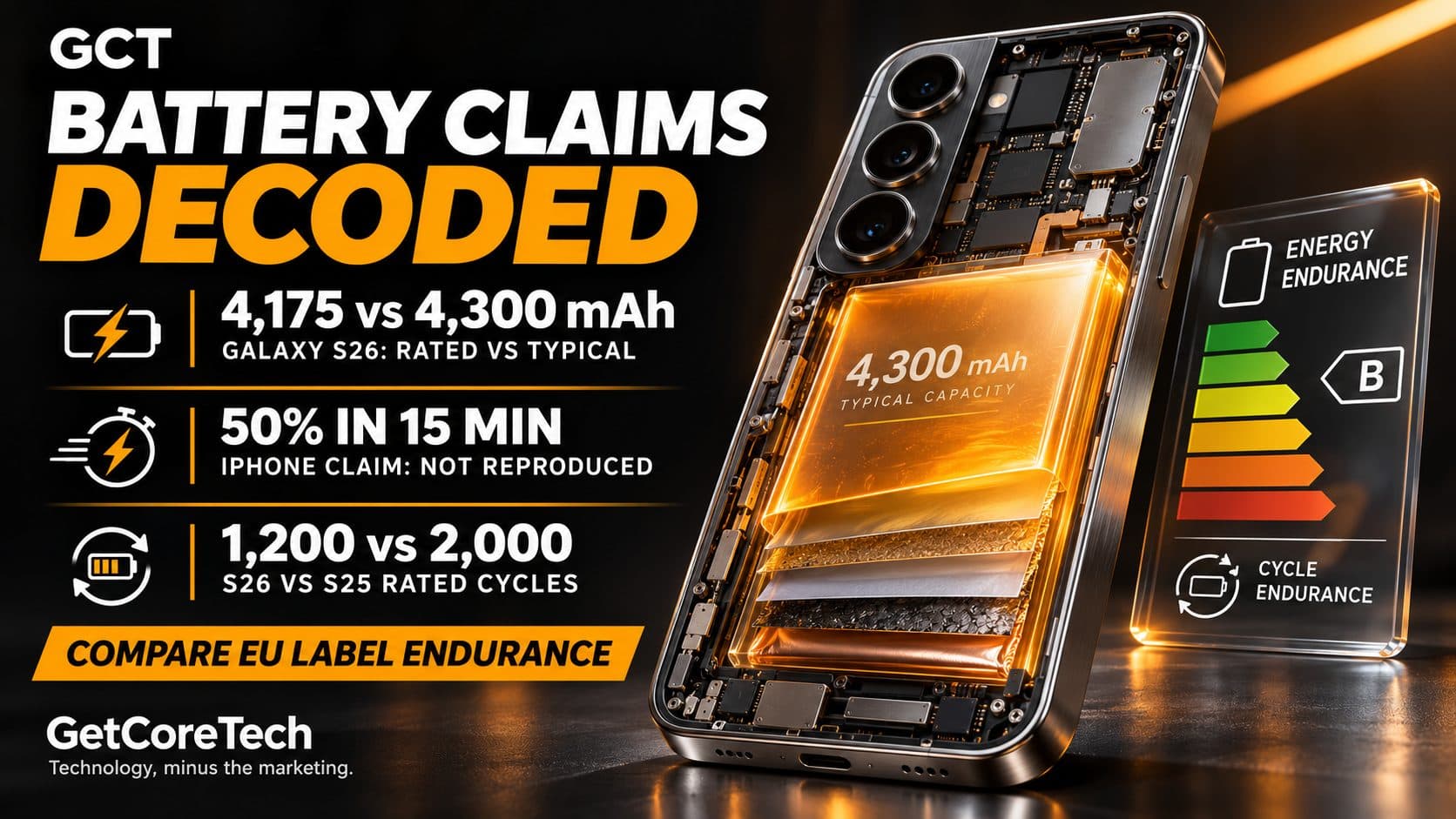
Reported According to the European Commission's energy-labelling page, smartphones and slate tablets placed on the EU market from 20 June 2025 must carry a label showing battery endurance per cycle, from a standardised test of usage meant to reproduce a typical real-life situation. The label also gives endurance in charge cycles, a repeated-free-fall class from A to E, a repairability class from A to E and an Ingress Protection rating.2 A QR code on the label leads to the model's entry in the EPREL product database.2
The ecodesign rules behind the label set minimums. Batteries must keep at least 80% of their capacity after 800 charge cycles, critical spare parts must stay available until seven years after the model leaves the EU market, and operating-system upgrades must run for at least five years after the last unit is sold.2 The regulation also forbids devices designed to alter their performance under testing.2
The scope is narrow. Tablet computers, phones with unrollable displays and high-security smartphones fall outside it, and the Commission's page dates its consumer guidelines 11 June 2026 and says the regulation is due for review by September 2027.2
AI labels set a hardware floor, and one maker dropped the name
Reported Microsoft's Windows 11 specifications page defines a Copilot+ PC as a machine with an NPU rated at 40 or more TOPS, 16 GB of RAM and a 256 GB SSD.3 A PC with a 40-TOPS NPU but less memory or storage is not a Copilot+ PC, and Microsoft says features such as improved Windows search need a machine that meets all of the requirements.3 The label certifies a hardware floor. It says nothing about how fast any feature runs.
On 24 September 2026 Windows Central reported that Microsoft and PC makers are pulling back the Copilot+ PC name, and that Surface executive Brett Ostrum confirmed the newest Surface machines are not being called Copilot+ PCs.4 The requirements still stand on Microsoft's own page as of 30 October 2026.3 The name is going; the specification is the thing to check.
Apple draws its line on phones differently. TechRadar reported on 14 September 2026 that iOS 27 runs on 33 iPhone models, back to the iPhone 11, yet Apple Intelligence stays limited to the iPhone 15 Pro and newer.8 Expressive Siri voices and advanced dictation need what Apple calls its "most powerful on-device model," and the list of qualifying phones starts at the iPhone 17 Pro and iPhone Air, without the base iPhone 17.8 Whether a given feature runs on the phone or on a server is a separate question, which the guide to what runs locally on phones and laptops answers feature by feature.
Update promises can't be audited before 2033
Notebookcheck reported on 25 February 2026 that Samsung launched the Galaxy S26 with a seven-year update promise.5 That report is the oldest source in this guide. A seven-year term that began in February 2026 ends in February 2033, and no independent test can confirm delivery until then. In ladder terms the promise is a rung 1 claim: stated, with nothing yet to measure.
Apple's record shows up in support lists instead. TechRadar counted 33 iPhone models eligible for iOS 27, including the iPhone 11 and iPhone SE (2020), and its phones editor believed it to be the largest such pool Apple has produced.8 Eligibility for one release is not a promise, since the sources reviewed here show no published end date from Apple, but it is a record anyone can check.
The EU minimum counts differently. It runs five years from the end of sales of the last unit, not from launch,2 so the same rule gives a different launch-to-end window for a model sold for two years than for one sold for four.
Wi-Fi 7 speed names add three bands together
Reported Xiaomi's support FAQ for its BE19000 Pro router shows the arithmetic: 1,376 Mbps on 2.4 GHz, 5,760 Mbps on 5 GHz and 11,520 Mbps on 6 GHz, a combined theoretical total of about 18,656 Mbps.6 The 19000 in the name is that sum, rounded. Each figure is a band's theoretical ceiling. The name does not tell a buyer what a single device will receive.
The same FAQ says actual speeds vary with environmental interference, network conditions and the performance of the connected device.6 Microsoft adds the client side: full Wi-Fi 7 features, including Multi-Link Operation and 320 MHz channels, need a Wi-Fi 7 adapter in a PC running Windows 11 24H2 or later and a Wi-Fi 7 router or access point.3 A new router paired with an older laptop adapter therefore delivers a partial Wi-Fi 7 link at most.
What a buyer can check without a lab
The decoder pairs each headline claim with what its test actually covers and a check that needs no equipment.
| Claim | What it measures | How to check it |
|---|---|---|
| "Up to X hours" battery | One maker-chosen workload, such as looped local video | Read the footnote, then find an independent test on a browsing or mixed workload; for EU-sold models, compare the label's endurance per cycle |
| "AI phone" or "AI PC" | A hardware floor or a supported-device list | Open the maker's requirements page and compare it with your model; ask which features run locally |
| "N years of updates" | A commitment with a start date | Find the policy page, note the start date and whether it covers security patches, OS upgrades or both |
| BE19000 or "up to 19 Gbps" | The sum of each band's theoretical maximum | Split the number by band, then check which Wi-Fi generation your own device supports |
| Repairability or drop class | An EU-standardised score defined in the regulation | Scan the label's QR code and open the model's EPREL entry2 |
The EU label row is the only one backed by a regulator's test; the others rest on a maker's document. Opinion A rating that states its test conditions can be compared across models, and one that does not should be discounted.
What would move it up a rung
Battery ratings reach rung 5 when an independent test reruns the maker's stated workload and reports the result beside the rating. The EU label already supplies a standardised figure for every model sold there, so the quickest check is to read endurance per cycle on a model's EPREL entry and set it beside the maker's headline number.2
Update promises move only with time. Samsung's February 2026 seven-year term can be tested in 2033, and the nearest evidence is a maker's on-time record on shorter promises, visible in its security bulletins.
AI labels move when a maker publishes, per feature, whether it runs on the device or on a server, which is the table the on-device AI guide builds from maker documentation. Wi-Fi 7 speed names would move if routers printed a per-band figure beside the combined number.


Comments