
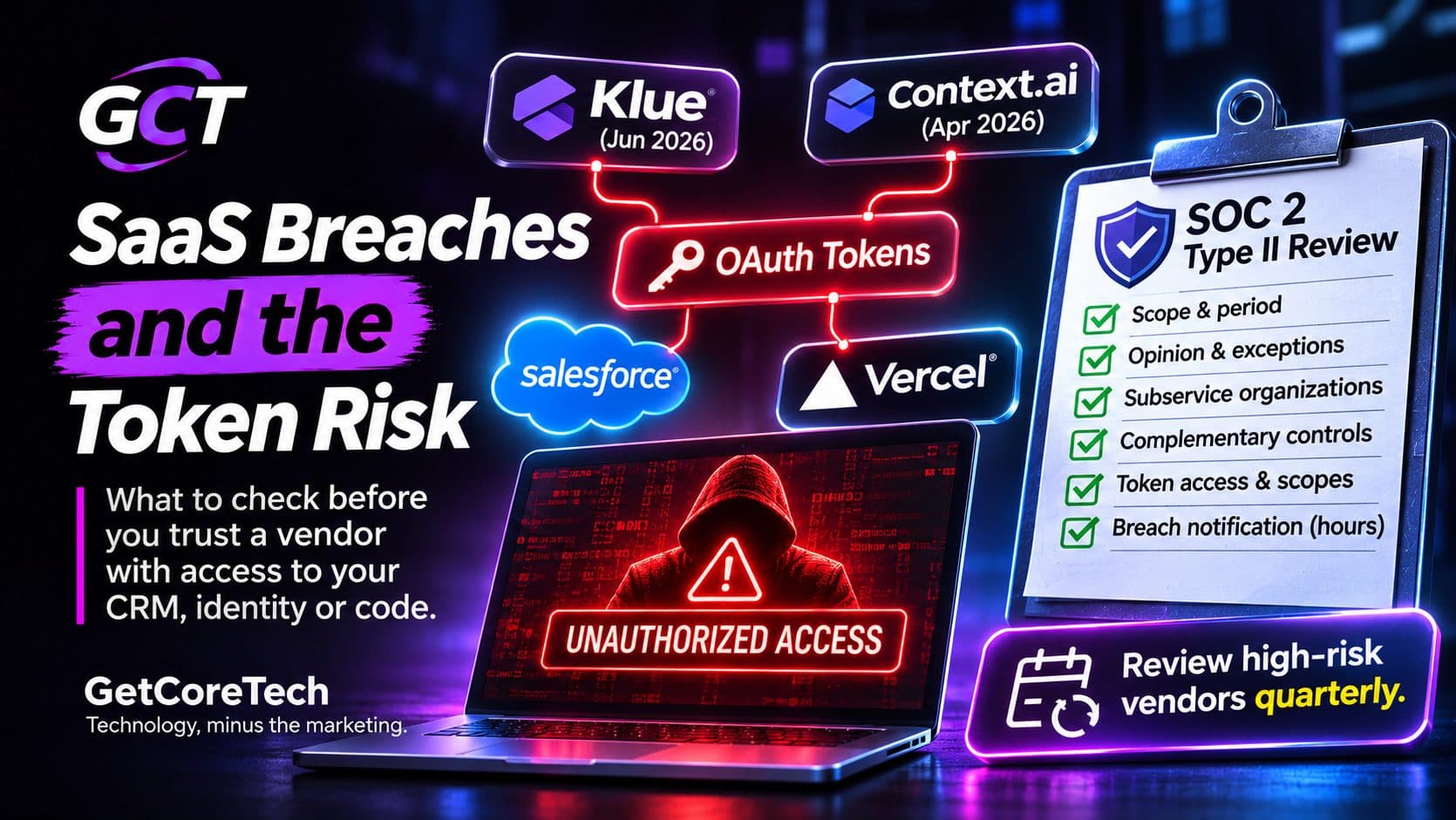
Two 2026 SaaS breaches reached customers through tokens the vendors held for them: a forgotten credential at Klue gave attackers OAuth tokens into customer Salesforce environments in June,1 and an infostealer infection at Context.ai led to a breach at Vercel in April.2 So review a SaaS vendor on what it holds on your behalf before you read its audit report: get the full SOC 2 Type II report and check its period and scope against the product you are buying, list every token, key and scope the vendor will hold, and get a written breach-notification deadline; if the vendor will hold tokens into your CRM, identity or code systems, do that review first and repeat it every quarter.
Klue and Context.ai show where the review gap is
Reported Klue, a competitive-intelligence vendor, said it detected unauthorized activity on 12 June 2026 and that attackers got in through a compromised legacy credential tied to an integration service. The attacker used that access to obtain the OAuth tokens Klue held to connect to customers' Salesforce and other platforms. Huntress's investigation, as The Hacker News relays it, found the credential had been created for a third party to prototype an integration that was later abandoned.1 The attacker pushed a code update that collected the tokens, then queried customers' Salesforce environments directly.1 ReliaQuest saw automated scripts query Salesforce for almost 24 hours, including a burst of nearly a thousand queries in 15 minutes against one environment.1 Salesforce disabled the Klue Battlecards integration and said the problem was limited to Klue's app connection, not a flaw in Salesforce.1 By The Hacker News's update of 23 June, 13 organizations had publicly confirmed impact, including HackerOne, Snyk, LastPass and BeyondTrust, and it was unclear how many Salesforce customers were affected in total.1
Reported In April, Vercel disclosed a breach that the Cloud Security Alliance (CSA) traces to Context.ai, an AI agent platform that at least one Vercel employee had authorized with broad OAuth permissions over a Google Workspace account. An infostealer infected a Context.ai employee in February, attackers reached Context.ai's AWS environment in March, and OAuth tokens let them into the employee's Workspace identity and then Vercel's internal systems.2 CSA's point for buyers is that enterprises run vendor risk assessments at procurement while failing to scrutinize the OAuth grant itself.2
A questionnaire answered at signing misses this risk. ReliaQuest describes such integrations as non-human identities with persistent, often broad access that get far less monitoring than employee accounts.1
Read the SOC 2 Type II report for scope, period and exceptions
A SOC 2 Type II report combines management's description of a system, an independent CPA's opinion and test results over a defined period, so it cannot be read as a pass-or-fail badge.3 Five checks decide whether it covers your purchase.
First, confirm identity: the legal name, the examination period, the auditor's report date and the products and locations described. The Security category applies in every SOC 2 examination, while Availability, Processing Integrity, Confidentiality and Privacy appear only when selected, so a report over Security and Availability gives no opinion on Privacy. Match the system name to the product you are buying, because a shared parent company or an ISO certificate elsewhere does not put the product inside the boundary.3
Second, read the opinion word by word and note whether it is modified. An unmodified opinion can still sit beside disclosed exceptions, so read the test results too and ask for each exception which control failed, over what period, and whether the auditor tested the fix.3
Third, find the complementary user entity controls, the controls the vendor assumes you operate, such as restricting customer administrator access or configuring authentication. Give each applicable one a named owner on your side.3
Fourth, check the subservice organizations. If the report carves out a cloud platform or support processor, the auditor did not examine its controls in that report.3
Fifth, count the days between the period end and today. A bridge letter gives a management representation about that gap, and it does not extend the auditor's opinion.3
The checklist
Opinion I would put these questions to every vendor that will hold your data or credentials, and treat a missing answer as a finding. The "accept" column is my own bar, adapted from the sources.
| Area | Ask the vendor | Accept | Red flag |
|---|---|---|---|
| Assurance report | Full SOC 2 Type II report, period and product in scope | Unmodified opinion, recent period, your product inside the boundary | Type I only, a summary letter, or a product outside the boundary3 |
| Integrations and tokens | Which OAuth tokens, API keys and scopes will you hold for us, where are they stored, how do we revoke them | Minimum scopes, token expiry and rotation, revocation we can trigger | "Allow All" scopes and long-lived tokens that need a human to remove2 |
| Credential lifecycle | How do you retire abandoned service accounts and prototype credentials | An inventory with owners and expiry dates | No process. Klue's entry point was a prototype credential nobody had retired1 |
| Detection | Do you log token use and alert on unusual API volume, and can we export those logs with source addresses | Customer-visible API logs and alerting | Vendor-side visibility only. In the Klue attacks, access came from infrastructure unconnected to Klue1 |
| Identity and access | SSO, admin MFA, role-based admin, automated user removal | All four supported on your plan | Shared admin accounts |
| Data handling | Where is our data stored, how is it encrypted, how long is it kept, how do we export and delete it on exit | Written retention and deletion terms | No export path |
| Subprocessors and AI | Subprocessor list with change notice, whether our data trains models, which AI features need our OAuth access | Written answers and an opt-out | AI features that request broad access by default2 |
| Incident notification | Contractual notification deadline and a named contact | A deadline in hours, in the contract | "Promptly" with no number2 |
| Customer duties | Which complementary user entity controls apply to us | A named owner for each | Never read3 |
Tier vendors by what they hold
Opinion A vendor that holds tokens or keys into your CRM, identity provider, cloud account or source control belongs in the top tier, however small its contract. A compromise there reaches your systems directly, which is how Klue's customers were hit. Tier two holds your data but cannot act inside your systems, and gets the SOC 2 review and the table once a year. Tier three holds no data and needs only the basics.
Start with the grants nobody reviewed. CSA says applications that employees authorized with enterprise accounts, outside IT-managed provisioning, are the most likely to carry elevated permissions that were never reviewed, and it advises revoking broad grants and re-provisioning needed tools with scopes restricted to what they require.2 Treat OAuth grants as a standing attack surface and review them on a regular cadence, which for the top tier I would set at quarterly.2
The sources leave gaps. I could not open the vendors' own incident reports or the AICPA's report guidance, so the SOC 2 review steps come from a buyer's guide that cites the AICPA materials. The total number of Klue customers affected is unclear in the reporting, and the data claims in the Vercel case come from a threat actor that Vercel has not confirmed.123
Run the review in this order
- Inventory every OAuth grant and integration in your identity provider and SaaS admin consoles, recording the scopes, the identity that authorized each one, and whether IT or an individual employee approved it.2
- Tier every vendor by what it holds, using the three tiers above.
- Request the full SOC 2 Type II report from each top-tier vendor and check identity, period, opinion, exceptions and carve-outs.3
- Assign a named owner to each applicable complementary user entity control.3
- Send the token, credential-lifecycle and logging questions from the table, and keep the answers in writing.
- Revoke broad grants held by individual employees, and re-provision any tool the business needs through IT with minimum scopes.2
- Put the breach-notification deadline and your right to revoke tokens into the contract.
- Record one decision per vendor, either accept, accept with actions, request evidence or decline, with the reviewer, the report version and the next review date.3
- Re-review top-tier vendors every quarter, and straight away when a vendor discloses an incident.
Revisit when Klue's investigation names how many customers were affected, or when a top-tier vendor of yours discloses an incident.

Comments