SaaS Churn Benchmarks 2026: What Counts as "Good" Retention Now
There is no longer one number for "good" SaaS retention. SaaS Capital's 2026 survey of more than 1,000 private B2B companies puts median net revenue retention (NRR) at 103% for bootstrapped businesses with $3M–$20M in ARR. But ChartMogul's 2025 retention data on AI-native software — a category that barely existed as a benchmarking segment two years ago — shows a median NRR of just 48%, against an 82% median for traditional B2B SaaS in the same dataset. Both numbers are real, current, and from credible sources. The benchmark that matters now depends entirely on which of those categories a given business actually belongs to.Why a Single Benchmark Stopped Being Useful
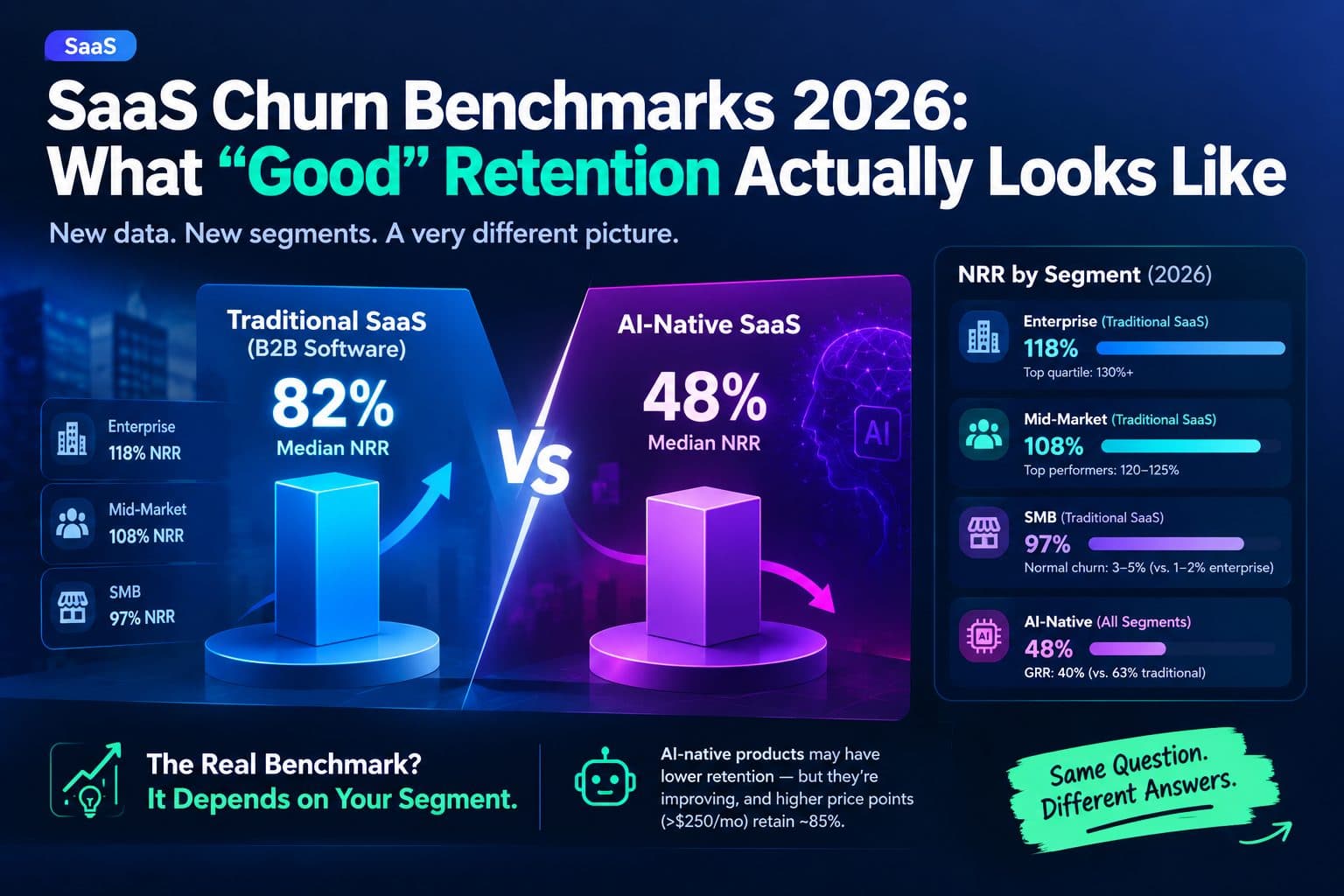
For most of the last decade, "good NRR" had a roughly stable answer: above 100% meant a business could grow without adding new customers, and 110–120%+ was the range associated with best-in-class, high-multiple SaaS companies. That framework still holds for traditional B2B software. What's changed in 2026 is that a large and fast-growing category — AI-native products, where AI is the core of the product rather than a supporting feature — behaves so differently on retention that folding it into the same benchmark distorts both halves of the comparison. ChartMogul's "AI Churn Wave" analysis, drawing on cohort data from more than 3,500 software businesses, found AI-native companies posting a median gross revenue retention (GRR) of 40%, compared with 63% for traditional B2B SaaS in the same dataset. On the net revenue side, AI-native median NRR came in at 48%, versus an 82% median for traditional B2B SaaS. Those aren't close numbers — a traditional SaaS company with 48% NRR would be in genuine crisis; for an AI-native product in ChartMogul's dataset, it's roughly the current midpoint.What Changed: The "AI Tourist" Effect Is Real, and It's Fading
The mechanism behind the gap has a name in the data: what ChartMogul calls the "AI tourist" effect. Users sign up out of curiosity — to try an AI writing tool, an image generator, or a ChatGPT alternative — with no real workflow need behind it, then cancel once the novelty wears off. Budget-tier AI products, under $50 a month, saw gross revenue retention as low as 23% in ChartMogul's data, meaning fewer than one in four dollars of starting revenue survived twelve months. The more current and more newsworthy part of the data is that this is already improving. AI-native median GRR climbed from 27% in January 2025 to 40% by September 2025 — a meaningful recovery in under a year, which ChartMogul attributes to early tourists churning out and the remaining base shifting from experimentation toward production use. Pricing tier turns out to be the sharpest predictor of which AI products are past the tourist phase: AI-native plans priced above $250 a month retain at roughly 85% NRR — in line with healthy traditional SaaS — while $50–$249 plans retain around 61%, and sub-$50 plans remain stuck near 32%. Higher price points generally mean a deliberate purchasing decision, budget sign-off, and workflow integration, all of which build switching costs; cheap, novelty-driven tools have none of that, and users abandon them the moment a marginally better free alternative appears.The Traditional SaaS Benchmarks, by Segment
For traditional B2B SaaS, the more useful 2026 benchmark isn't a single blended number — it's a number by contract size, because the spread between segments is wide enough that a blended median misleads in both directions. Enterprise (ACV above $100,000) runs a median NRR around 118%, with top-quartile companies exceeding 130%. Public examples at the high end: Snowflake reported 125% NRR in its fiscal Q4 2026, and Datadog posted roughly 120% NRR on $3.43 billion in 2025 revenue. Mid-market (ACV $25,000–$100,000) runs a median NRR around 108%, with top performers reaching 120–125%. SMB (ACV below $25,000) runs a median NRR around 97% — meaning the typical SMB-focused SaaS business is shrinking slightly within its existing customer base before counting any new-logo growth. That's a structural reality rather than a failure signal on its own: SMB monthly logo churn of 3–5% is normal, against 1–2% for enterprise, according to Optifai's 2026 pipeline study of 939 B2B SaaS companies. SaaS Capital's 2026 survey of bootstrapped companies with $3M–$20M in ARR — a segment that skips venture funding and therefore skews toward more capital-disciplined growth — shows median NRR of 103% and median gross revenue retention of 91%, with 90th-percentile NRR reaching 117.9%. That's a useful reference point precisely because it's bootstrapped: there's no growth-at-all-costs discounting propping the number up. One more gap worth naming explicitly: "B2B SaaS median NRR" varies noticeably depending on which population a report is measuring. Venture-backed cohorts in ChartMogul's broader dataset have shown medians closer to 106%, while the same firm's AI-focused analysis used 82% as its traditional-SaaS comparison baseline from a differently weighted sample. A 2026 joint study by Aleph and Benchmarkit, covering 342 B2B SaaS and AI-native companies using full-year 2025 results, found a median GRR of 84% among the 226 companies that reported it. None of these numbers contradict each other so much as measure different things — funding stage, company size, and reporting period all shift the median meaningfully, which is exactly why a single industry-wide benchmark is the wrong tool for judging any individual company's retention.Monthly Churn, Not Just Annual Retention
NRR and GRR describe revenue over a year; monthly logo churn is the more immediate operational signal, and it also splits sharply by segment. Optifai's 2026 study of 939 B2B SaaS companies puts typical monthly churn at 3–5% for SMB, 1.5–3% for mid-market, and 1–2% for enterprise, with best-in-class companies at any tier holding under 1%. Separately, an aggregate analysis of 500-plus companies put the overall B2B SaaS median monthly churn at 3.5%, split roughly into 2.6 percentage points of voluntary cancellations and 0.8–0.9 points from failed billing — a reminder that a meaningful share of "churn" in most datasets is a payment problem, not a product or pricing one, and is disproportionately fixable with better dunning and payment retry logic rather than a retention campaign.Why This Actually Matters for Valuation, Not Just Reporting
The reason retention benchmarks get this much scrutiny in 2026 isn't academic — it flows straight into valuation. A McKinsey analysis of more than 100 B2B SaaS companies found that top-quartile performers on NRR traded at a median 24x EV/revenue multiple, against 5x for bottom-quartile peers — a roughly fivefold gap driven substantially by a single metric. Software Equity Group's Q4 2024 public-market analysis found a similar pattern: companies with NRR above 120% traded at a median 11.7x EV/TTM revenue, against a 5.6x index median, a 109% premium. That's the practical reason segment-adjusted benchmarking matters more than a single headline number: an SMB-focused company at 97% NRR isn't failing by its own segment's standard, but an enterprise company at the same 97% is flashing a warning sign investors will price in immediately.What This Means for a SaaS Operator Setting Retention Targets Now
Benchmark against your own segment, not the industry blend. A 97% NRR SMB business and a 97% NRR enterprise business are telling completely different stories — pull the ACV-banded number, not the aggregate one.
If you're AI-native, don't panic at retention numbers that would be a crisis for traditional SaaS. A 48% NRR is roughly the current AI-native median; the more useful question is whether it's trending toward the recovery pattern (27% to 40% GRR in nine months) or stuck at tourist-tier levels.
Price and switching costs predict AI-native retention better than the underlying technology does. ChartMogul's data shows AI products above $250/month retaining like healthy traditional SaaS, while sub-$50/month tools retain like free trials. Pricing and workflow depth, not model quality, appear to be the deciding factor.
Separate voluntary churn from billing churn before designing a fix. With involuntary (failed-payment) churn accounting for roughly a quarter of total churn in aggregate data, dunning and payment-retry improvements are often the fastest, cheapest wins available before touching product or pricing.
Comments
Log in or sign up to join the discussion.
Loading comments…