
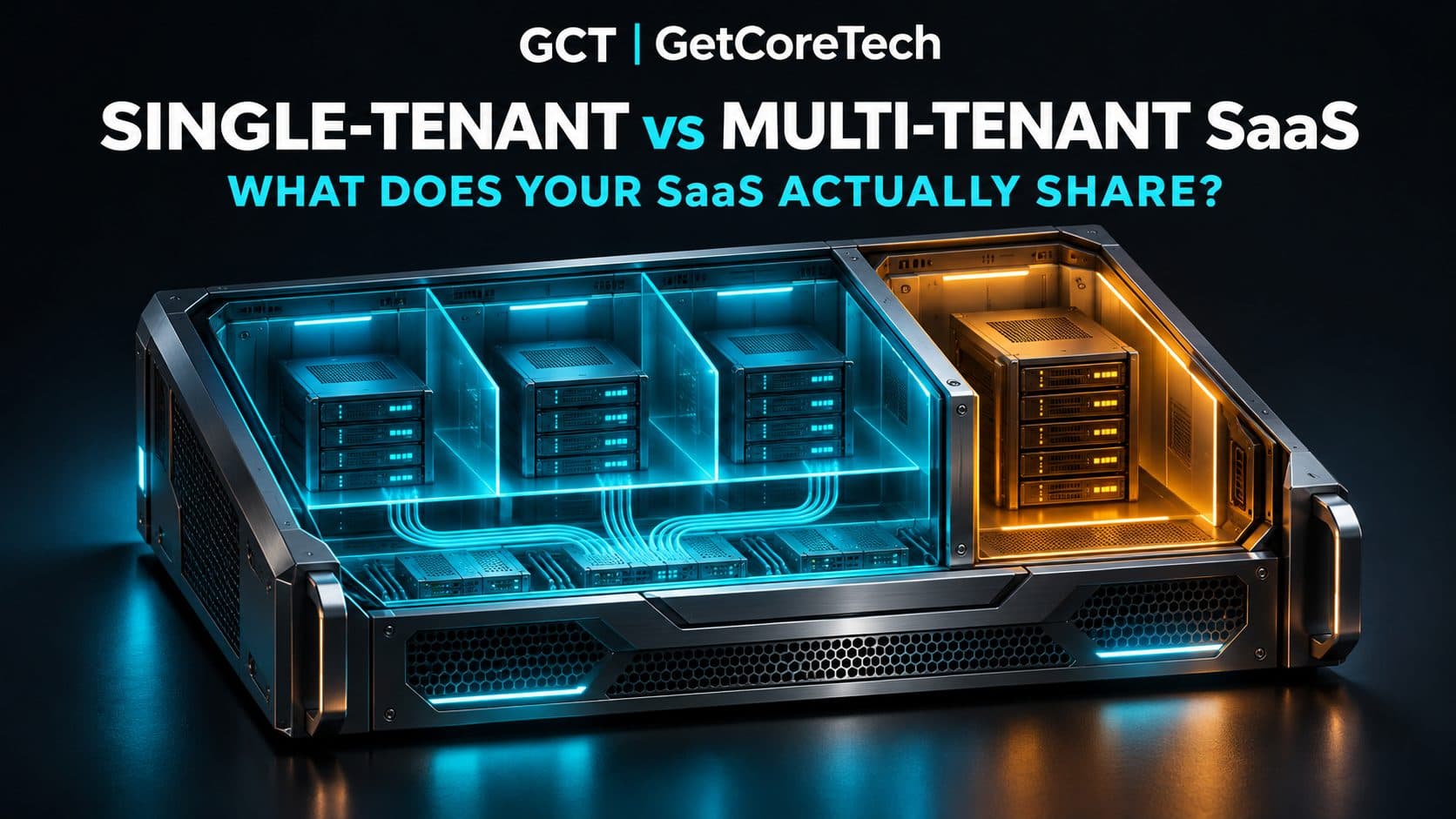
Multi-tenant software as a service (SaaS), software the vendor runs and customers rent, puts many customers, called tenants, on one shared deployment, meaning one set of infrastructure running the product, while single-tenant SaaS gives each customer a deployment of its own.1 Real products rarely sit at either end, so the useful question is what the vendor shares, who enforces the wall between tenants, and what breaks when that wall fails.12
What is the difference between single-tenant and multi-tenant SaaS?
The difference is what gets shared. When tenants share one deployment, the vendor typically relies on application code and a tenant identifier stored in the database to keep each tenant's data apart; when tenants have dedicated deployments, they have their own infrastructure, so the code has less to account for.1 Dedicated deployments are sometimes called supertenants or stamps.1 A tenant is usually one customer organization in a business-to-business product, though a family or club can also be a tenant in a consumer product.1
Microsoft's Azure Architecture Center calls the choice commercial as well as technical. Its guidance says the instinct to share nothing becomes expensive as the customer count grows: in a fully dedicated model, if one tenant needs a given amount of infrastructure, 100 tenants probably need 100 times that amount.1
Vendors also sell both on one price list. Snowflake's top edition, Virtual Private Snowflake (VPS), runs in a completely separate environment that shares no hardware with accounts outside it and targets customers with the strictest requirements, such as financial institutions.3 Isolation can cost features: Snowflake's edition matrix marks Snowflake Marketplace and public listings as not included in VPS.3
What can a vendor share, and what can it keep separate?
Azure treats isolation as a spectrum, from nothing shared to everything shared, and says each layer of the product can sit at a different point on it. A typical product might share the web tier, share the application layer with common message queues, and keep databases separate per tenant.1 AWS uses different words for the same ideas: a silo gives each tenant its own resources, a pool shares them, and a bridge mixes the two.2 AWS also argues a full-stack silo is still SaaS if the separate stacks share identity, onboarding, metering, deployment and operations.2
| Model | What is shared | Main benefit | Main risk |
|---|---|---|---|
| Automated single-tenant (silo) | Only the tooling that deploys each stack | Data is isolated, tenants rarely hurt each other's performance, and updates can roll out progressively | Cost grows with tenant count, and upgrades and fleet-wide reporting take work |
| Fully multitenant (pool) | Everything | One set of infrastructure to run, at lower cost | Data leaks, heavy tenants slowing others, one change reaching every customer, scale limits |
| Vertically partitioned | Some tenants share a deployment; others get their own | Shared cost for most, dedicated deployments for those who need or pay for them | The codebase must support both, and you must track who is where |
| Horizontally partitioned (bridge) | Some layers, such as the application tier | Dedicated databases absorb heavy load without touching other tenants | Per-tenant components still need automated deployment |
Each row's benefit and risk come from Azure's tenancy models guidance.1
How does a shared database keep tenants apart?
With a tenant identifier on every row and a rule that every query must filter on it. The weak point is that the rule lives in each piece of code that touches the data. Opinion AWS's Tod Golding argues that isolation enforcement should not be left to service developers, because it is unrealistic to expect no one to cross a tenant boundary by accident, and that logging in is not the same as isolation.2
Reported One security vendor's review of more than 200 self-hosted AI and SaaS products found cross-tenant data exposure in 78, with the same pattern repeating: the write path checked ownership while a neighbouring read path did not.5 The author sells a verification tool and offers assessments, most findings were still under coordinated disclosure, and the product names were withheld, so treat the count as unverified.5
Databases can enforce the boundary below the application. PostgreSQL's row security policies restrict which rows a query can see or change; once row security is enabled on a table, access must be allowed by a policy, and a table with no policy shows no rows.4 Each policy expression is evaluated for each row before any condition from the user's query, with a narrow exception for functions guaranteed not to leak, so a forgotten filter cannot widen the result.4 Several gaps remain, and PostgreSQL's documentation names them:
- Superusers and roles with the BYPASSRLS attribute always skip row security, and a table's owner usually does too unless the table is set to FORCE ROW LEVEL SECURITY.4
- Integrity checks such as unique and foreign key constraints bypass row security, which can leak information through a covert channel.4
- Policies that read other tables can leak through race conditions between concurrent transactions.4
What goes wrong in each model?
In a shared deployment, the best-known failure is the noisy neighbor problem, where one tenant's activity degrades another tenant's performance.6 It also happens when many small tenants peak at the same time, and Azure says it cannot be completely eliminated; mitigations include monitoring consumption per tenant, throttling and quotas, extra stamps and rebalancing tenants across them.6 A shared deployment also means one release reaches the whole customer base, which makes maintenance simpler and riskier at once.1 Dedicated deployments let changes roll out progressively and keep one tenant's load from hurting others, at the cost of linear spending and slower upgrades.1
The wall can also fail below the application. Reported On 4 September 2026 a researcher reported that Cloudflare Containers ran with a storage option that skipped zeroing reused disk blocks, so a customer's small write could expose bytes left by another customer's container on the same host.7 The researchers saw residual data on 18 of 24 placements and 20 of 22 nodes across four continents, though the technique could not target a specific victim.7 Cloudflare removed the option, retired existing container disks, found no evidence of exploitation by anyone else, and finished cleanup on 19 September.7
How do you choose? A worked example
These numbers are illustrative, not data. Imagine a vendor with 500 small customers, 20 mid-size customers that run heavy reports, and 3 customers in regulated industries that insist on their own infrastructure.
- Define the tenant as one customer organization, which gives 523 tenants.1
- Count the pure single-tenant option: 523 deployments to patch, monitor and report across, with cost rising roughly in step with tenant count.1
- Count the fully shared option: one deployment, but one of the 20 heavy customers can slow the other 522, and every release reaches all 523 at once.16
- Partition. Put the 500 small tenants on one shared deployment protected by row security policies, give the 20 heavy customers dedicated databases behind the shared application tier, and give the 3 regulated customers dedicated stamps.14
- Total the result: 4 deployments plus 20 per-tenant databases, against 523 deployments.
- Add the controls the model depends on: per-tenant usage telemetry and quotas, and a test that one tenant cannot read another's data.61
Azure notes that a vendor can charge more for a dedicated deployment, which helps recover its extra cost.1
What do people commonly get wrong about tenancy?
Two beliefs about the two models show up in vendor guidance, and each has a documented correction.
Common misreading: a single-tenant deployment isn't real SaaS. AWS says some people challenge whether a full stack per tenant counts as a true SaaS environment. What the source says: AWS calls it a valid variant when the separate stacks sit inside shared identity, onboarding, metering, deployment, analytics and operations, trading economies of scale for compliance or domain needs.2
Common misreading: sharing infrastructure means giving up isolation, or isolation requires a separate database per tenant. Azure's guidance notes the intuitive urge to share nothing. What the sources say: AWS says isolation is not a resource-level construct and can be enforced by policies applied at run time, though some high-compliance domains require a database per tenant; PostgreSQL row security is one such run-time mechanism.124
What should teams do next?
- Record which deployment holds each tenant, so tenants can move between deployments as their needs change.1
- Enforce tenant scoping below the request handlers, with row security that applies to the table owner as well, and test it with at least two tenants.41
- Log consumption with the tenant's identifier attached, for example request units per request, so noisy neighbors show up in telemetry.6
- Keep the codebase able to run both shared and dedicated deployments if a premium tier is likely.1

Comments