Multi-Agent AI: Gartner's Top Trend, Hidden Failure Rate
Gartner calls multi-agent AI its top 2026 trend. New research puts failure rates as high as 86.7% — and traces most of it to coordination, not weak models.
The GetCoreTech Team Sep 13, 2026 · 9 min read
What Are Multi-Agent AI Systems? Gartner's Top 2026 Trend Has a Failure-Rate Problem Nobody's Advertising
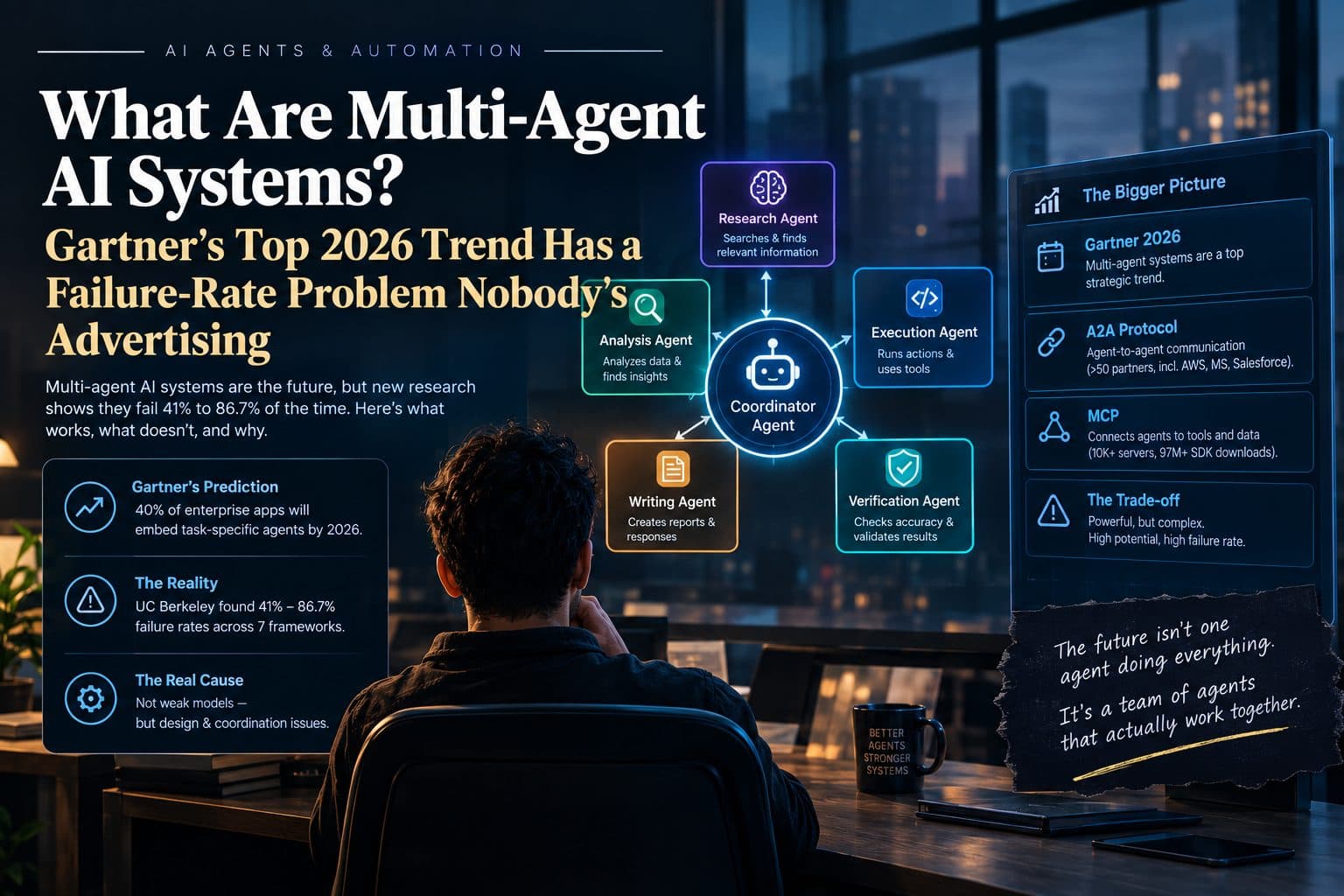
Multi-agent systems — teams of specialized AI agents that divide up a task instead of one general-purpose model doing everything — are Gartner's top strategic technology trend for 2026, with the firm predicting 40% of enterprise applications will embed task-specific agents by the end of this year, up from under 5% in 2025. At the same time, the first large-scale empirical study of why these systems actually fail, from researchers at UC Berkeley, found failure rates between 41% and 86.7% across seven popular multi-agent frameworks — and traced most of it to design and coordination problems, not weak underlying models. Both things are true simultaneously, and understanding why is more useful than either headline alone.
What a Multi-Agent System Actually Is
A multiagent system (MAS) is a collection of AI agents that interact to achieve individual or shared complex goals, whether delivered in a single environment or developed and deployed independently across distributed environments. The practical distinction from a standard AI assistant: instead of one model handling an entire task end to end, a multi-agent system breaks the task into pieces and assigns each piece to an agent built and tuned for that specific job — one agent that verifies eligibility, another that checks a knowledge base, another that drafts a response, a coordinator agent that hands work between them.
Gartner has grouped its 2026 trend list into three strategic themes — the Architect, the Synthesist, and the Sentinel — reflecting how organizations build, orchestrate, and protect digital value, and it places multi-agent systems in the Synthesist category alongside domain-specific language models and physical AI, as technologies organizations combine to create new value. That framing matters: Gartner isn't positioning MAS as a novelty feature but as infrastructure that other AI investments are expected to run on top of.
Why This Is Actually New Territory, Not Recycled Hype
Two things changed in the last year that make 2026 a genuinely different moment than the "agents" hype of 2023–2024: agent-to-agent communication got a real standard, and adoption numbers moved from pilot programs to production infrastructure.
Google's Agent-to-Agent (A2A) protocol was donated to the Linux Foundation in June 2025 with more than 50 partner companies, including AWS, Microsoft, Salesforce, and SAP, and has emerged as a leading standard for letting AI agents from different vendors discover, authenticate, and collaborate without exposing each other's internal implementation details. That's distinct from Anthropic's Model Context Protocol (MCP), which solves a different problem — MCP connects an agent to tools and external data, while A2A connects one agent to another, which is what lets a coordinator agent hand off work to specialist agents in a multi-agent system. By April 2026, MCP was implemented on more than 10,000 enterprise servers with over 97 million SDK downloads, adopted by Anthropic, OpenAI, Google, Microsoft, and AWS, while A2A was in production use at more than 150 organizations, notably within hyperscale cloud and SaaS ecosystems. That's the plumbing that makes it realistic for a company's Salesforce agent, its ServiceNow agent, and an internally built agent to actually coordinate on the same workflow — something that required custom point-to-point integration as recently as 2024.
The Adoption Numbers, and the Number Gartner Doesn't Lead With
The bull case is well-documented. Gartner predicts that by 2028, organizations that leverage multiagent AI for 80% of customer-facing business processes will dominate their markets, and organizations that fail to adopt multiagent AI for customer relationship management processes risk losing competitive advantage as expectations for low-effort service become the norm. Separately, Gartner predicts that by 2027, 70% of multi-agent systems will use narrowly specialized agents rather than general-purpose ones, improving accuracy but also increasing coordination complexity.
What gets quoted far less often is Gartner's own companion prediction about the failure side of the same category: more than 40% of agentic AI projects will be canceled by the end of 2027 due to escalating costs, unclear business value, or inadequate risk controls, and Gartner has explicitly flagged "agent washing" — vendors rebranding existing chatbots and robotic process automation as agentic AI without substantial underlying capability — as a driver of the hype outpacing the substance. A single firm is simultaneously the source of the most-cited adoption forecast and the most-cited failure forecast for this category. That's not a contradiction — it's a description of where the technology actually is: real infrastructure is being built, and a lot of what's being deployed on top of it isn't ready.
The Research on Why Multi-Agent Systems Actually Fail
The most concrete data on the failure side comes from a 2025 study by researchers including Mert Cemri and Melissa Pan, which set out to answer a specific question: multi-agent systems are supposed to outperform single-agent setups by dividing labor, so why do their real-world performance gains often turn out to be minimal? The researchers built MAST-Data, a public dataset of more than 1,600 annotated execution traces collected across seven popular multi-agent frameworks, and developed MAST (Multi-Agent System Failure Taxonomy) through analysis of an initial 150 traces validated by expert human annotators with high inter-annotator agreement.
The results were blunt. Failure rates across the state-of-the-art frameworks studied ranged from 41% to 86.7%, with performance gains often minimal compared to simpler single-agent systems or even basic techniques like best-of-N sampling. The taxonomy that emerged identifies 14 distinct failure modes split across three categories: 42% of failures traced back to bad specifications (poor prompt design, missing role constraints, no clear termination criteria), 37% to coordination breakdowns between agents, and 21% to weak verification of an agent's own output. The most common specific problems: agents operating on incorrect assumptions, ignoring input from peer agents, or failing to verify their own outputs before passing work along.
The finding that should reshape how a technical team reads the Gartner adoption numbers: the paper's authors conclude that MAS failures are not merely a limitation of the underlying LLMs but indicative of deeper organizational flaws similar to those seen in human high-reliability organizations — the equivalent of a project failing from bad process design, not from the people on it being unskilled. That reframes the fix. The taxonomy's own conclusion is that the remedies are not glamorous: write better specifications up front, enforce structured communication between agents, add independent verification steps, and monitor everything, because this is distributed-systems engineering applied to LLM agents, not a model-selection problem.
What This Looks Like When It Works
The pattern showing up in production deployments that have actually stuck, as opposed to pilots that stalled, is narrow specialization rather than one do-everything agent. Thoughtful AI, a healthcare revenue-cycle automation company, built its product around exactly this structure: named, role-specific agents — EVA for eligibility verification, CAM for claims automation, PHIL for payment posting, PAULA for prior authorization, and DAN for denials management — each scoped to a single job rather than one general system handling the entire revenue cycle. The company has said each agent can be trained in roughly the time it takes to onboard a human worker for the equivalent role.
That narrow-scope pattern lines up directly with Gartner's own prediction about where the category is heading — specifically toward more narrowly specialized agents, not fewer, general-purpose ones, even though that specialization is also what increases coordination complexity and, per the Berkeley research, creates more opportunities for the inter-agent misalignment failures that account for over a third of observed failures. The tools worth using are the ones being built with that trade-off in mind, not marketed around it.
What This Means If You're Actually Building One
Treat coordination as the hard problem, not the model. The Berkeley data puts specification and coordination failures at roughly four times the rate of pure verification failures — the place to invest engineering time is agent-to-agent communication design, not swapping in a stronger underlying model.
Scope agents narrowly on purpose. Both the Gartner trend data and the production examples above point the same direction: specialized, single-responsibility agents outperform one agent trying to do everything, even though narrower agents mean more coordination surface area to get right.
Build in verification as a separate step, not a hope. Nearly a quarter of documented failures came from agents that never independently checked their own output before passing it downstream.
Don't mistake protocol maturity for system reliability. MCP and A2A solve the plumbing problem — how agents reach tools and each other. They say nothing about whether the agents you connect with them are well-specified.
FAQ
Q: What's the difference between a multi-agent system and a regular AI assistant with plugins?
A: A standard assistant with plugins or tool access is still one model making all the decisions, using tools as extensions of itself. A multi-agent system distributes the decision-making itself across multiple independent agents, each potentially built differently, with a coordinator managing handoffs between them — closer to a team than to one worker with more tools.
Q: Is MCP the same thing as a multi-agent system?
A: No. MCP standardizes how a single agent connects to external tools and data sources. It's a prerequisite piece of infrastructure for multi-agent systems, but a system using MCP with just one agent isn't a multi-agent system — that requires multiple agents coordinating, which is what A2A and similar protocols are built for.
Q: Why do multi-agent systems fail more often than single-agent setups?
A: Every handoff between agents is a point where context can be lost, instructions can be misread, or one agent's output can be trusted by another without verification. Research analyzing over 1,600 real execution traces found these coordination and specification issues account for the large majority of observed failures — more than model quality itself.
Q: Are multi-agent systems worth the added complexity for a smaller business?
A: Not automatically. The failure research and Gartner's own project-cancellation forecast both point to the same risk: added complexity without a correspondingly narrow, well-specified task tends to produce worse reliability, not better results. A single well-scoped agent for a specific job is often a safer starting point than a multi-agent architecture built speculatively.
Q: What industries are actually running multi-agent systems in production right now, not just pilots?
A: Healthcare revenue-cycle management is one of the more mature examples, with vendors like Thoughtful AI running named, role-specific agents for tasks like eligibility verification and claims processing. Financial services and insurance are also active deployment areas, though public, verifiable performance data from named companies is still thinner than the marketing volume around the category would suggest.
Q: Does "agentic AI" mean the same thing as "multi-agent system"?
A: No, and conflating them is a common source of confusion. Agentic AI describes a system that can plan and carry out multi-step tasks with limited step-by-step instruction — that can be a single agent. A multi-agent system is a specific architecture within agentic AI where multiple such agents coordinate with each other, rather than one agent handling the whole task alone.
FAQ
A standard assistant with plugins or tool access is still one model making all the decisions, using tools as extensions of itself. A multi-agent system distributes the decision-making itself across multiple independent agents, each potentially built differently, with a coordinator managing handoffs between them — closer to a team than to one worker with more tools.
No. MCP standardizes how a single agent connects to external tools and data sources. It's a prerequisite piece of infrastructure for multi-agent systems, but a system using MCP with just one agent isn't a multi-agent system — that requires multiple agents coordinating, which is what A2A and similar protocols are built for.
Every handoff between agents is a point where context can be lost, instructions can be misread, or one agent's output can be trusted by another without verification. Research analyzing over 1,600 real execution traces found these coordination and specification issues account for the large majority of observed failures — more than model quality itself.
Not automatically. The failure research and Gartner's own project-cancellation forecast both point to the same risk: added complexity without a correspondingly narrow, well-specified task tends to produce worse reliability, not better results. A single well-scoped agent for a specific job is often a safer starting point than a multi-agent architecture built speculatively.
Healthcare revenue-cycle management is one of the more mature examples, with vendors like Thoughtful AI running named, role-specific agents for tasks like eligibility verification and claims processing. Financial services and insurance are also active deployment areas, though public, verifiable performance data from named companies is still thinner than the marketing volume around the category would suggest.
No, and conflating them is a common source of confusion. Agentic AI describes a system that can plan and carry out multi-step tasks with limited step-by-step instruction — that can be a single agent. A multi-agent system is a specific architecture within agentic AI where multiple such agents coordinate with each other, rather than one agent handling the whole task alone.
The GetCoreTech Team
We write about the SaaS, AI, and infrastructure decisions builders actually have to make.
Comments
Log in or sign up to join the discussion.
Loading comments…