What Is Agentic AI? A Plain-English Guide to How AI Agents Work
Agentic AI isn't a new species of AI — it's a generative model wired into a loop that lets it plan, use tools, and act toward a goal with minimal prompting. Here's what that loop actually looks like, how agents really connect to tools, and where the genuine risks sit.
The GetCoreTech Team Aug 29, 2026 · 11 min read · Updated Sep 12, 2026
What Is Agentic AI? A Plain-English Guide to How AI Agents Work
Agentic AI is a generative AI model — typically a large language model — wired into a loop that lets it plan a sequence of steps, call external tools, and act toward a goal with minimal step-by-step instruction, rather than just answering a single prompt. It isn't a separate technology from generative AI; it's what you get when you add planning, tool access, and self-checking around a model that already exists.
What "Agentic" Actually Means
Most AI tools people used through the early 2020s were reactive: you gave a prompt, the model gave a response, and that was the end of the exchange. "Agentic" describes a different mode of operation — a system that takes a goal, works out what steps are needed to reach it, carries those steps out (often by using tools or software on your behalf), and adjusts based on what happens along the way, without needing a new instruction after every step.
The distinction is about how many steps happen per human instruction, not about the underlying model being fundamentally smarter. A single well-designed prompt still produces a single response. An agentic system takes one goal and can produce dozens of actions in service of it.
How an AI Agent Actually Works
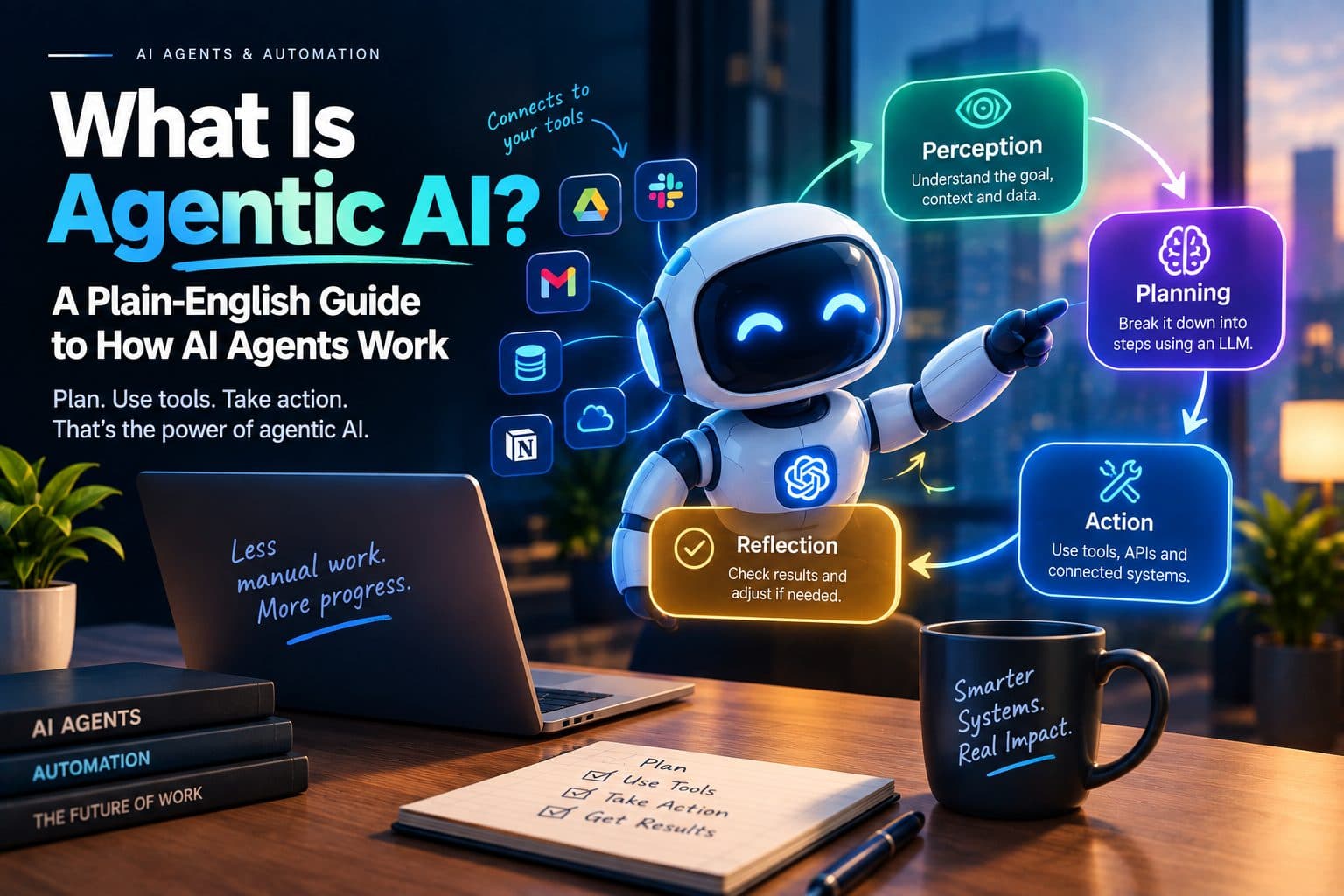
Strip away the marketing and a production agentic system generally has four working parts. Perception takes in the current state of things: a user request, a document, the result of a previous action. Planning — usually handled by the language model itself — breaks a goal into an ordered set of steps. Action calls a tool, API, or piece of software to actually do something, rather than just describing what should be done. And Reflection checks whether the action worked and adjusts the plan if it didn't.
Remove the language model from that loop and there's no reasoning left to plan or adapt with — the LLM is the part doing the actual thinking; everything else is scaffolding that lets it act instead of just talking.
How Agents Actually Connect to Tools
The vague old answer to "how does an AI agent connect to real systems" used to be "via APIs." The concrete current answer is the Model Context Protocol (MCP), an open standard Anthropic released in late 2024 that gives AI models one consistent way to connect to external tools, databases, and software instead of requiring a custom integration for every combination of model and system. It's since been adopted across major AI products, and in December 2025 Anthropic donated MCP to a newly formed Agentic AI Foundation under the Linux Foundation, alongside contributions from OpenAI and Block, to keep it vendor-neutral going forward. This is the actual plumbing behind most of what gets called "agentic AI" in production today.
Real-World Examples of Agentic AI in Action
Agentic systems are already doing real, bounded work across several industries — with the important caveat that "autonomous" in production almost always means "operating within permissions a human set, not without any oversight."
In software development, coding agents can plan and execute changes across multiple files, run tests, and iterate based on the results, rather than just suggesting a single line of code. In customer support, agents read a ticket, pull account or order data, take an action (like issuing a refund within a set limit), and follow up, escalating to a human when a situation falls outside their scope. In cybersecurity, agents monitor logs and network activity, flag anomalies, and in some deployments take a first containment action automatically while a human reviews it. In finance and operations, agents reconcile transactions, flag anomalies for fraud review, and route exceptions to the right team. In research and analysis, agents pull information from multiple sources, synthesize it, and hand a structured summary or recommendation to a person for a final call.
How Agentic AI Shows Up in Everyday Life
Consumer-facing assistants are moving in the same direction, though more slowly and with narrower autonomy than the enterprise examples above. The clearest current example: Google is retiring Google Assistant on mobile devices starting September 4, 2026, moving users to Gemini, which is built to handle multi-step requests (like adding and removing items from a list in one instruction) rather than single fixed voice commands. Microsoft has similarly added agent-style features to Copilot that can complete multi-step tasks across Microsoft 365 apps rather than just answering a question.
The near-term trajectory for consumer assistants is narrow, permissioned autonomy — handling a defined task like drafting a reply, updating a calendar, or reordering a household item — rather than an assistant with open-ended run of your accounts and devices.
Why Businesses Are Adopting Agentic AI
The appeal for businesses is straightforward: agentic systems can run continuously and handle multi-step processes end to end, rather than requiring a human to manage each handoff. Common enterprise use cases include customer support triage, sales outreach and follow-up, data analysis and reporting, HR onboarding steps, inventory and supply-chain monitoring, and software testing. The realistic framing is that agentic AI takes over well-scoped, repeatable multi-step work, freeing people for judgment calls, strategy, and anything that needs real accountability.
The Real Risks — and the Real Hype
Because an agentic system takes real actions rather than just generating text a human reviews before acting on it, the stakes are structurally different from a chatbot giving a wrong answer. Two things are worth knowing before treating any "agentic AI" claim at face value.
The Hype Is Measurable
Gartner predicted in June 2025 that over 40% of agentic AI projects will be canceled by the end of 2027, citing escalating costs, unclear business value, and inadequate risk controls — not model capability. The same research flagged "agent washing," where existing chatbots, RPA tools, or assistants get rebranded as agentic without meaningfully new capability, estimating that only a small fraction of the thousands of vendors marketing agentic AI products were building something that actually earned the label.
Governance Is Catching Up, Not Ahead
Two real frameworks are worth knowing if you're evaluating or building agentic systems. The NIST AI Risk Management Framework is a voluntary framework built around four functions (Govern, Map, Measure, Manage) that's become a common technical baseline for AI governance programs. The OWASP Top 10 for Agentic Applications — published in December 2025 — is the first widely adopted catalog of security risks specific to systems that plan, hold memory, and take actions across tools, covering issues like goal hijacking (where manipulated content redirects what an agent is actually trying to do) and excessive permissions.
On the regulatory side, the picture differs sharply by region. The EU AI Act has been in phased effect since February 2025, with rules for general-purpose AI models applying from August 2025; a 2026 amendment (the "Digital Omnibus") pushed the compliance deadline for standalone high-risk systems from August 2026 to December 2027, while transparency rules for things like AI chatbots still take effect on the original August 2026 schedule. In the United States, the federal approach has moved in the opposite direction: the prior administration's AI safety executive order was revoked in January 2025, and the current administration's July 2025 AI Action Plan and December 2025 executive order both prioritize deregulation and preempting stricter state-level AI rules over a national safety-audit regime. In practice, that means the compliance bar for a given agentic deployment depends heavily on which jurisdiction it operates in.
What to Actually Expect Going Forward
More agentic capability will be built directly into tools people already use (coding assistants, office software, browsers) rather than sold as a separate category. Tool-connection standards like MCP will become the default way agents reach real systems, reducing custom integration work. A real shakeout will emerge between agentic products with genuine planning and tool-use capability and "agent-washed" products that are RPA or chatbots with new branding. Security and governance frameworks (NIST AI RMF, OWASP's Agentic Top 10) will mature alongside adoption, rather than adoption waiting for governance to catch up. And there will be continued emphasis on scoped permissions and human approval checkpoints for higher-stakes actions, since the core risk of agentic systems is what they can do, not what they say.
Conclusion
Agentic AI is best understood as a deployment pattern for generative AI, not a rival to it: take a capable language model, give it the ability to plan, call tools through a standard like MCP, and check its own work, and you have an agent. The genuinely useful skill right now isn't just knowing that agentic AI exists — it's being able to tell a real agentic deployment, with scoped permissions and a governance framework behind it, from a chatbot with a new label.
FAQ
What is Agentic AI in simple words?
Agentic AI is a generative AI model — usually a large language model — given the ability to plan multi-step tasks, use outside tools, and act toward a goal with minimal step-by-step human instruction. Instead of responding once to a prompt, it can carry out a sequence of actions, check the results, and adjust, more like a digital assistant handling a task end to end than a tool that answers a single question.
How is Agentic AI different from traditional automation?
Traditional automation follows fixed, pre-programmed steps and can't handle anything outside that script. Agentic AI uses a language model to reason about a goal, decide what steps are needed, and adjust when something unexpected happens — it can handle workflows where the next step depends on changing information, not just repeat a fixed sequence.
Where is Agentic AI used in real life today?
Coding agents that plan and execute changes across multiple files, customer-support agents that resolve tickets within set permissions, cybersecurity agents that monitor for threats and take a first containment step, and finance and operations agents that reconcile data and flag exceptions for human review are all in active production use.
How does Agentic AI actually make decisions?
The reasoning is done by the underlying language model, which breaks a goal into smaller steps, decides what to do next based on the current situation, and calls tools to carry out each step. A reflection step checks whether the action worked before moving on. This is fundamentally an LLM planning and re-planning in a loop, not a separate decision-making system running underneath it.
Is Agentic AI safe to use?
It's safer when it's built and governed deliberately. Because agents take real actions rather than just producing text a human reviews first, well-designed systems use scoped permissions, human approval for higher-stakes actions, and monitoring. The NIST AI Risk Management Framework and OWASP's Top 10 for Agentic Applications (published December 2025) are the two most concrete reference points for what responsible agentic deployment looks like in practice.
Will Agentic AI replace human jobs?
It's more likely to change jobs than eliminate them outright. Agentic systems are best suited to repeatable, well-scoped multi-step work — scheduling, data entry, first-pass ticket triage — while judgment calls, strategy, and accountability for outcomes still need a person. The realistic shift is toward roles that supervise and direct agentic systems rather than perform every step of a process by hand.
How can businesses benefit from Agentic AI?
The main gains are continuous operation and end-to-end handling of multi-step processes that previously needed a human at every handoff — customer support triage, sales follow-up, reporting, and inventory monitoring are common starting points. The tradeoff is that these systems need real permission scoping and oversight to avoid the failure modes covered by frameworks like the OWASP Agentic Top 10, so the setup cost is higher than a simple automation script.
What technologies power Agentic AI?
A large language model provides the reasoning and planning; a tool-connection layer — increasingly built on the Model Context Protocol (MCP) — lets the agent call external software and data sources; and an orchestration layer (frameworks like LangGraph, AutoGen, or CrewAI) manages memory, multi-step execution, and coordination when multiple agents work together. Reinforcement learning plays a role in training some of these systems, but the core reasoning engine in virtually all production agentic AI today is an LLM, not a standalone RL system.
How does Agentic AI interact with tools and software?
Increasingly through the Model Context Protocol (MCP), an open standard released by Anthropic in late 2024 that gives an AI model one consistent way to connect to external tools, databases, and applications instead of needing a custom integration built for every combination of model and system. This is what lets an agent search the web, query a database, or send an email as part of completing a task.
What is the future potential of Agentic AI?
Expect agentic capability to keep getting built directly into tools people already use rather than sold as a standalone category, tool-connection standards like MCP to become the default way agents reach real systems, and security and governance frameworks like NIST's AI RMF and OWASP's Agentic Top 10 to mature alongside adoption. The technology's trajectory depends as much on governance and permission design maturing as it does on the underlying models getting more capable.
FAQ
Agentic AI is a generative AI model — usually a large language model — given the ability to plan multi-step tasks, use outside tools, and act toward a goal with minimal step-by-step human instruction. Instead of responding once to a prompt, it can carry out a sequence of actions, check the results, and adjust, more like a digital assistant handling a task end to end than a tool that answers a single question.
Traditional automation follows fixed, pre-programmed steps and can't handle anything outside that script. Agentic AI uses a language model to reason about a goal, decide what steps are needed, and adjust when something unexpected happens — it can handle workflows where the next step depends on changing information, not just repeat a fixed sequence.
Coding agents that plan and execute changes across multiple files, customer-support agents that resolve tickets within set permissions, cybersecurity agents that monitor for threats and take a first containment step, and finance and operations agents that reconcile data and flag exceptions for human review are all in active production use.
The reasoning is done by the underlying language model, which breaks a goal into smaller steps, decides what to do next based on the current situation, and calls tools to carry out each step. A reflection step checks whether the action worked before moving on. This is fundamentally an LLM planning and re-planning in a loop, not a separate decision-making system running underneath it.
It's safer when it's built and governed deliberately. Because agents take real actions rather than just producing text a human reviews first, well-designed systems use scoped permissions, human approval for higher-stakes actions, and monitoring. The NIST AI Risk Management Framework and OWASP's Top 10 for Agentic Applications (published December 2025) are the two most concrete reference points for what responsible agentic deployment looks like in practice.
It's more likely to change jobs than eliminate them outright. Agentic systems are best suited to repeatable, well-scoped multi-step work — scheduling, data entry, first-pass ticket triage — while judgment calls, strategy, and accountability for outcomes still need a person. The realistic shift is toward roles that supervise and direct agentic systems rather than perform every step of a process by hand.
The main gains are continuous operation and end-to-end handling of multi-step processes that previously needed a human at every handoff — customer support triage, sales follow-up, reporting, and inventory monitoring are common starting points. The tradeoff is that these systems need real permission scoping and oversight to avoid the failure modes covered by frameworks like the OWASP Agentic Top 10, so the setup cost is higher than a simple automation script.
A large language model provides the reasoning and planning; a tool-connection layer — increasingly built on the Model Context Protocol (MCP) — lets the agent call external software and data sources; and an orchestration layer (frameworks like LangGraph, AutoGen, or CrewAI) manages memory, multi-step execution, and coordination when multiple agents work together. Reinforcement learning plays a role in training some of these systems, but the core reasoning engine in virtually all production agentic AI today is an LLM, not a standalone RL system.
Increasingly through the Model Context Protocol (MCP), an open standard released by Anthropic in late 2024 that gives an AI model one consistent way to connect to external tools, databases, and applications instead of needing a custom integration built for every combination of model and system. This is what lets an agent search the web, query a database, or send an email as part of completing a task.
Expect agentic capability to keep getting built directly into tools people already use rather than sold as a standalone category, tool-connection standards like MCP to become the default way agents reach real systems, and security and governance frameworks like NIST's AI RMF and OWASP's Agentic Top 10 to mature alongside adoption. The technology's trajectory depends as much on governance and permission design maturing as it does on the underlying models getting more capable.
The GetCoreTech Team
We write about the SaaS, AI, and infrastructure decisions builders actually have to make.
Comments
Log in or sign up to join the discussion.
Loading comments…