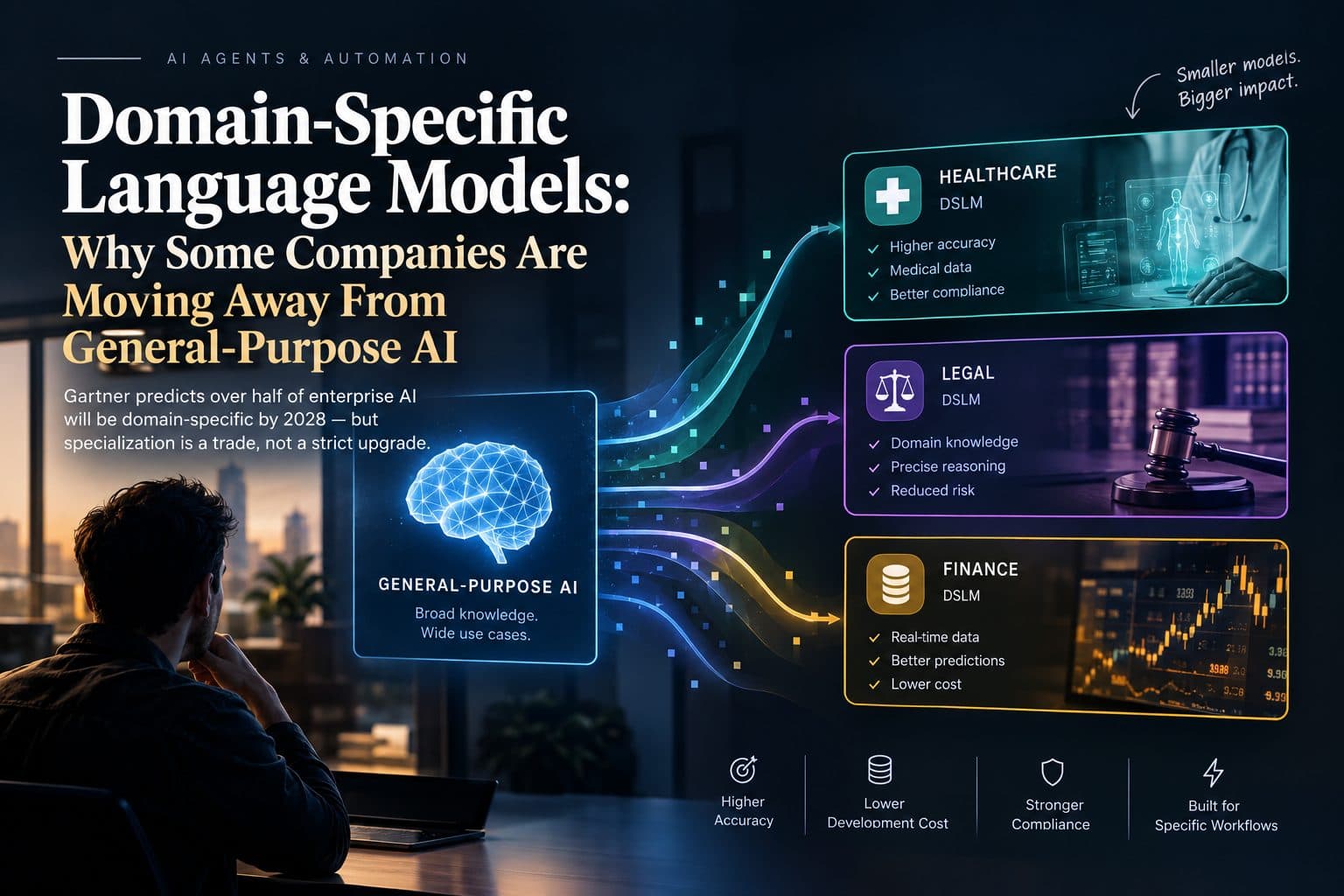
Domain-Specific Language Models: Why Some Companies Are Moving Away From General-Purpose AI
Gartner named domain-specific language models (DSLMs) one of its top strategic technology trends for 2026 and projects that by 2028, more than half of the generative AI models enterprises use will be domain-specific rather than general-purpose — up from roughly 1% in 2024. The core claim isn't that bigger, general models are getting worse; it's that for specific, high-stakes, narrow tasks, a smaller model trained on the right data reliably beats a frontier general model on accuracy, cost, and compliance, while remaining worse than that same general model at everything outside its lane.What Counts as a DSLM
Gartner defines domain-specific language models as models trained or fine-tuned on specialized data for a particular industry, function, or process, distinct from general-purpose LLMs trained on broad, internet-scale data. The distinction isn't purely about parameter count — a DSLM can be a small model trained from scratch on niche data, or a general foundation model fine-tuned on top of a narrower dataset. What defines the category is the training data's specificity, not the architecture.The Numbers Behind the Trend
Gartner's research puts real figures behind the shift: DSLMs offer up to 50% lower development costs than general LLMs, and Gartner forecasts the DSLM and DSLM-underpinned application market will reach $131 billion in 2035. Gartner also frames DSLMs as a foundational component of agentic AI architectures specifically because contextual relevance and accuracy directly determine whether an agent can execute actions autonomously and correctly within a specialized workflow, rather than just producing plausible-sounding text. A related dynamic is pushing in the same direction from the cost side. Gartner separately forecasts that inference on a 1-trillion-parameter LLM will cost providers over 90% less by 2030 than in 2025, which sounds like it would favor giant general models — but Gartner's own framing cuts the other way: as commoditized intelligence trends toward near-zero cost, routine, high-frequency tasks are expected to route to smaller and domain-specific models that perform better than generic ones at a fraction of the cost when aligned to a specialized workflow, while frontier general reasoning stays reserved for what actually needs it.Where the Accuracy Gap Actually Shows Up
The clearest evidence for DSLM advantages comes from domain-specific benchmarks built with expert input rather than general leaderboards. HealthBench, released by OpenAI in May 2025 and now the standard 2026 medical evaluation, grades model responses against 48,562 rubric criteria authored by 262 physicians across 26 specialties and 60 countries — evaluating whether a model mentions what it should, avoids what it shouldn't, and calibrates its caveats appropriately, rather than matching a single gold answer. General-purpose model scores on it have moved fast (GPT-3.5 Turbo scored 16%, GPT-4o scored 32%, and OpenAI's o3 scored 60%), which illustrates the underlying point: even frontier general models still leave meaningful room on specialized rubrics that domain training is built to close. In finance, BloombergGPT — a 50-billion-parameter model trained on 363 billion tokens of Bloomberg's proprietary financial data plus general text — was among the first models to demonstrate this pattern concretely, and subsequent domain-tuned finance models have shown further gains: one academic evaluation found the finance-tuned model FinMA significantly outperformed both BloombergGPT and general-purpose GPT-4 on most financial-domain tasks. The pattern repeats across legal (LawBench, LegalBench-RAG) and medical (MedBench, DrBenchmark) evaluation suites: domain-specific evaluation research has generally concluded that general-purpose LLMs fall short on the narrow tasks these benchmarks test, even as they remain stronger broadly.The Counterpoint: Specialization Is a Trade, Not a Strict Upgrade
The research doesn't universally favor DSLMs, and treating this as a one-directional story would misrepresent it. A safety-focused benchmark called Trident-Bench, built on the AMA Principles of Medical Ethics, the ABA Model Rules of Professional Conduct, and the CFA Institute Code of Ethics, evaluated 19 general-purpose and domain-specialized models across law, finance, and medicine and found that strong generalist models could meet basic safety expectations while domain-specialized models often struggled specifically with subtler ethical nuance — the opposite pattern from the raw-accuracy benchmarks. The implication is that narrow domain training can improve task accuracy while not automatically improving judgment on edge cases the training data didn't emphasize. There's also a real alternative path that doesn't require building or licensing a separate model at all: pairing a general-purpose model with retrieval-augmented generation (RAG) over your own domain documents. General models with RAG can match or exceed specialized models on many tasks, particularly when an organization's own documents are more relevant to its actual use case than whatever data a specialized vendor's model happened to be trained on. For a team without the scale to justify fine-tuning or licensing a vertical model, that's often the more practical starting point.Where DSLMs Are Actually Being Deployed Now
Gartner's January 2026 report on domain-specific language models for security operations is a useful concrete case: it frames DSLMs as a foundational component of preemptive, agentic security systems, where models trained specifically on security telemetry, configuration states, and threat intelligence support exposure management, threat detection, and autonomous remediation more reliably than a general model would. That's the shape of the trend across sectors — DSLM adoption is concentrating in workflows where the task is narrow, the failure cost is high, and the domain data needed to specialize the model already exists in structured form (financial filings, clinical notes, legal case law, security telemetry).How to Decide Whether Your Team Actually Needs One
The task is narrow and repeats often. DSLMs earn back their development cost on high-frequency, well-defined tasks — general models remain the better default for open-ended or rarely repeated work.You have real domain data to train or fine-tune on. A DSLM is only as good as the specialized dataset behind it; without genuine proprietary or curated domain data, you're not actually building a DSLM, just a smaller general model with a narrower prompt.
Compliance or accuracy failures carry real cost. The domains where DSLMs show the clearest wins — medicine, law, finance, security — are exactly the ones where a wrong or non-compliant answer is expensive, not just embarrassing.
Try RAG on a general model first if you're resource-constrained. It's a lower-cost way to test whether domain specificity is actually your bottleneck before committing to a dedicated model.
Comments
Log in or sign up to join the discussion.
Loading comments…