Agentic AI vs. Generative AI: The Creator and The Executor, Explained
Agentic AI isn't a separate technology from generative AI — it's generative AI with planning, memory, and tool use layered on top. Here's how the two actually relate, and what changed since "agentic" became the industry's biggest buzzword.
The GetCoreTech Team Aug 29, 2026 · 8 min read · Updated Sep 12, 2026
Agentic AI vs. Generative AI: The Creator and The Executor, Explained
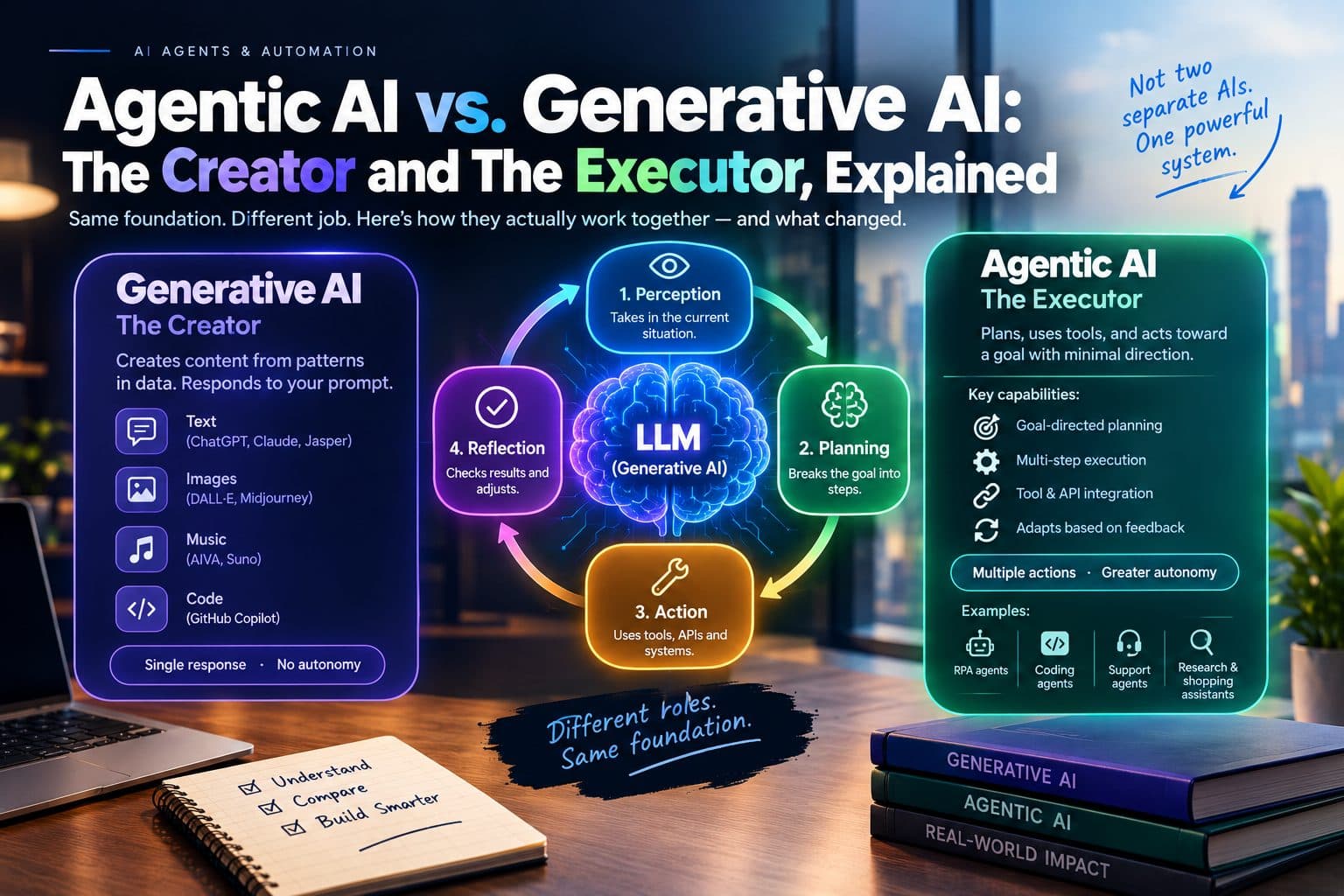
Generative AI creates content — text, images, code, music — from a prompt. Agentic AI takes that further by planning and carrying out multi-step tasks with minimal human input. But they aren't two separate technologies: today's agentic AI systems are almost always built on top of generative AI models (large language models), with an added layer that lets the model plan, use tools, and act on its own rather than just responding to a single prompt. Understanding that relationship — not just the surface difference — is the useful part.
What Is Generative AI?
Generative AI is designed to produce new content — text, images, music, code — based on patterns learned from training data. It doesn't act in the world or make independent decisions; it responds to a prompt and generates an output. Its key features are content creation from learned patterns, no autonomy beyond a single response, and heavy reliance on human prompting and iteration.
Examples include text tools like ChatGPT, Claude, and Jasper AI; image tools like DALL·E and Midjourney; music tools like AIVA and Suno; and code tools like GitHub Copilot. Worth noting: several of these tools, including GitHub Copilot, have themselves added agentic features — modes that plan and execute multi-step coding tasks rather than just completing a line — which is a good illustration of how blurry the line between the two categories has become in practice.
What Is Agentic AI?
Agentic AI refers to systems built to pursue a goal with minimal step-by-step direction: they perceive a situation, plan a sequence of actions, use tools or APIs to carry them out, and adjust based on what happens. Per Google Cloud's own definition of the term, this typically runs as a loop — perceive, reason (via an LLM), plan, act, reflect — rather than a single question-and-answer exchange. Its key features are goal-directed planning, multi-step task execution, the ability to call external tools and systems, and behavior that adjusts based on feedback rather than staying fixed.
Examples include AI-powered RPA tools that make decisions rather than just following fixed scripts, coding agents that plan and execute multi-file changes, customer-support agents that resolve tickets end-to-end, and research or shopping assistants that complete multi-step tasks on a user's behalf.
How the Two Actually Relate
The clearest way to think about it: generative AI is the reasoning engine, and agentic AI is that engine wired into a loop that can plan, act, and check its own work. A modern agentic system typically has four parts — a perception layer that takes in the current situation, a planning layer (usually the LLM itself) that breaks a goal into steps, an action layer that calls tools or APIs to actually do things, and a reflection layer that checks results and adjusts. Remove the generative model from that loop and there's no reasoning left to plan or adapt with — which is why "agentic AI" isn't really a rival to generative AI so much as one way of deploying it.
What Changed the Most: How Agents Actually Connect to Tools
The vague old answer to "how does agentic AI connect to real systems" was "integration with APIs." The concrete current answer is the Model Context Protocol (MCP), an open standard Anthropic released in late 2024 that gives AI models one consistent way to connect to external tools, databases, and services instead of requiring a custom-built integration for every combination of model and system. By 2026, MCP had been adopted by OpenAI, Google, and Microsoft, and Anthropic donated it to a newly formed Agentic AI Foundation under the Linux Foundation in December 2025. This is the actual plumbing behind most of what gets called "agentic AI" in production today — it's less exciting than the phrase "autonomous agent," but it's the part that makes the autonomy technically possible.
Generative AI + Agentic AI, Working Together
In practice, most useful agentic systems combine both roles rather than replacing one with the other. In marketing, generative AI drafts posts and ad copy while an agentic layer schedules them, monitors engagement, and adjusts a campaign based on results. In customer support, generative AI drafts responses while an agentic layer routes tickets, escalates when needed, and follows up without a human re-reading every message. In research and analysis, generative AI summarizes source material while an agentic layer applies the findings to a live process or decision in something closer to real time.
Limitations and Real Risk — Not Just Hype
Generative AI's limitations are well known: it can produce incorrect or biased output, and it does nothing without a prompt. Agentic AI's risks are larger, because it can take real actions — on systems, data, or money — rather than just generating text someone reviews before acting on it. That makes oversight and clearly scoped permissions a real requirement, not an afterthought.
It's also worth being skeptical of the current hype cycle specifically. Gartner predicted in June 2025 that over 40% of agentic AI projects will be canceled by the end of 2027, citing escalating costs, unclear business value, and inadequate risk controls — not model capability. The same research flagged widespread "agent washing," where existing chatbots, RPA tools, or assistants get rebranded as "agentic" without meaningfully new capability; Gartner estimated only a small fraction of the thousands of vendors claiming agentic AI products were building something that actually earned the label. None of this means the underlying technology doesn't work — it means a lot of what's marketed as agentic AI right now is overstated, and that's worth knowing before evaluating a vendor claim or a project pitch.
What to Actually Expect Going Forward
More agentic capability will be built directly into existing generative tools (coding assistants, office software) rather than sold as a wholly separate category. Standardized tool-connection protocols like MCP will become the default way agents reach real systems, reducing custom integration work. A real shakeout will emerge between agentic products with genuine planning and tool-use capability and "agent-washed" products that are RPA or chatbots with new branding. And continued emphasis on human oversight and permission scoping will follow as agentic systems take on tasks with real consequences.
FAQ
What is the main difference between Agentic AI and Generative AI?
Generative AI creates content — text, images, code, audio — from a prompt and doesn't act independently. Agentic AI plans and carries out multi-step tasks with minimal human input, using an LLM as its reasoning engine plus a loop for planning, tool use, and adjusting based on results.
Is Agentic AI a completely different technology from Generative AI?
No — this is the most common misconception. Nearly all current agentic AI systems are built on top of generative AI models (LLMs); the "agentic" part is a planning, tool-use, and reflection loop added around that model, not a separate underlying technology.
How do AI agents actually connect to real tools and systems?
Increasingly through the Model Context Protocol (MCP), an open standard Anthropic released in late 2024 and later donated to the Linux Foundation. MCP gives AI models one consistent way to connect to external tools and data sources instead of requiring custom integration code for every combination of model and system, and by 2026 it had been adopted by OpenAI, Google, and Microsoft.
Is Agentic AI fully autonomous?
Not in the sense of operating with zero oversight. Agentic AI systems work within goals, permissions, and boundaries set by a developer or user, and well-designed systems require human approval for higher-stakes actions. "Autonomous" in this context means completing multi-step tasks without constant prompting, not operating without any constraints.
What are real-world examples of Agentic AI?
Coding agents that plan and execute multi-file changes, AI-powered RPA tools that make decisions rather than following fixed scripts, customer-support agents that resolve tickets end-to-end, and research or shopping assistants that complete multi-step tasks on a user's behalf.
Is the "agentic AI" hype overstated?
Partly, yes. Gartner predicted in June 2025 that over 40% of agentic AI projects will be canceled by the end of 2027 due to escalating costs, unclear business value, and weak risk controls — and separately flagged widespread "agent washing," where existing chatbot or RPA products get rebranded as agentic without real new capability. The underlying technology is genuine, but a lot of current marketing around it isn't.
Which is better for a business: Agentic or Generative AI?
It depends on the need. Content creation, copywriting, design, and research support are generative AI's strength. Workflow automation, task execution, and end-to-end process handling are where agentic capability adds value. Most effective deployments combine both rather than choosing one.
What's the biggest risk specific to Agentic AI, compared to Generative AI?
Agentic AI can take real actions on systems, data, or money, while generative AI mainly produces content a human typically reviews before acting on it. That makes clear permission scoping and human oversight a functional requirement for agentic systems, not an optional safeguard.
Will Agentic AI replace Generative AI?
No — the framing doesn't really apply, since agentic AI is built on top of generative models rather than competing with them. The more accurate expectation is that agentic capability (planning, tool use, multi-step execution) increasingly gets built directly into generative tools people already use, rather than sold as a separate category.
FAQ
Generative AI creates content — text, images, code, audio — from a prompt and doesn't act independently. Agentic AI plans and carries out multi-step tasks with minimal human input, using an LLM as its reasoning engine plus a loop for planning, tool use, and adjusting based on results.
No — this is the most common misconception. Nearly all current agentic AI systems are built on top of generative AI models (LLMs); the "agentic" part is a planning, tool-use, and reflection loop added around that model, not a separate underlying technology.
Increasingly through the Model Context Protocol (MCP), an open standard Anthropic released in late 2024 and later donated to the Linux Foundation. MCP gives AI models one consistent way to connect to external tools and data sources instead of requiring custom integration code for every combination of model and system, and by 2026 it had been adopted by OpenAI, Google, and Microsoft.
Not in the sense of operating with zero oversight. Agentic AI systems work within goals, permissions, and boundaries set by a developer or user, and well-designed systems require human approval for higher-stakes actions. "Autonomous" in this context means completing multi-step tasks without constant prompting, not operating without any constraints.
Coding agents that plan and execute multi-file changes, AI-powered RPA tools that make decisions rather than following fixed scripts, customer-support agents that resolve tickets end-to-end, and research or shopping assistants that complete multi-step tasks on a user's behalf.
Partly, yes. Gartner predicted in June 2025 that over 40% of agentic AI projects will be canceled by the end of 2027 due to escalating costs, unclear business value, and weak risk controls — and separately flagged widespread "agent washing," where existing chatbot or RPA products get rebranded as agentic without real new capability. The underlying technology is genuine, but a lot of current marketing around it isn't.
It depends on the need. Content creation, copywriting, design, and research support are generative AI's strength. Workflow automation, task execution, and end-to-end process handling are where agentic capability adds value. Most effective deployments combine both rather than choosing one.
Agentic AI can take real actions on systems, data, or money, while generative AI mainly produces content a human typically reviews before acting on it. That makes clear permission scoping and human oversight a functional requirement for agentic systems, not an optional safeguard.
No — the framing doesn't really apply, since agentic AI is built on top of generative models rather than competing with them. The more accurate expectation is that agentic capability (planning, tool use, multi-step execution) increasingly gets built directly into generative tools people already use, rather than sold as a separate category.
The GetCoreTech Team
We write about the SaaS, AI, and infrastructure decisions builders actually have to make.
Comments
Log in or sign up to join the discussion.
Loading comments…