Why Python Frameworks Matter in Modern Web Application Development
For the first time in Python's history, neither Django nor Flask is the most-used web framework. FastAPI is — and the shift is driven largely by AI and LLM workloads.
The GetCoreTech Team Aug 29, 2026 · 5 min read · Updated Sep 12, 2026
Why Python Frameworks Matter in Modern Web Application Development
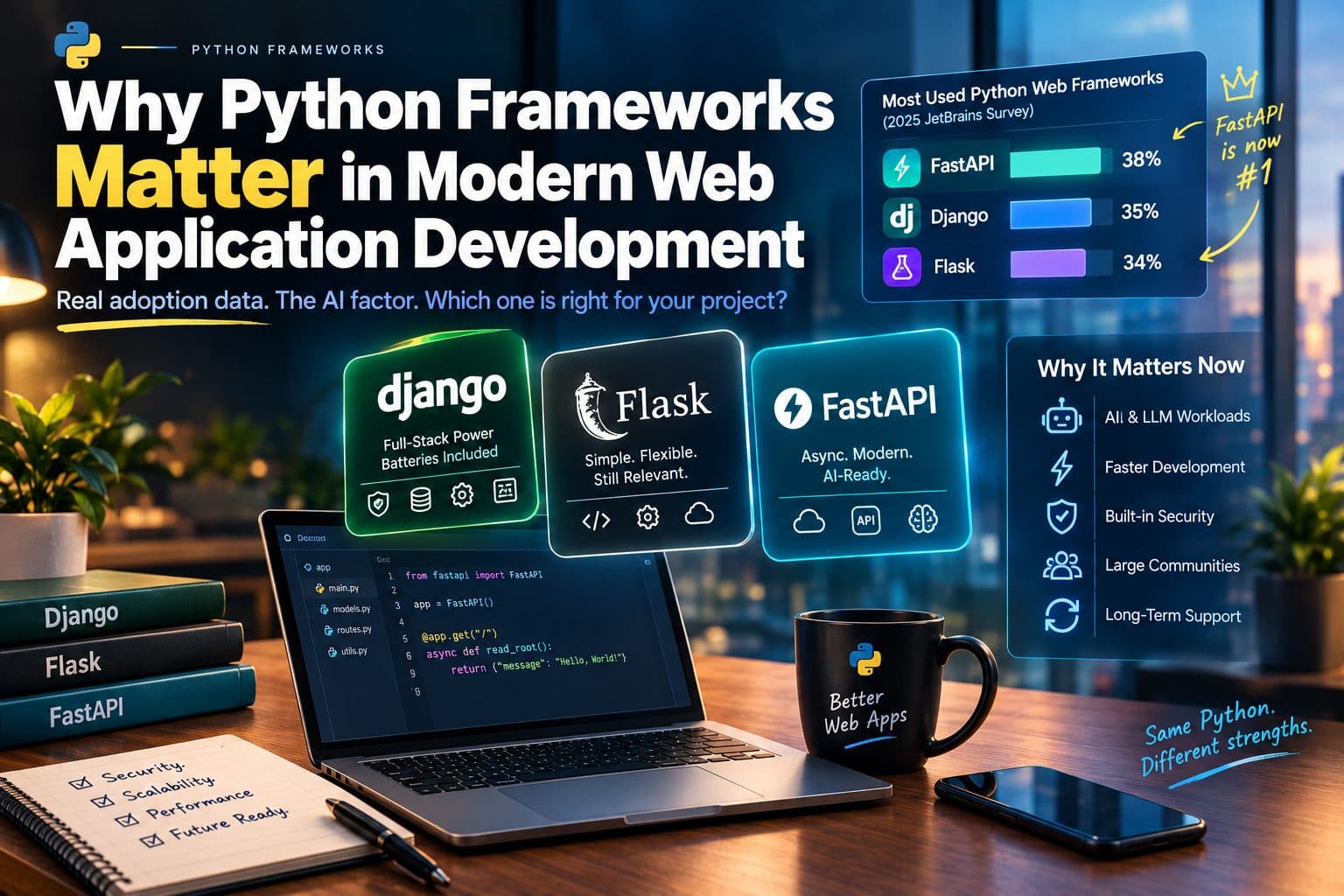
For the first time in Python's history, neither Django nor Flask is the most-used web framework — FastAPI is. The 2025 State of Python survey, run jointly by the Python Software Foundation and JetBrains among more than 30,000 developers, found FastAPI adoption at 38%, ahead of Django at 35% and Flask at 34%, up from just 29% a year earlier. The shift tracks closely with AI: FastAPI's async-first architecture fits naturally with machine learning model serving, RAG (retrieval-augmented generation) systems, and AI agent APIs, where request handling times vary and non-blocking I/O matters.
Why Frameworks Matter at All
Modern web applications need secure authentication, database management, API communication, input validation, and protection against common attack patterns before they can be considered production-ready. Building all of this from scratch is slow and introduces real security risk — frameworks solve this by providing tested, widely-used, continuously patched solutions for problems every serious web application shares. Using an established framework instead of custom-built infrastructure meaningfully reduces the odds of shipping a preventable vulnerability like SQL injection, cross-site scripting, or CSRF, since these protections come built-in and are maintained by large communities rather than reinvented per-project.
Django: Still the Full-Stack Default
Django remains the strongest choice for full-stack applications that need a built-in admin interface, authentication system, and object-relational mapper out of the box — its "batteries-included" philosophy hasn't gone away. Despite FastAPI's overall adoption lead, Django's decline in the JetBrains survey was modest (35%, down slightly from the prior year), reflecting how much established Django infrastructure remains in production even as new projects increasingly start elsewhere. Django has also added meaningful async support in recent versions, narrowing what used to be a clear gap with FastAPI, though its ORM and other async internals are still described by the Django team as a work in progress as of version 5.2.
FastAPI: Now the Default for New APIs, Especially AI-Facing Ones
FastAPI's rise tracks closely with the broader AI buildout: teams building RAG pipelines, LLM orchestration layers, or AI agent APIs are increasingly choosing it by default. Its core advantages — automatic OpenAPI documentation, Pydantic-based type validation, and native async support — reduce a category of bugs and boilerplate that older frameworks require more manual handling for. For any team building an AI agent that needs to expose tool-calling endpoints or serve model inference, FastAPI has become close to the default starting point.
Flask: Still Viable, Increasingly a Legacy Choice for New Work
Flask hasn't disappeared, but its growth has plateaued while FastAPI's has accelerated — organizations with pre-2020 Python infrastructure are more likely to be predominantly Flask-based, while newer projects skew toward FastAPI. Flask remains a reasonable choice for small applications, simple APIs, or situations where its minimal, unopinionated structure is genuinely preferred over FastAPI's more structured approach — but for a brand-new project in 2026, it's a harder default to justify than it was five years ago.
How to Actually Choose
If you're building a full-stack application with an admin panel, user-facing templates, and complex data relationships, Django remains the strongest fit. If you're building a new API — especially one serving AI/ML models, RAG pipelines, or agent tool-calling — FastAPI is the current default for good reason. If you're maintaining or extending an existing Flask codebase, or building something genuinely minimal, Flask is still a defensible choice, just a less common one for new projects.
The right call depends on what you're building, not which framework was most popular five years ago — but it's worth knowing that the ground has genuinely shifted under this decision since the last time many teams made it.
FAQ
Is FastAPI actually more popular than Django now?
By overall developer adoption, yes — the 2025 State of Python survey (PSF/JetBrains) found FastAPI at 38% adoption versus Django's 35% and Flask's 34%, the first time neither Django nor Flask led. That's a developer-adoption figure, not an enterprise-production-share figure, so it doesn't necessarily mean most existing production Django systems are being replaced.
Why has FastAPI grown so quickly?
Largely due to AI and machine learning workloads. FastAPI's async-first architecture and native support for non-blocking I/O fit naturally with model-serving patterns like RAG systems and LLM orchestration, where request times vary — making it a common default for teams building AI agent APIs.
Should I still learn Django in 2026?
Yes, particularly if you're building full-stack applications with complex data models, built-in admin needs, or joining a team maintaining existing Django infrastructure. Django's ecosystem remains substantial even as FastAPI leads in new API-specific projects.
Is Flask dead or becoming obsolete?
No, but its growth has plateaued relative to FastAPI. Flask remains viable for small applications and simple APIs, and organizations with Python infrastructure built before 2020 are more likely to still run on it — but it's a harder default recommendation for brand-new projects than it was several years ago.
What security benefits do Python frameworks provide over custom-built code?
Established frameworks include built-in, continuously maintained protections against common vulnerabilities like SQL injection, cross-site scripting (XSS), and cross-site request forgery (CSRF). Django in particular automatically escapes user input and handles secure password hashing by default, reducing the risk of security mistakes that often appear in custom-built systems.
Which framework is best for building an AI agent's API?
FastAPI is the current default for this specifically. Its async support and Pydantic-based validation handle the variable-latency, I/O-heavy patterns typical of AI agent tool-calling and model inference well, and it's a common choice for teams building RAG pipelines or LLM orchestration layers as of 2026.
Do these frameworks work well with cloud infrastructure?
Yes, all three integrate well with containerization and major cloud platforms like AWS, Azure, and Google Cloud, and support standard CI/CD deployment pipelines. This is table stakes across modern Python frameworks rather than a differentiator between them.
FAQ
By overall developer adoption, yes — the 2025 State of Python survey (PSF/JetBrains) found FastAPI at 38% adoption versus Django's 35% and Flask's 34%, the first time neither Django nor Flask led. That's a developer-adoption figure, not an enterprise-production-share figure, so it doesn't necessarily mean most existing production Django systems are being replaced.
Largely due to AI and machine learning workloads. FastAPI's async-first architecture and native support for non-blocking I/O fit naturally with model-serving patterns like RAG systems and LLM orchestration, where request times vary — making it a common default for teams building AI agent APIs.
Yes, particularly if you're building full-stack applications with complex data models, built-in admin needs, or joining a team maintaining existing Django infrastructure. Django's ecosystem remains substantial even as FastAPI leads in new API-specific projects.
No, but its growth has plateaued relative to FastAPI. Flask remains viable for small applications and simple APIs, and organizations with Python infrastructure built before 2020 are more likely to still run on it — but it's a harder default recommendation for brand-new projects than it was several years ago.
Established frameworks include built-in, continuously maintained protections against common vulnerabilities like SQL injection, cross-site scripting (XSS), and cross-site request forgery (CSRF). Django in particular automatically escapes user input and handles secure password hashing by default, reducing the risk of security mistakes that often appear in custom-built systems.
FastAPI is the current default for this specifically. Its async support and Pydantic-based validation handle the variable-latency, I/O-heavy patterns typical of AI agent tool-calling and model inference well, and it's a common choice for teams building RAG pipelines or LLM orchestration layers as of 2026.
Yes, all three integrate well with containerization and major cloud platforms like AWS, Azure, and Google Cloud, and support standard CI/CD deployment pipelines. This is table stakes across modern Python frameworks rather than a differentiator between them.
The GetCoreTech Team
We write about the SaaS, AI, and infrastructure decisions builders actually have to make.
Comments
Log in or sign up to join the discussion.
Loading comments…