
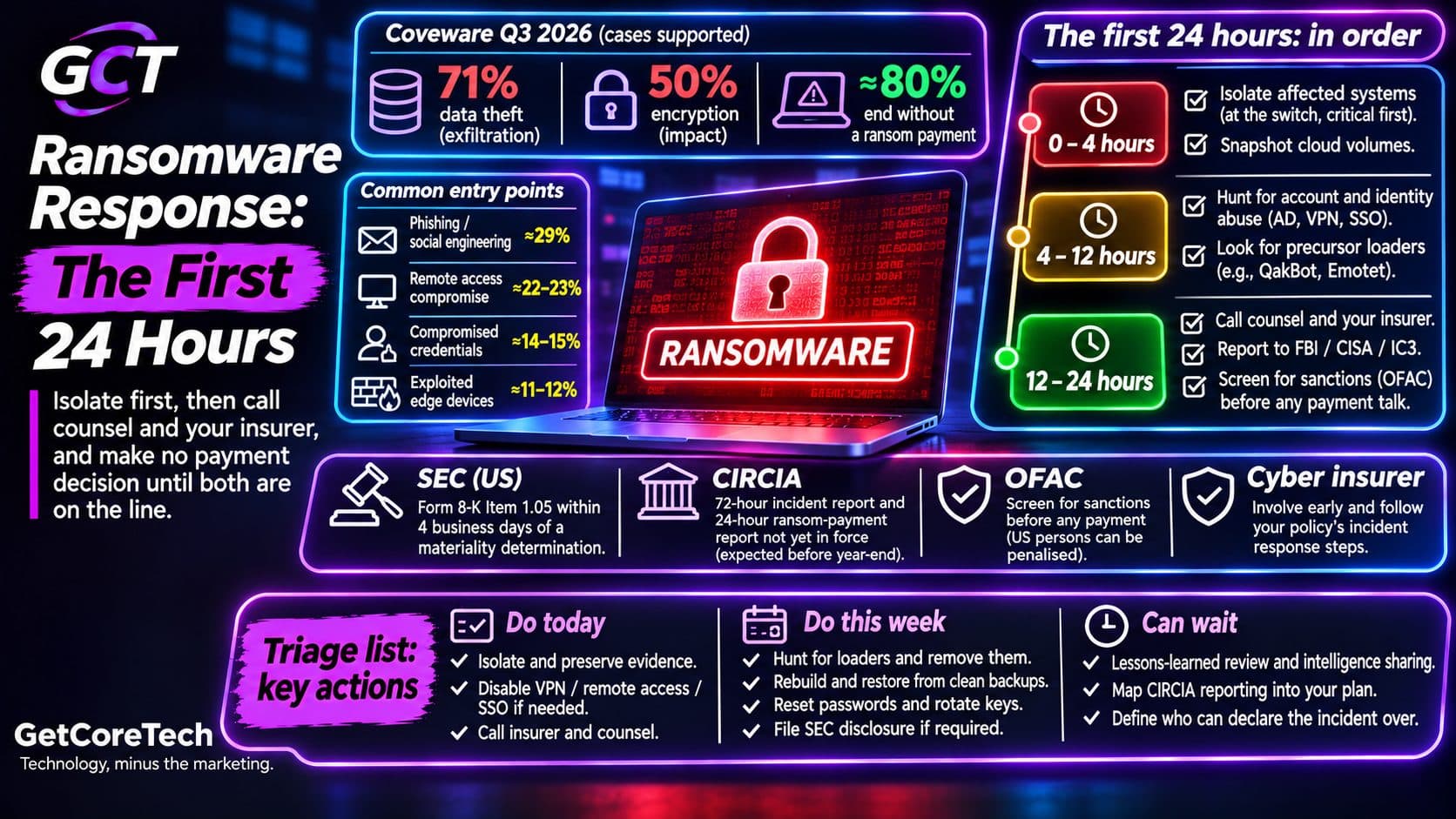
Isolate first, call counsel and your insurer second, and make no payment decision until both are on the line. CISA’s response checklist still opens with isolating affected systems and tells you to run its first three steps in order.1 What changed is the incident itself: in Coveware’s Q3 2026 cases, data theft showed up in 71% of incidents and encryption in 50%, so the legal work can start before a single file is locked.2
You need this if your team has a suspected ransomware or data-extortion incident right now, or you own the plan for one. The isolation and evidence steps apply to everyone. The SEC filing applies only to SEC registrants, and the federal CIRCIA reporting rule is not yet in force. The legal steps assume a US organisation, and none of this is legal advice. Status as of 8 November 2026.
Data theft now arrives with encryption, or instead of it
Measured Coveware counted data exfiltration in 71% of its Q3 2026 incidents, level with lateral movement at 71%. Credential access ran 56%, and impact (encryption or service interruption) reached 50%, up from Q2.2 These are cases Coveware supported, not the whole market, and Coveware is now owned by Veeam, a backup vendor.2 It says nearly 80% of incidents end without a ransom payment, in its discussion of data-extortion-only attacks.2
Entry looks like a login. Phishing and social engineering led at about 29%, remote access compromise ran 22–23%, compromised credentials 14–15%, and exploited edge devices and unpatched appliances 11–12%.2 Measured Sophos’s 2026 report covers 661 cases from November 2024 to October 2025. It puts identity-related causes at 67% of root causes, the median time to reach Active Directory at 3.4 hours, and ransomware deployment outside business hours at 88%.3 Sophos sells managed detection, and that data is more than six months old.
Opinion Treat the first day as an identity incident that may also involve encryption.
Hours 0 to 4: isolate in order, and do it quietly
CISA says to find the affected systems and isolate them at once. If several systems or subnets look hit, take the network offline at the switch, critical systems first.1 For cloud resources, snapshot the volumes before anything changes, so you keep a point-in-time copy for forensics.1
The intruder may be watching. CISA tells you to isolate in a coordinated way and use out-of-band channels such as phone calls, because a visible response can push attackers to move laterally or deploy ransomware widely before the network is down.1 Coveware reaches the same place from its cases: isolated moves against control channels can make attackers switch tools or speed up, so one person needs clear isolation authority.2 Put the response team’s phone numbers on paper, not on the file share that just got encrypted.
Power-off is the fallback. CISA says to power down only when you cannot disconnect a device, because that destroys volatile memory and the evidence in it.1 If you cannot contain at once, it says to image a sample of affected hosts, capture their memory, and preserve short-lived evidence: system memory, Windows Security logs and firewall log buffers.1
Hours 4 to 12: find the accounts, not just the machines
Start CISA’s enterprise hunt with identity: new Active Directory accounts, escalated privileges, Domain Admin activity and anomalous VPN logins.1
Look for a loader before you restore anything. CISA says a ransomware event can sit on top of an earlier, unresolved compromise, with precursor malware such as Bumblebee, Dridex, Emotet, QakBot or Anchor, and that access to such networks is often sold on.1 Rebuilding from backups before you find the loader restores the intruder along with the data.1
If credentials were taken, close the doors they open. CISA says breaches often involve mass credential theft, and it lists disabling VPNs, remote access servers, SSO resources and public-facing cloud assets as a containment step.1 It sequences full password resets after the environment is cleaned and rebuilt.1 Coveware lists verified identity systems during containment and secure administrative access to backups among the things recovery depends on.2
Hours 12 to 24: the calls that start clocks
Counsel belongs in the room before the first filing.
CISA tells victims to follow the notification steps in their incident plan and to involve IT, managed security providers and the cyber insurer.1 It also says to report to CISA, your local FBI field office, the FBI’s IC3 or the Secret Service. It says to ask federal law enforcement about decryptors even if you can contain the incident, because researchers sometimes find flaws in a variant’s encryption.1
If you are an SEC registrant, the Form 8-K Item 1.05 filing is due four business days after you determine the incident is material, and you must make that determination without unreasonable delay.4 A payment that ends the attack does not cancel the duty, and neither does an insurer reimbursing the payment.4 If you have not settled materiality, SEC staff guidance from May 2024 steers voluntary disclosure to Item 8.01.4 The rule is under pressure. As of American Banker’s June 2026 report, bank trade groups had petitioned the SEC to rescind it and Chair Paul Atkins had opened a review of disclosure rules.5 I found no rescission in my searches as of 8 November.
Reported CIRCIA’s 72-hour incident report and 24-hour ransom-payment report are not in force yet. HIPAA Journal reported on 5 October that CISA sent the final rule to the White House for review, with publication expected before the end of the year.6 CISA encourages voluntary reporting in the meantime, and HIPAA duties will continue alongside the new rule.6
Screen for sanctions before any payment talk. OFAC’s advisory says liability is strict: a US person can be penalised for paying a blocked party without knowing it.7 It reaches incident response firms and insurers that negotiate or facilitate payments, and it lists prompt reporting and full cooperation with law enforcement as mitigating factors.7 The advisory dates from September 2021, and I found no newer replacement. Coveware adds that paying rarely lifts notification duties and that a promise to delete stolen data cannot be verified.2
How you’d notice
The ransom note or the extortion email is the late signal. The earlier ones sit in your logs.
CISA flags misuse of built-in Windows tools to cripple recovery: bcdedit, fsutil (deletejournal), vssadmin, wbadmin, and wmic against shadow copies.1 It also flags unexpected remote monitoring and management software, unexpected PowerShell or PsTools use, credential dumping from LSASS, and Cobalt Strike processes named to look like legitimate Windows ones.1 Exfiltration shows as transfers through Rclone, Rsync, web file storage or FTP and SFTP.1 Coveware says attackers use standard web services and cloud storage to blend that traffic into routine activity.2
Read the logs for the hours outside business first. Sophos found 79% of exfiltration and 88% of ransomware deployment happened then.3
Triage list: the first 24 hours
Do today
- Isolate affected systems at the switch, critical systems first, and snapshot cloud volumes before changing anything.
- Name one person with authority to order isolation, and move response coordination to phone calls.
- Preserve system memory, Windows Security logs and firewall log buffers from a sample of affected hosts before they roll over.
- Disable VPN, remote-access servers and SSO sessions if you suspect stolen credentials.
- Call your cyber insurer and outside counsel.
- Report to your FBI field office, IC3 or CISA, and ask about decryptors for the variant.
- Search endpoint and identity logs for the signals under “How you’d notice,” starting with the hours outside business.
Do this week
- Hunt for precursor loaders such as QakBot or Emotet before you restore anything from backup.
- Rebuild critical systems from pre-configured clean images and restore from offline, encrypted backups onto a clean VLAN.
- Reset passwords after the rebuild, and rotate customer-managed encryption keys.
- File the Item 1.05 Form 8-K within four business days of a materiality determination, or use Item 8.01 for voluntary disclosure while materiality is undecided (SEC registrants only).
- Ask counsel to run sanctions screening before any payment discussion, and to check breach-notification duties for the stolen data.
Can wait
- Write the lessons-learned review, and share indicators with CISA or your sector ISAC.
- Map CIRCIA’s 72-hour and 24-hour reports into your plan once the final rule publishes.
- Define the criteria for declaring the incident over, and who declares it.



Comments