
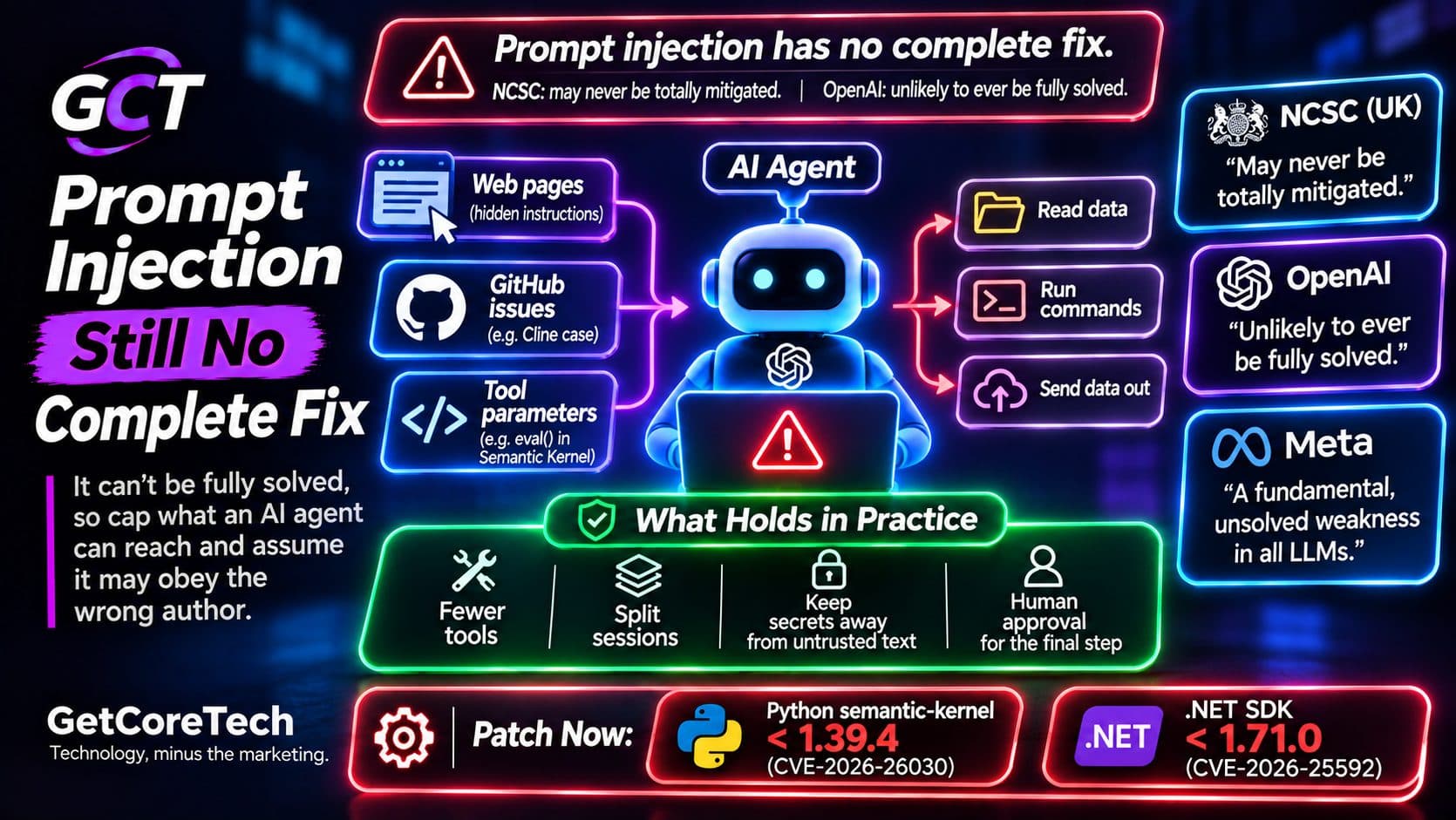
Prompt injection has no complete fix at the model layer. The UK's NCSC says it may never be totally mitigated, and OpenAI says it is unlikely to ever be fully solved.12 What holds is capping what a hijacked agent can reach: fewer tools, split sessions, secrets kept away from untrusted text, and a human on the final step.
You need this if your team runs an LLM feature that reads text it didn't write (mail, web pages, tickets, pull requests) and can also call tools, write files or send data out. It is less urgent if the model only returns text to the person who typed the prompt and holds no tools. One patch item applies now: Python semantic-kernel before 1.39.4 and the .NET SDK before 1.71.0. Status as of 8 November 2026.
The model has no boundary between instructions and data
SQL injection became fixable because parameterised queries stop the database from ever reading input as an instruction. NCSC's blog of 8 December 2025 says LLMs have no such mechanism: the model predicts the next token, with no separate class for data.1 It tells teams to treat the model as an "inherently confusable deputy" and plan for residual risk.1
OpenAI wrote on 22 December 2025 that injection is unlikely to ever be fully solved, and declined to say whether its Atlas update measurably cut successful attacks.2 Meta calls it a fundamental, unsolved weakness in all LLMs.3
Opinion Design as if the model will sometimes obey the wrong author.
Attacks already run through web pages, issue titles and tool parameters
OWASP's 2026 agentic security report, summarized by Help Net Security, maps injection to six of the ten categories in its agentic Top 10 and finds coding agents supply most of the new attack data.4
Hidden instructions on public web pages
Measured In research covered by Help Net Security, Google scanned 2-3 billion crawled pages a month for known injection patterns and saw a 32% relative rise in malicious cases between November 2025 and February 2026. Forcepoint found payloads aimed at financial fraud. Neither team found evidence of coordinated campaigns, though shared templates across domains suggested organized tooling.5
An April 2026 preprint validated 15.3 thousand injections across 11.7 thousand pages among 1.2 billion URLs. About 70% sat in non-rendered HTML such as comments and metadata. In 5,200 tests on 13 models, compliance reached up to 8% for smaller models on plain text, and structured page formats lowered it.6
A GitHub issue title that reached release credentials
Cline added an AI triage workflow built on claude-code-action on 21 December 2025. It ran for any GitHub account, held Bash, Write and Edit tools, and placed the issue title in the prompt.7 Adnan Khan traced a path from that title, through GitHub Actions cache poisoning, to nightly credentials that could publish production releases. He reported it on 1 January 2026 and went public on 9 February after weeks without a response.7
Reported On 17 February an unknown actor used an npm token that Cline's 9 February rotation had not revoked and published cline@2.3.0 with a postinstall script that installed openclaw. Cline said the CLI binary was unchanged and shipped 2.4.0 the same day.7
The agent did what its prompt told it to.
A model-chosen parameter that reached eval()
Microsoft's Defender team disclosed two Semantic Kernel flaws on 7 May 2026. CVE-2026-26030 hits Python semantic-kernel before 1.39.4 when the In-Memory Vector Store filter backs the Search Plugin in its default setup: a model-supplied parameter reached eval() and a blocklist validator missed it. CVE-2026-25592 hits the .NET SDK before 1.71.0, where a file-download function was exposed to the model and wrote to any host path it was handed. Both are fixed in the versions named. Microsoft's post doesn't report exploitation in the wild.8
Microsoft's guidance is that the model isn't a security boundary, and any tool parameter it can influence is attacker-controlled input.8
Filters lose to an attacker who adapts
Measured A 14-author preprint of 10 October 2025 attacked 12 published defenses with gradient, reinforcement-learning, search and human-guided methods. Attack success exceeded 90% for most, and the majority of those defenses had reported near-zero in their own papers.9
NCSC warns against deny-lists for the same reason: attacks can be reworded without limit.1
| Defense | Evidence | Verdict |
|---|---|---|
| Phrase deny-list | NCSC: attacks can be reworded without limit | Don't rely on it |
| Spotlighting, prompt sandwiching, tool filter | CaMeL paper: 5, 24 and 8 of 949 static attacks succeeded, 44 undefended | Lowers odds on static attacks |
| Prompting, training, filter models, secret tokens | Nasr et al.: all 12 tested were bypassed by adaptive attacks | Fails against a motivated attacker |
| Capability limits and approval gates | CaMeL paper: 0 of 949 succeeded; Meta's Rule of Two | Holds inside its threat model, costs utility |
CaMeL's authors compared defenses on 949 static AgentDojo attacks against Claude 3.5 Sonnet: 44 got through undefended, 24 with prompt sandwiching, 8 with a tool filter and 5 with spotlighting.10 They add that US AISI found adaptive prompts sharply cut that model's robustness, and expect the same for heuristic defenses.10 Opinion A vendor's "blocked" rate describes a test set, not an attacker.
Designs that cap the damage are the ones that hold
Meta's Agents Rule of Two, published 31 October 2025, says a session should combine no more than two of three properties until injection can be reliably detected: untrusted input, access to sensitive data or systems, and the power to change state or communicate externally. A session needing all three needs human approval. Meta adds that the rule supplements least privilege and fails if users approve prompts blindly.3
Measured CaMeL, from Google, Google DeepMind and ETH Zurich researchers, gives a planner model only the user's request, sends untrusted data to a tool-less model, and checks every tool call against policy. It completed 77% of AgentDojo tasks with provable security against 84% undefended, at a median 2.82 times the input tokens.10 The authors say injection isn't solved and that someone must write and maintain the policies.10
NCSC relays a plain rule: an LLM reading a party's content should hold no more privilege than that party.1 Khan's advice for Cline follows it: no Bash, Write or Edit in the public triage workflow, no cache restore where release secrets live, and separate nightly credentials.7
How you'd notice an injection is working
Watch the agent's host. Microsoft points to an agent process that suddenly spawns command lines or drops scripts into startup folders, and says to review from the day a vulnerable version shipped to the day you patched. On a hit, treat the host as compromised and rotate every credential the agent could reach.8
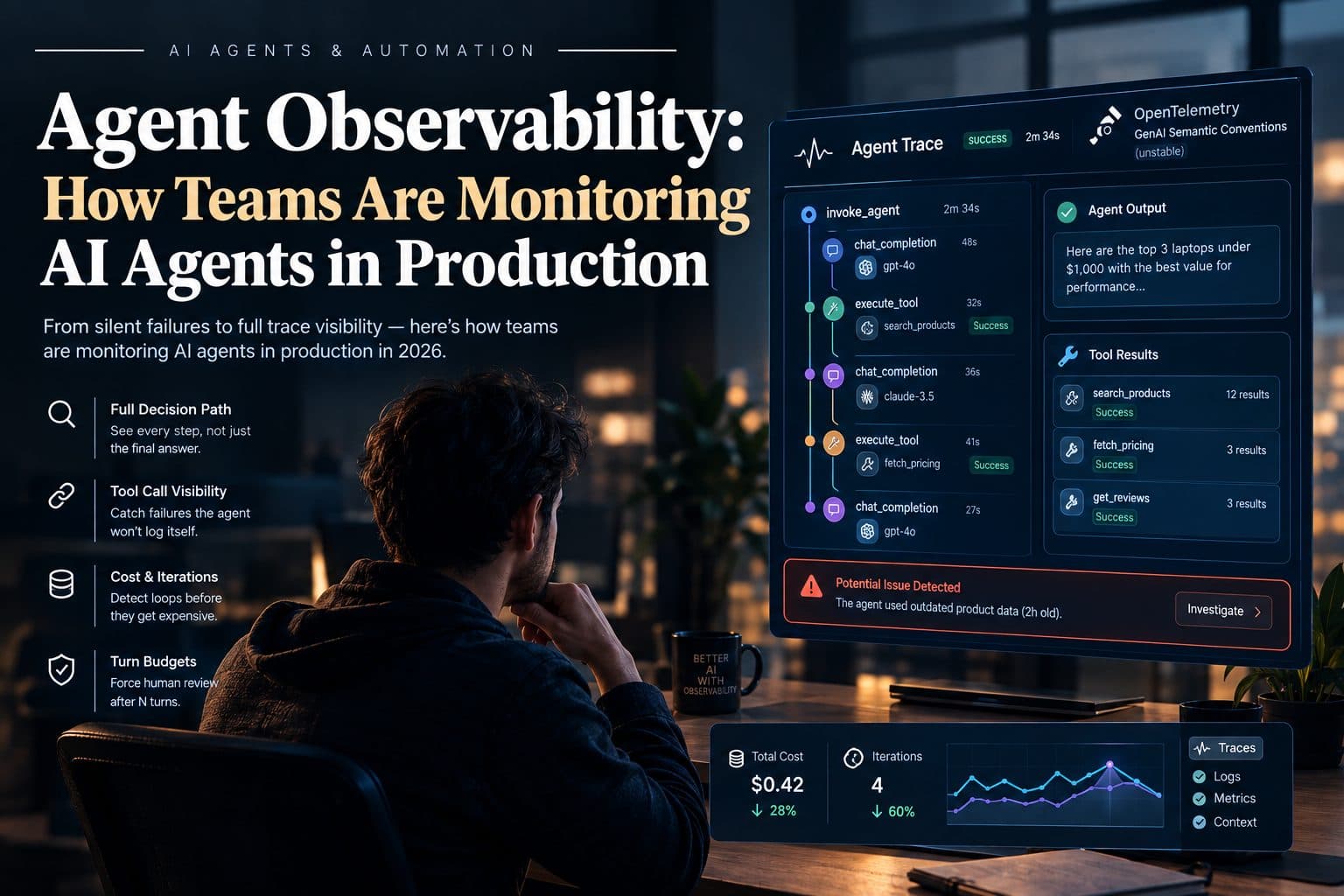
Log full model inputs and outputs, tool calls and failures. NCSC notes attackers usually have to refine an attack, so repeated failed calls can expose early attempts.1 In CI, Khan found release runs where the actions/checkout cleanup step failed with no output, an indicator of his own proof-of-concept cache-poisoning tool, and the team had patched around the failures without investigating.7 Diff what the agent fetched against what a browser renders, since about 70% of injected instructions sit outside the rendered page.6
Cap what a hijacked agent can do
Do today
- Upgrade Python semantic-kernel to 1.39.4 or later (the In-Memory Vector Store filter is the exposed path) and the .NET SDK to 1.71.0 or later.8
- Remove Bash, Write and Edit from every agent workflow that public users can trigger, and stop anonymous accounts from triggering them.7
- Verify in the registry that every rotated release token is actually revoked; Cline deleted the wrong npm token and the live one was used eight days later.7
- Search workflows for issue, pull-request and comment fields interpolated into agent prompts; each hit is an injection point to review.7
Do this week
- Audit each agent against the Rule of Two and put a human approval on the third property wherever all three apply.3
- Move release, cloud and mail credentials out of any session that reads outside text, and split nightly from production publishing identities.7
- Allowlist paths, hosts and recipients for every tool parameter in deterministic code, and treat model-chosen values as attacker input.8
- Log model inputs, outputs, tool calls and failures, and alert on agent hosts that spawn shells or write startup scripts.18
Can wait
- Trial a CaMeL-style planner and quarantine split on one high-privilege workflow, budgeting about 2.8 times the input tokens and the time to write policies.10
- Retest any purchased injection filter against adaptive attacks, and prefer vendors who explain how they reduce risk over those who claim to stop it.19
- Feed web agents structured page representations; the April 2026 preprint found they lowered compliance, in its own tests on 13 models.6


Comments