AI-Native Development: From Writing Code to Directing It
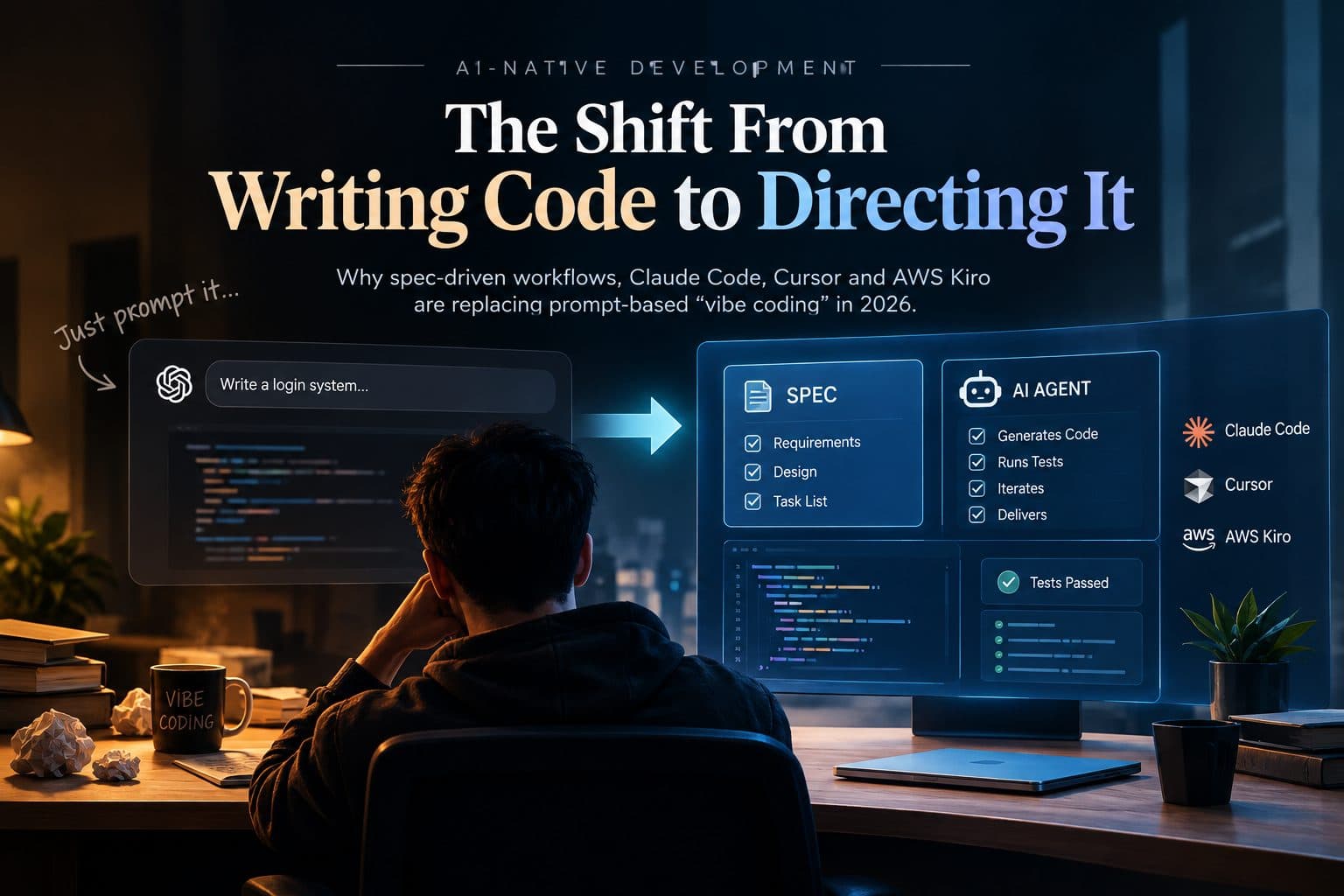
"Vibe coding" produced worse code, data shows. Now developers write specs and let AI agents implement — here's how spec-driven development works.
The GetCoreTech Team Sep 13, 2026 · 9 min read
AI-Native Development: Inside the Shift From Writing Code to Directing It
The defining shift in software development in 2026 isn't that AI writes more code — it's that the industry is actively walking back from letting AI write code from bare prompts, after data showed what that produced. GitClear's analysis of over 600 million commits found block-level code duplication climbed 81% since 2023, and refactored (reused, cleaned-up) code fell from 21% of changed lines in 2022 to just 3.8% in the first half of 2026. In response, GitHub, AWS, and the major AI coding agents have spent the past year building tooling around a different workflow entirely: developers write a precise specification of what they want, and an AI agent implements, tests, and iterates against that spec — a practice now widely called spec-driven development (SDD).
What "Directing, Not Writing" Actually Means
The term getting used loosely across 2026 trend reports is "AI-native development," but the concrete practice underneath it has a name: spec-driven development. It's a software methodology where a structured, versioned specification — not the code itself — is treated as the source of truth, and code is generated or maintained against that spec by an AI coding agent. The movement defines itself explicitly against "vibe coding," the term for loosely prompting an AI and shipping whatever comes back, popularized by Andrej Karpathy in early 2025. Vibe coding works fine for throwaway prototypes; it's the practice GitClear's duplication and churn data is describing.
Under SDD, a developer's job shifts from typing implementation details to defining intent precisely enough that a coding agent can't reasonably get it wrong — a distinction Microsoft's own engineering team has framed as the difference between decision autonomy and implementation autonomy. The agent gets implementation autonomy; the human keeps decision autonomy, at least for now.
Why This Became Urgent, Not Theoretical
The GitClear data is the concrete evidence for why this shift wasn't optional. The firm's most recent analysis, tracking seven code-quality signals across 2023–2026, found copy-pasted code climbed from 9.4% of changed lines in 2022 to 15.7% in the first half of 2026, while moved (refactored) code — the signal of a developer actually reusing and cleaning up existing logic rather than pasting a new copy — collapsed from 21% to 3.8% over the same window. Duplicated code blocks, measured per million changed lines, hit 73.0 in the 2026 data, up 81% from 40.3 in 2023 and the highest level GitClear has recorded. Duplicated blocks carry what the firm calls a "propagation tax": every future change to one copy has to be manually tracked down and applied to every sibling copy scattered across the codebase, often in files the original developer never touches again.
That's the failure mode spec-driven tooling is explicitly built to address. As one 2026 field guide on the practice put it, AI agents are good at writing code and bad at guessing what a developer meant — and an underspecified prompt like "add login" leaves an agent to fill the gaps with whatever default seems reasonable, which frequently isn't what the team actually wanted.
The Named Tools Behind the Shift
This isn't an abstract methodology debate; it's showing up in what platform vendors are actually shipping.
AWS Kiro is the clearest signal of how seriously this is being taken at the infrastructure level. AWS announced Kiro on July 14, 2025, built specifically around spec-driven development — before an agent writes any code, Kiro produces a requirements document, a design document, and a task list that stay in the repository as the source of truth. Kiro reached general availability on May 7, 2026, and AWS positioned it not as a feature addition but as a full replacement for Amazon Q Developer, whose IDE plugins and paid subscriptions are set to lose support entirely on April 30, 2027. That's a major cloud vendor retiring an existing AI coding product line in favor of a spec-first one.
GitHub Spec Kit, released as an open-source, MIT-licensed CLI toolkit in September 2024, takes a different approach: rather than an integrated IDE, it's a portable toolkit that layers a structured spec → design → tasks → implementation workflow on top of whichever coding agent a team already uses. It supports more than 30 AI coding agents, including Claude Code, GitHub Copilot, and Gemini CLI, and had passed 93,000 GitHub stars by mid-2026.
Claude Code and Cursor are the two tools most responsible for how fast this shift reached individual developers. Both appeared in Stack Overflow's Developer Survey for the first time in the 2025 edition (fielded May–August 2025, published December 29, 2025) and immediately landed in the top tier of AI-enabled development environments alongside VS Code — Cursor at 18% usage share and Claude Code at 10%, described by multiple outlets covering the survey as the fastest first-year debut of a development tool in the survey's history. By JetBrains' January 2026 State of Developer Ecosystem survey, Claude Code's awareness among developers had climbed from 31% in April–June 2025 to 57%, with both Claude Code and Cursor reaching 18% global work adoption.
The Trust Gap That's Actually Driving the Behavior Change
The Stack Overflow data underneath all of this contains the real tension: AI coding tool adoption reached 84% of developers in the 2025 survey, up from 76% in 2024 and 70% in 2023 — but trust in the accuracy of that output fell to 29%, down from 43% the year before, an 11-point single-year drop. The top complaint, cited by 66% of respondents, was dealing with AI output that's "almost right, but not quite," and 45% said debugging AI-generated code takes longer than writing it themselves would have.
That's not a contradiction between two separate trends — it's cause and effect. Rising adoption without rising trust is exactly the condition spec-driven development is designed to fix: instead of asking developers to trust an agent's judgment on ambiguous intent, it moves the judgment call earlier, into a spec the developer wrote and can verify against, and treats the generated code as something to check against that spec rather than something to trust outright.
Where the Approach Still Has Real Limits
Spec-driven development is not a solved problem, and treating it as one would be its own version of uncritical AI enthusiasm. Early implementations have a documented weakness: specs and code can fall out of sync over time, since most tooling treats the spec as a relatively static document rather than something that's automatically kept current as implementation details change — the same drift problem SDD is supposed to solve, one level up. There's also active, unresolved disagreement inside the engineering community about how much human review the workflow actually needs; Microsoft's own developer blog on the topic drew public pushback from readers arguing that current-generation coding agents can already execute spec-kit-style workflows autonomously, making the human checkpoints in the middle more friction than safeguard. Neither position has settled data behind it yet — it's a live debate, not a resolved one.
What This Means for a Developer or Engineering Team Right Now
The skill that matters is shifting, not disappearing. Writing precise specifications, acceptance criteria, and edge cases is replacing typing implementation as the highest-leverage thing a senior developer does — it's a different skill, not a lesser one.
Tool choice increasingly means multiple tools, not one. Most engineering orgs by 2026 run more than one agent across teams — Claude Code, Cursor, GitHub Copilot, and others — often on the same project, which is part of why portable, agent-agnostic spec tooling like GitHub Spec Kit has traction.
"It compiles" is no longer the bar. The GitClear data on duplication and churn is a direct argument for measuring AI-assisted output against maintainability signals, not just whether it runs on the first try.
The trust gap won't close by waiting. Developers aren't abandoning AI tools despite low trust in their output — they're using them more and building verification into the workflow instead, which is the practical shape "trust but verify" has taken in 2026 engineering teams.
FAQ
Q: What's the difference between spec-driven development and just writing detailed prompts?
A: A prompt is typically a one-off, disposable instruction for a single interaction. A spec in SDD is a structured, versioned artifact that stays in the repository, gets updated as requirements change, and serves as a persistent shared reference between the developer and any AI agent working on the code — closer to a living requirements document than a chat message.
Q: Do I need to use a dedicated tool like Kiro or Spec Kit to do spec-driven development?
A: No. The practice can be done manually with a written requirements document and disciplined prompting. Dedicated tooling like GitHub Spec Kit or AWS Kiro automates the workflow — generating design documents and task breakdowns from the spec, and checking implementation against it — but the underlying discipline of writing intent down before generating code doesn't require any specific product.
Q: Is AI-generated code actually worse than human-written code?
A: On maintainability signals specifically — duplication, refactoring rates, and short-term code churn — the available data points that direction. GitClear's analysis of over 600 million commits found meaningfully more duplicated code and less refactoring in AI-heavy codebases through 2026 than in prior years. That's a maintainability finding, not a claim that AI-generated code doesn't function; a lot of it works on the first run, which is part of why the underlying quality issues aren't always caught before it ships.
Q: Does adopting spec-driven development mean developers write less code?
A: In terms of raw typing, generally yes — an AI agent does most of the line-by-line implementation. But the specification-writing, review, and verification work that replaces it is not necessarily less time-consuming, particularly for complex or ambiguous features where getting the spec right is the hard part.
Q: Why did AWS retire Amazon Q Developer instead of just updating it?
A: AWS positioned Kiro as a ground-up replacement rather than an incremental update, built specifically around spec-first workflows rather than the prompt-driven model Q Developer was built on. Existing Q Developer IDE plugins and subscriptions continue working until end-of-support in April 2027, giving current users a multi-year migration window.
Q: Is "vibe coding" going away?
A: Not entirely — it remains a reasonable approach for prototypes, throwaway scripts, and exploratory work where long-term maintainability isn't the point. The shift is specifically about production and long-lived codebases, where the GitClear data shows the costs of unstructured, prompt-only workflows compounding over time.
FAQ
A prompt is typically a one-off, disposable instruction for a single interaction. A spec in SDD is a structured, versioned artifact that stays in the repository, gets updated as requirements change, and serves as a persistent shared reference between the developer and any AI agent working on the code — closer to a living requirements document than a chat message.
No. The practice can be done manually with a written requirements document and disciplined prompting. Dedicated tooling like GitHub Spec Kit or AWS Kiro automates the workflow — generating design documents and task breakdowns from the spec, and checking implementation against it — but the underlying discipline of writing intent down before generating code doesn't require any specific product.
On maintainability signals specifically — duplication, refactoring rates, and short-term code churn — the available data points that direction. GitClear's analysis of over 600 million commits found meaningfully more duplicated code and less refactoring in AI-heavy codebases through 2026 than in prior years. That's a maintainability finding, not a claim that AI-generated code doesn't function; a lot of it works on the first run, which is part of why the underlying quality issues aren't always caught before it ships.
In terms of raw typing, generally yes — an AI agent does most of the line-by-line implementation. But the specification-writing, review, and verification work that replaces it is not necessarily less time-consuming, particularly for complex or ambiguous features where getting the spec right is the hard part.
AWS positioned Kiro as a ground-up replacement rather than an incremental update, built specifically around spec-first workflows rather than the prompt-driven model Q Developer was built on. Existing Q Developer IDE plugins and subscriptions continue working until end-of-support in April 2027, giving current users a multi-year migration window.
Not entirely — it remains a reasonable approach for prototypes, throwaway scripts, and exploratory work where long-term maintainability isn't the point. The shift is specifically about production and long-lived codebases, where the GitClear data shows the costs of unstructured, prompt-only workflows compounding over time.
The GetCoreTech Team
We write about the SaaS, AI, and infrastructure decisions builders actually have to make.
Comments
Log in or sign up to join the discussion.
Loading comments…