
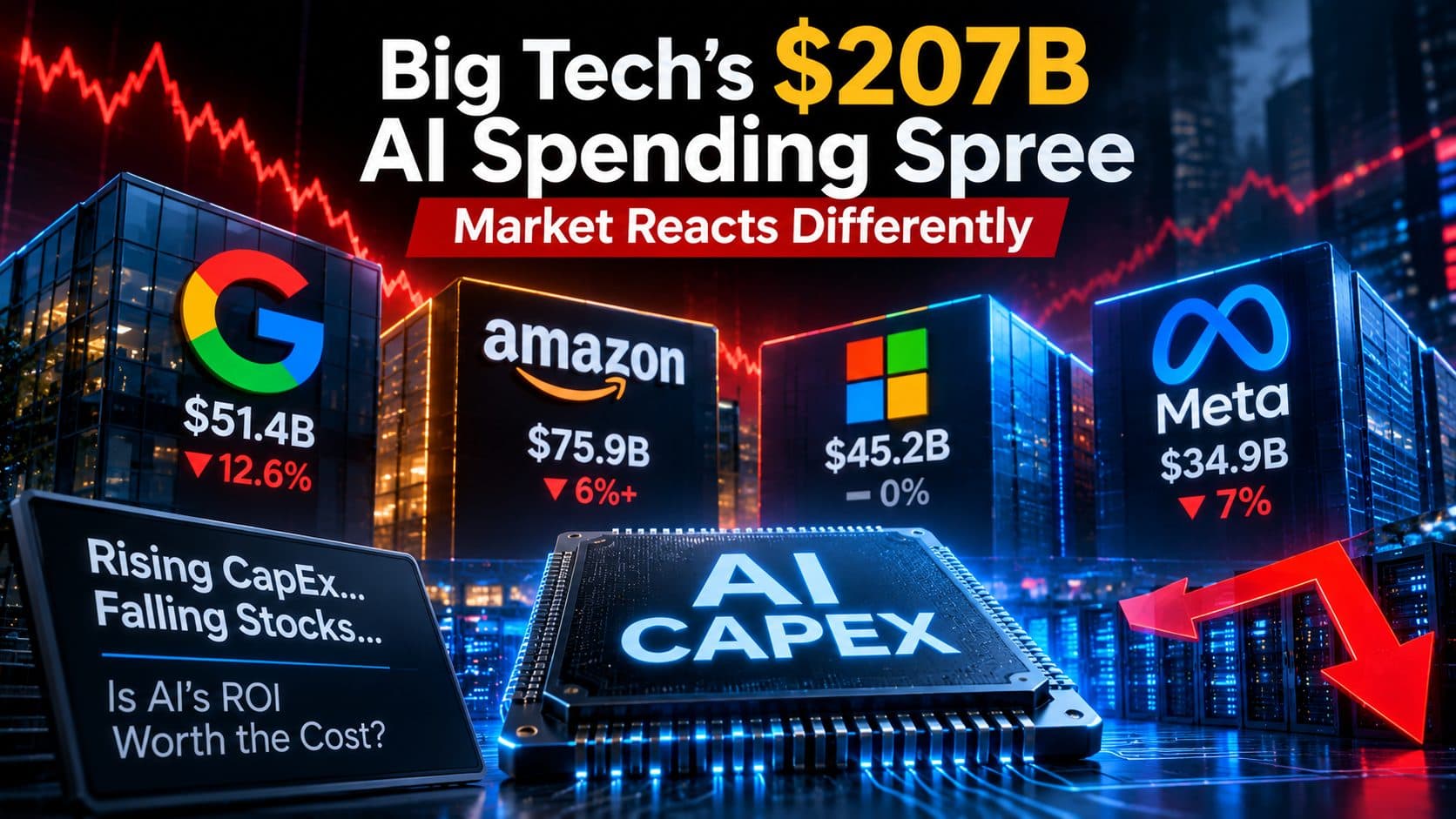
Alphabet, Amazon, Microsoft and Meta reported about $207 billion of capital spending in their latest quarters, and the three companies with negative free cash flow in their reported period fell furthest, but no document read here shows that cash flow caused the moves.1234 Microsoft, the only one of the four with positive free cash flow, closed down 0.16% on 29 October.35 Alphabet closed down about 12.6% that day, and Meta fell 6.98% on 22 October.67 Confidence: moderate, because every operating figure comes from the companies' own releases and calls, and the four report on different definitions and time windows.
The scorecard: four definitions behind $207 billion of capex
Capital expenditure (capex) is spending on long-lived assets such as data centers and servers, and the four companies count it differently. Alphabet's $51,355 million is purchases of property and equipment.1 Meta's $34.91 billion adds $964 million of principal payments on finance leases to $33,942 million of purchases.2 Microsoft's $45.2 billion includes $7.4 billion of finance leases, recognized at full principal when the lease starts, and its cash paid for property and equipment was $39.4 billion.3 Amazon's $75.9 billion is cash capex: $77,259 million of purchases less $1,381 million of proceeds from sales and incentives.4
A finance lease lets a company use equipment or facilities over time instead of paying the full price up front, but it still creates payment obligations. That is why the Meta and Microsoft figures include leases while the Alphabet and Amazon figures here are purchases of property and equipment.
Measured Adding the four reported figures gives $207.4 billion ($51.4 billion + $34.9 billion + $45.2 billion + $75.9 billion), which is my arithmetic and mixes definitions.1234 Using only cash paid for property and equipment, net of Amazon's proceeds, the same four total about $200.6 billion ($51.4 billion + $33.9 billion + $39.4 billion + $75.9 billion), so the headline total depends on whether leases count.1234
Most of this is described as AI spending, though the companies' own breakdowns differ. AI infrastructure means the servers, networking equipment and data centers used to train and run AI models. Alphabet's CFO said the vast majority of its capex went to technical infrastructure supporting AI, about 65% of it servers and networking equipment and 35% data centers.8 Microsoft said roughly three-quarters of its capex was short-lived assets, primarily CPUs and GPUs.3 Amazon's CFO said its cash capex primarily relates to AWS and AI.9 Meta's release does not break its capex down.2
| Company | Latest-quarter capex | Free cash flow | 2026 capex outlook | Stock reaction |
|---|---|---|---|---|
| Alphabet18 | $51.4B (purchases of property and equipment) | −$9.1B, quarter | $195B–$205B | Down about 12.6% on 29 Oct6 |
| Meta2 | $34.9B (includes finance-lease principal) | −$2.12B, quarter | $135B–$145B, narrowed from $130B–$145B | Down 6.98% on 22 Oct7 |
| Microsoft3 | $45.2B (includes finance leases; $39.4B cash) | +$18.6B, quarter | Over $50B next quarter; about $170B for calendar 2026 | Down 0.16% on 29 Oct5 |
| Amazon49 | $75.9B (net cash capex) | −$42.4B, trailing 12 months | About $220B cash capex | Down 4.25% in the regular session on 29 Oct, then 6.11% more after hours |
The scorecard shows scale and direction. It does not support a precise ranking of capital efficiency, because the quarters, definitions and price windows differ.
Cash flow and funding: three negative, one positive
Operating cash flow is the cash a business generates from its operations before investing. Free cash flow (FCF) is operating cash flow minus capex, but each company defines the deduction differently: Alphabet subtracts purchases of property and equipment, Meta also subtracts finance-lease principal, Amazon subtracts purchases net of proceeds, and Microsoft's CFO reported cash paid for property and equipment.1243 Measured The latest figures are Alphabet negative $9,065 million for the quarter, Meta negative $2,120 million against positive $10,625 million a year earlier, Microsoft positive $18.6 billion against $25.66 billion a year earlier, and Amazon negative $42,357 million over the trailing twelve months against positive $14,788 million a year earlier.12354 Amazon's third quarter alone was negative $33,456 million ($42,422 million of operating cash flow minus $75,878 million of net capex), by my arithmetic, and on a trailing-twelve-month basis Alphabet's free cash flow was still positive at $19,747 million.41
Alphabet: cloud doubled, Search slowed, cash went negative
Revenue growth is the percentage change in revenue against the same period a year earlier. Alphabet's was 25% to $127.6 billion, with Google Cloud up 103% to $30.7 billion and Google Search & other up 12% to $63.35 billion.1 Operating income, which is revenue minus operating costs, rose 30% to $40.6 billion.1 Measured Capex was $51,355 million, so free cash flow was negative $9,065 million, and the CFO said operating cash flow was also reduced by a TPU inventory build and a $5.2 billion cash payment on a 2018 European Commission fine.18 Adding back the fine and the $3,220 million inventory change gives roughly negative $0.6 billion, which is my arithmetic and not an Alphabet figure.18
Share repurchases were zero in the quarter, against $11.5 billion a year earlier. Alphabet received $12.4 billion from stock issuance and $29.0 billion from debt issuance, before $3.6 billion of repayments, and long-term debt stood at $125.1 billion against $46.5 billion at the end of 2025.1 The release says the notes were issued for general corporate purposes, so the documents do not show that the proceeds covered the free-cash-flow gap.1
Earnings guidance is a company's own forecast for coming periods, such as revenue, operating income or capex. Forecast Alphabet kept its 2026 capex guidance at $195 billion to $205 billion and said capex will increase significantly in 2027, with details due on its fourth-quarter call.8 Its CFO said infrastructure spending and the TPU inventory build will keep pressuring free cash flow.8
Alphabet's shares closed down about 12.6% on 29 October, which news reports put at roughly half a trillion dollars of market value.6 Management cited currency, the EU's removal of its de minimis customs exemption, a World Cup-inflated June and AI Mode's lower monetization as drivers of the Search slowdown from the second quarter, and sized none of them.8 Our separate report on Alphabet's nearly $500 billion stock-market decline covers the search advertising slowdown, AI Mode monetization and the financial pressures behind the sell-off.
Opinion Alphabet's problem was not a lack of AI demand: Cloud growth and a $561 billion Cloud backlog point to strong commercial interest, while the monetization of AI-powered Search is still being worked out.18
Meta: revenue up 26%, but capex took cash flow negative
Meta's revenue rose 26% to $64.60 billion, and advertising revenue was $63.06 billion.2 Income from operations fell 37% to $12.99 billion because costs included a $9.89 billion charge for an August agreement with 52 state attorneys general over teen mental health litigation, which provides for payments of up to about $18.59 billion. Excluding the charge, operating income would have been $22.88 billion.2
Measured Capex including finance-lease principal was $34.91 billion, against about $19.4 billion a year earlier by my arithmetic ($18,829 million plus $545 million), and free cash flow was negative $2,120 million.2 Operating cash flow rose to $32,786 million from $29,999 million, while purchases of property and equipment rose to $33,942 million from $18,829 million, about 80% more. By my arithmetic the capex increase, and not the legal charge, explains the swing in free cash flow, although the release gives no payment schedule for the settlement.2
Meta made no share repurchases in the quarter, against $3.3 billion a year earlier, and none in the first nine months of 2026, against $26.2 billion in the same period of 2025.2 It raised $24.9 billion of long-term debt, net, in those nine months, and its long-term debt was $80.9 billion at 30 September against $58.7 billion at the end of 2025.2 Its board also approved a new class of non-voting Class C stock, effective in January 2027, which the release describes as giving Meta the ability to raise capital for the scale of AI-related investment. The release does not state an amount raised.2
Reported Meta narrowed its 2026 capex outlook to $135 billion to $145 billion from $130 billion to $145 billion, which raises the bottom of the range, and said its AI investments are already delivering substantial incremental advertising revenue, while its newer AI investments will take longer to generate returns than its core business.2 Meta's shares closed down 6.98% at $648.85 on 22 October, the first full session after the results.7
Microsoft: positive cash flow, then a $25 billion bond sale
Microsoft's revenue rose 19% to $92.3 billion, Microsoft Cloud revenue rose 30% to $63.9 billion and Azure grew 48%.3 Measured Capex was $45.2 billion, including $7.4 billion of finance leases, and cash paid for property and equipment was $39.4 billion. Operating cash flow was $58 billion, up 29%, which left free cash flow of $18.6 billion.3 That is about 27.5% below $25.66 billion a year earlier, by my arithmetic from TIKR's figure.5
Microsoft's capex was held down because some third-party capacity deliveries were delayed, and its CFO said that spending moves into the second half of the fiscal year.3 Forecast She guided second-quarter capex above $50 billion and about $170 billion for the calendar year, and said Microsoft expects to remain free cash flow positive in fiscal 2027.3
On the call, the CFO said Microsoft has access to the debt markets and had not yet tapped them.3 A day later Microsoft priced $25 billion of senior unsecured notes in ten tranches maturing from 2028 to 2066, its first US investment-grade bond sale since 2017, with coupons from 4.85% to 6.35%, according to TIKR's report of Bloomberg. Microsoft says the proceeds are for general corporate purposes, which may include capex.5 Its shares closed down 0.16% on 29 October after an after-hours jump of about 4% the evening before.5
Opinion Positive free cash flow did not keep Microsoft out of the bond market, so the contrast with the other three is about the size of the gap and not about whether anyone borrows.5
Amazon: AWS accelerated, but the cash gap is the widest
Amazon's operating income rose 61% to $28.1 billion at a 13.9% margin, its highest ever. AWS sales rose 39% to $46.0 billion with $17.8 billion of operating income, a 38.7% margin, and Amazon called it AWS's fastest growth in nearly five years.4
Measured Cash capex was $75.9 billion in the third quarter, and trailing free cash flow was negative $42.4 billion against positive $14.8 billion a year earlier, driven primarily by a $94.8 billion year-over-year increase in net purchases of property and equipment.4 Long-term debt was $173,125 million at 30 September against $65,648 million at the end of 2025, and Amazon took in $48,102 million of long-term debt in the third quarter alone.4 The statements do not show how much of that borrowing went to capex.
Forecast Amazon kept its 2026 cash capex plan at about $220 billion, and CEO Andy Jassy said 2027 spending will be meaningfully higher and that AWS can grow more than 40% in each of 2027 and 2028.49
Earnings per share of $1.89 missed a $1.96 consensus, and revenue of $201.9 billion was about $0.2 billion short of $202.1 billion, according to Investing.com.9 Net income fell to $20.7 billion from $21.2 billion, which Amazon attributed mainly to $9.5 billion of pre-tax gains on its Anthropic investments in the third quarter of 2025.4 The shares fell 4.25% in the regular session on 29 October to $243.79, before the results, and a further 6.11% after hours to $228.90, about 10.1% below the prior close.9 The pre-release fall cannot be a reaction to the results. For a detailed look at the results, see our report on Amazon's Q3 2026 earnings and 39% AWS growth.
What was measured, by whom, and who paid
Every capex and cash-flow figure here comes from documents the companies prepared: unaudited quarterly results, with free cash flow a non-GAAP measure each company defines for itself.124 The share-price figures are a different kind of measurement, each a snapshot of one session or one after-hours window.
| Source | Who ran it | Method and sample | Result | Funded by |
|---|---|---|---|---|
| Alphabet Q3 2026 release1 | Alphabet | Unaudited quarterly financials, one quarter | Capex $51.4B; FCF −$9.1B; no buybacks | Alphabet, self-reported |
| Alphabet Q3 call transcript8 | Alphabet executives and sell-side analysts | One call; Motley Fool transcript that may contain errors | 2026 capex guide $195B–$205B; 2027 to rise significantly | Alphabet; transcript by the Motley Fool, which discloses a position in and recommends Alphabet |
| Meta Q3 2026 release2 | Meta | Unaudited quarterly financials, one quarter | Capex $34.9B; FCF −$2.12B; $9.89B legal charge | Meta, self-reported |
| Microsoft Q1 FY2027 call transcript3 | Microsoft executives and sell-side analysts | One call; Motley Fool transcript that may contain errors | Capex $45.2B; FCF $18.6B | Microsoft; transcript by the Motley Fool, which discloses a position in and recommends Microsoft |
| Amazon Q3 2026 release4 | Amazon | Unaudited quarter, nine months and trailing twelve months | Cash capex $75.9B; TTM FCF −$42.4B | Amazon, self-reported |
| Amazon Q3 call transcript9 | Amazon executives and sell-side analysts, reproduced by Investing.com | One call; transcript produced with AI support and editor review | Prices: −4.25% regular, −6.11% after hours | Advertising-funded outlet |
| Share-price reports567 | TIKR (on Yahoo Finance), Gulf News citing CNBC and CNN, and Gotrade | Closes and after-hours quotes, single sessions | MSFT −0.16%; GOOGL about −12.6%; META −6.98% | TIKR sells research subscriptions and the Yahoo page carries a Coinbase link; Gulf News is advertising-funded; Gotrade runs a trading app and labels parts of its page AI-generated |
The first six rows are the companies describing themselves. The independent element is price data, which records what investors did and not why they did it.
Where sources disagree and which to weigh more
The capex total depends on definitions. The $207.4 billion figure mixes two cash-only definitions with two that include finance leases, and the $200.6 billion figure is closer to like-for-like but still depends on how each company labels purchases. I treat the $200.6 billion figure as the more comparable and report both.
Reports of Alphabet's one-day loss in market value differ by source and by time of day. ARY News, citing Yahoo Finance calculations, put it at about $482 billion, and Gulf News, citing CNBC and CNN, at roughly $500 billion.106 Market value is share price times shares outstanding and moves every minute, so I use roughly half a trillion dollars as the order of magnitude and 12.6% as the closing move.6
After-hours figures can differ from the next regular session. Microsoft rose about 4% after hours on 28 October and closed down 0.16% the next day.5 The Amazon after-hours price used here is likewise a snapshot and not the close of the next regular session.9
For amounts I weight the companies' own releases above secondary summaries, and for price moves I weight reported closes above after-hours quotes. Microsoft's bond details come from a TIKR piece relaying Bloomberg, so I treat them as reported and not confirmed from Microsoft's own announcement, which I did not open.5
What the evidence does not establish
The documents do not establish that free cash flow caused the different price moves. Each company also reported other news: Alphabet's management said AI Mode monetizes less, Meta's operating income fell 37% on a legal charge, Amazon missed on earnings per share and fell 4.25% before it reported, and Microsoft reported 48% Azure growth and then gave back an after-hours gain.82935 Four companies are too few observations to separate these effects.
Reported Alphabet's CFO said she expects a return on invested capital meaningfully above its cost of capital, and Amazon's CEO said there is a clear line of sight to attractive financial returns.89 Those are management statements, and none of the four reports measures returns on the new capex yet.
The latest reports do not show AI demand declining: Google Cloud grew 103%, AWS 39%, Azure 48% and Meta's advertising revenue 26%.1432 Microsoft's CFO said customer demand exceeds available supply, so these growth rates also reflect how much capacity each company could bring online.3 The statements also do not say which borrowing paid for which capex.
Depreciation spreads the cost of an asset over its useful life, so today's spending reduces reported operating income in later years even after the cash has gone. Alphabet's CFO said servers and networking equipment generally have useful lives of 6 years and data centers 7 to 40 years.8 Measured Depreciation rose to $8,369 million from $5,611 million at Alphabet and, on a broader depreciation and amortization line, to $7,154 million from $4,963 million at Meta and to $20,949 million from $16,796 million at Amazon in the quarter.124 Microsoft's depreciation was not in the materials I read.
Verdict: cash flow is the best-supported reading, not a proven cause
Opinion Free cash flow is the best-supported difference between the four: Microsoft was the only one positive and the only one that closed roughly flat, while Alphabet, Meta and Amazon, all negative, saw the larger falls, at 12.6% and 6.98% on their closes and 6.11% after hours on top of an earlier 4.25%.35679
Confidence stays moderate. The financial facts are filed and checkable, while attributing price moves to cash flow rests on four companies that each had other news, and Microsoft's bond sale shows that positive free cash flow did not remove the need to borrow.5
One measurement would change this reading: fourth-quarter free cash flow for all four on a common basis, set beside the share-price reaction. If Microsoft's turns negative as quarterly capex moves above $50 billion and its shares hold, or Alphabet's and Amazon's recover while capex stays high and their shares do not, cash flow weakens as the explanation.384

Comments