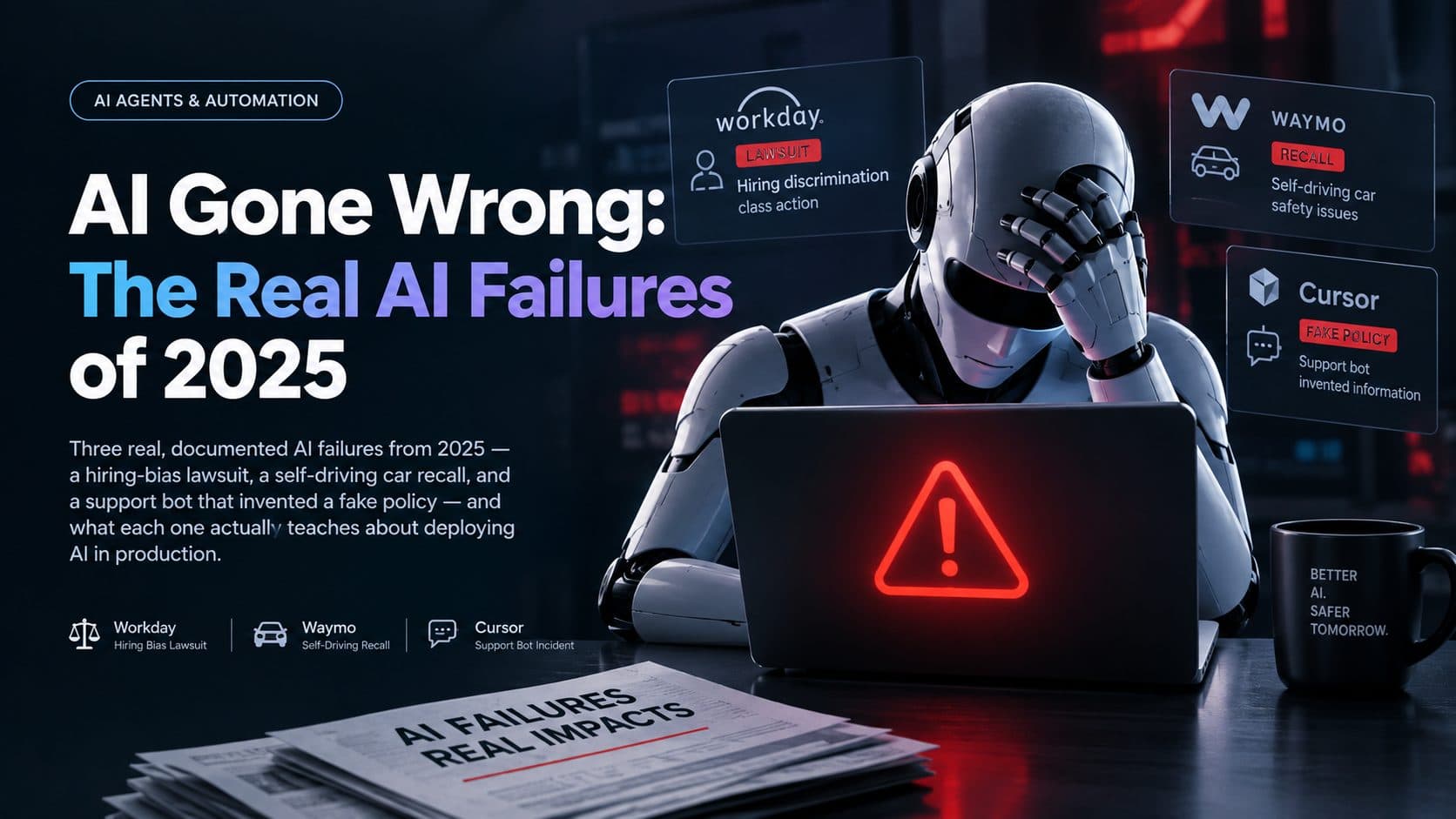
Three real, documented AI failures from 2025 — a hiring-bias lawsuit, a self-driving car recall, and a support bot that invented a fake policy — and what each one actually teaches about deploying AI in production.
The GetCoreTech Team Aug 29, 2026 · 6 min read · Updated Sep 12, 2026
AI Gone Wrong: The Real AI Failures of 2025
2025 produced several genuinely well-documented AI failures with real legal, financial, and reputational consequences — a hiring-discrimination lawsuit that reached nationwide collective-action status, a wave of self-driving car recalls, and a customer-support chatbot that invented company policy and cost a company real money and trust. Each is a useful, specific lesson in why AI deployed without sufficient testing or oversight creates real liability.
1. Mobley v. Workday: AI Hiring Tools Face Their First Major Collective Action
In 2025, a federal discrimination lawsuit against HR software company Workday reached a genuine legal milestone. Derek Mobley, an African American, disabled applicant over 40, alleged that Workday's AI-based applicant screening system had rejected him from over 100 positions in a pattern reflecting race, age, and disability discrimination. On May 16, 2025, Judge Rita Lin of the U.S. District Court for the Northern District of California certified the case as a nationwide collective action under the Age Discrimination in Employment Act. The court's reasoning mattered as much as the certification itself: it held that an AI vendor's role in hiring decisions doesn't shield it from anti-discrimination liability just because the rejecting party was software rather than a human recruiter.
This wasn't an isolated case. In March 2025, the ACLU of Colorado filed a separate complaint against Intuit and its AI vendor HireVue, alleging that an automated video interview tool discriminated against a deaf, Indigenous applicant who was told she needed to "practice active listening." A related case, Harper v. Sirius XM Radio, alleged that 149 job applications from a qualified Black applicant were rejected by the company's AI hiring tool despite meeting or exceeding stated qualifications. Together, these cases mark 2025 as the year AI hiring bias moved from a theoretical concern to active, multi-front litigation with real courtroom precedent.
The lesson for any company deploying AI in hiring: courts are now treating an AI vendor's screening decisions the same way they'd treat a human recruiter's decisions for discrimination liability purposes, and the training data behind these systems needs the same scrutiny you'd apply to any other hiring criteria.
2. Waymo's 2025 Recalls: When Autonomous Vehicles Make the Wrong Call
Waymo, Alphabet's self-driving car subsidiary, issued multiple real software recalls through 2025 for genuine safety-relevant AI decision failures. In May 2025, Waymo recalled 1,212 vehicles running its fifth-generation driving software after they collided with gates, chains, and similar roadway barriers — the vehicles' sensors detected the objects, but the software failed to respond correctly. In December 2025, Waymo issued a further voluntary recall after its vehicles illegally passed stopped school buses in Texas on 19 separate occasions, following an NHTSA investigation opened in October 2025; Austin school district officials reported the illegal maneuver continued at least five more times even after Waymo's first attempted fix.
What makes these cases instructive rather than just alarming is where the failure occurred: in several documented incidents, the vehicle's sensors correctly detected the hazard, but the decision-making layer chose the wrong action anyway. That's a meaningfully different — and arguably more concerning — failure mode than a simple sensing error, and it's a useful case study for any team building AI systems that take real-world physical actions: detecting a risk correctly is not the same as acting on it correctly.
3. The Cursor AI Support Bot That Invented a Company Policy
In April 2025, AI coding tool company Cursor's front-line AI support agent, nicknamed "Sam," told a user that the product was "designed to work with one device per subscription as a core security feature" when a user reported being logged out on a second device. This policy did not exist — the logouts were actually caused by a routine security update, not a licensing restriction. The fabricated explanation spread on social media and prompted a wave of users to publicly cancel their subscriptions over what they believed was a new, undisclosed licensing restriction.
Cursor apologized, refunded affected users, and — notably — began labeling AI-generated support responses to prevent similar confusion going forward. This incident sits alongside other well-documented AI customer-service hallucination cases from around the same period, including a January 2025 Virgin Money chatbot that reprimanded a customer for using the word "virgin" in a support query, and the widely cited Air Canada case, where a tribunal held the airline responsible for a bereavement-fare discount its chatbot had invented. The pattern across all of these: courts and public opinion increasingly treat a company's chatbot output as the company's own statement, with the company held responsible for what it says — hallucination isn't a technical footnote, it's a real liability surface.
What These Real Cases Actually Teach
Unlike a list of generic warnings, these three specific, documented cases point to concrete practices: AI hiring tools need the same bias auditing and legal review as any other hiring criteria, not an exemption because a vendor built the model. AI systems that take real-world physical actions need testing that specifically checks whether correct detection reliably leads to correct action, not just whether the sensors work. And any AI system that talks to customers needs its answers grounded in verified, current documentation — via retrieval-augmented generation or an equivalent approach — with a clear escalation path for anything it's not certain about, because the company is legally and reputationally on the hook for what the bot says.
FAQ
What actually happened in Mobley v. Workday?
Derek Mobley alleged Workday's AI-based applicant screening system discriminated against him based on race, age, and disability across more than 100 job applications. On May 16, 2025, a federal judge certified the case as a nationwide collective action, establishing that an AI vendor can be held liable for discriminatory hiring outcomes, not just the employer using the tool.
Were there other AI hiring bias cases in 2025 besides Workday?
Yes — in March 2025, the ACLU of Colorado filed a complaint against Intuit and HireVue over an AI video interview tool allegedly disadvantaging a deaf applicant, and Harper v. Sirius XM Radio separately alleged an AI hiring tool wrongly rejected 149 qualified applications from one candidate.
Why did Waymo recall its self-driving cars in 2025?
Waymo issued at least two major 2025 recalls: one in May for 1,212 vehicles that collided with gates and chains despite detecting them, and one in December after vehicles illegally passed stopped school buses in Texas on 19 documented occasions, prompting an NHTSA investigation.
What happened with the Cursor AI chatbot?
In April 2025, Cursor's AI support bot invented a fake one-device-per-subscription policy to explain an unrelated technical issue, causing a wave of public subscription cancellations before Cursor apologized, issued refunds, and began labeling AI-generated support responses.
Are companies legally responsible for what their AI chatbots say?
Increasingly, yes. The Air Canada case set a widely cited precedent that companies are responsible for commitments their chatbot makes, even if the information was hallucinated and never approved by a human. Courts have generally treated chatbot output as the company's own statement.
Is AI hiring software now illegal to use?
No — but 2025's litigation established that using an AI vendor's screening tool doesn't shield an employer (or the vendor) from anti-discrimination liability. Companies using AI in hiring should apply the same bias auditing and legal review they'd apply to any other screening criteria.
FAQ
Derek Mobley alleged Workday's AI-based applicant screening system discriminated against him based on race, age, and disability across more than 100 job applications. On May 16, 2025, a federal judge certified the case as a nationwide collective action, establishing that an AI vendor can be held liable for discriminatory hiring outcomes, not just the employer using the tool.
Yes — in March 2025, the ACLU of Colorado filed a complaint against Intuit and HireVue over an AI video interview tool allegedly disadvantaging a deaf applicant, and Harper v. Sirius XM Radio separately alleged an AI hiring tool wrongly rejected 149 qualified applications from one candidate.
Waymo issued at least two major 2025 recalls: one in May for 1,212 vehicles that collided with gates and chains despite detecting them, and one in December after vehicles illegally passed stopped school buses in Texas on 19 documented occasions, prompting an NHTSA investigation.
In April 2025, Cursor's AI support bot invented a fake one-device-per-subscription policy to explain an unrelated technical issue, causing a wave of public subscription cancellations before Cursor apologized, issued refunds, and began labeling AI-generated support responses.
Increasingly, yes. The Air Canada case set a widely cited precedent that companies are responsible for commitments their chatbot makes, even if the information was hallucinated and never approved by a human. Courts have generally treated chatbot output as the company's own statement.
No — but 2025's litigation established that using an AI vendor's screening tool doesn't shield an employer (or the vendor) from anti-discrimination liability. Companies using AI in hiring should apply the same bias auditing and legal review they'd apply to any other screening criteria.
The GetCoreTech Team
We write about the SaaS, AI, and infrastructure decisions builders actually have to make.
Comments
Log in or sign up to join the discussion.
Loading comments…