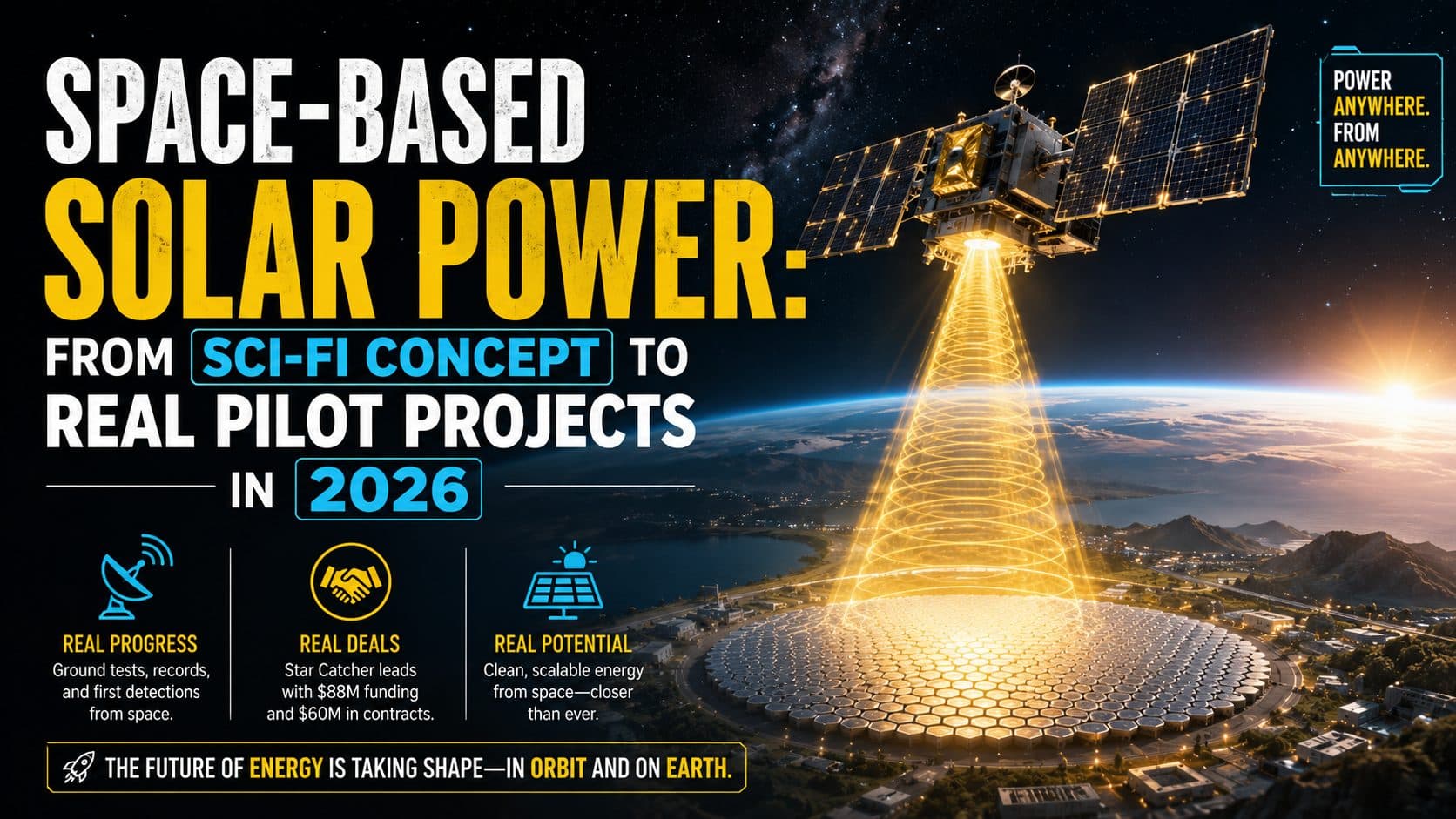
The space solar pilot furthest along in 2026 isn't the one beaming power to Earth. Star Catcher Industries closed a $65 million Series A in May to build a constellation that beams power between satellites, backed by $60 million in already-signed contracts — while the marquee Earth-facing demonstrations from China and Japan remain, respectively, a ground-based test and a satellite that hasn't left the launch pad yet.
The headline projects haven't actually reached orbit
China's "Zhuri" (Sun Chasing) project, run out of Xidian University, produced the most-covered space solar milestone of the year. In May, the team reported it had wirelessly transmitted 1,180 watts of power over 100 meters at a direct-current-to-direct-current efficiency of 20.8%, according to Xinhua and confirmed by the South China Morning Post. A drone flying at 30 kilometers per hour also received 143 watts from 30 meters away. It's a real engineering result. It's also a test conducted entirely on the ground, at a 75-meter tower in Xi'an — not a satellite, not an orbit, not a beam that's crossed any atmosphere. Japan's OHISAMA project is closer to the sci-fi image people actually have in mind: a 180-kilogram satellite in low Earth orbit converting sunlight to microwaves and beaming roughly 1 kilowatt down to a 13-antenna receiving station in Suwa. Japan Space Systems, funded by the Ministry of Economy, Trade and Industry, has been promising a launch "later this year" since mid-2025. A progress-status paper the project team submitted to the International Astronautical Congress this year still describes hardware "under development," with no confirmed launch date as of this writing. The satellite that would make Japan the first country to deliver usable orbit-to-ground electricity hasn't flown. Caltech got there first, in a much smaller way. In 2023, its SSPD-1 demonstrator used an array called MAPLE to detect a microwave signal beamed from orbit to a receiver on a campus rooftop — the first time power had ever been transmitted from space, aimed at Earth, and detected. Project lead Ali Hajimiri was direct about the scale: "the level of energy, of course, is very small at this point," he told Caltech Magazine. Three years later, nobody has meaningfully exceeded it in an actual space-to-ground demonstration. Smaller private players tell the same story from a different angle. TerraSpark, a Luxembourg startup founded in 2025, closed a €5 million pre-seed round in March and partnered with DCUBED for a planned orbital deployment mission — a real step, but still a funding announcement and a hardware partnership, not a satellite in the sky delivering power anywhere.The pilot that's actually raising money and signing contracts
Star Catcher skips the hardest part of the classic vision entirely. Instead of beaming power through the atmosphere to a ground receiver, it beams concentrated sunlight to other satellites' existing solar panels, in orbit, with no atmospheric loss and no need to avoid aircraft or populated areas. SpaceNews reported the company's May round — led by B Capital with Shield Capital and Cerberus Ventures — brought total funding to $88 million, on top of $60 million in signed power-delivery contracts and a pipeline the company puts at $3 billion in prospective annual revenue. It had already delivered 1.1 kilowatts across 100 meters in a 2025 ground test at Kennedy Space Center, breaking a prior record set by DARPA. A first in-space demonstration is planned before the end of 2026. Retired Gen. John "Jay" Raymond, the first Chief of Space Operations of the U.S. Space Force, joined Star Catcher's board alongside the round. That's not a detail about clean energy. It's a signal about who the paying customer actually is — and it lines up with Star Catcher's own list of early targets: orbital data centers, direct-to-device communications satellites, and synthetic aperture radar imaging spacecraft, all power-hungry, all already in orbit, none of them waiting on a receiving station on Earth.Why this is the pilot that's ahead, not a coincidence
Satellite-to-satellite power delivery solves an easier problem than powering a city. There's no beam-safety case to make to a regulator about microwaves crossing populated airspace. There's no multi-kilometer rectenna field to site and build. The customer's hardware — a standard satellite solar panel — already exists; Star Catcher's pitch is that it works with equipment already in orbit, without modification. Earth-beaming SBSP has none of those shortcuts. Every serious proposal for it still requires ground receiving stations spanning kilometers, beam-control precision fine enough to track a target moving at orbital velocity, and enough launch mass in orbit to matter at grid scale — the kind of scale where ESA's own 2022–2023 cost studies estimated a positive business case only after 54 gigawatt-class satellites were built. ESA's SOLARIS program, funded specifically to bring Europe to a go/no-go decision on that kind of build-out, has spent three years on concept studies and technology development rather than hardware.None of this means the concept is dead. It means 2026's actual pilots are quietly redefining what "space-based solar power" means in practice.
Comments
Log in or sign up to join the discussion.
Loading comments…