Bioprinted Organs in 2026: Tissue Yes, Kidneys Not Yet
Bioprinted ears, skin, and cartilage are in patients or trials. Whole vascularized organs are still stuck behind the oxygen-diffusion limit, and the closest lab-made kidney is a gene-edited pig organ.
GetCoreTech Staff Oct 3, 2026 · 6 min read · Updated Oct 18, 2026
Bioprinted tissue is already in patients in 2026 — but only the kind that doesn't need its own blood supply. A 3D-printed ear has been in a clinical trial since 2021, and printed skin and cartilage are past the lab-demo stage. Whole vascularized organs, the kidneys and livers people are actually dying waiting for, are still blocked by the same oxygen-diffusion limit that's stalled the field for over a decade — and the technology currently closest to putting a lab-made kidney into a patient isn't bioprinting at all.
The shortage bioprinting was supposed to fix
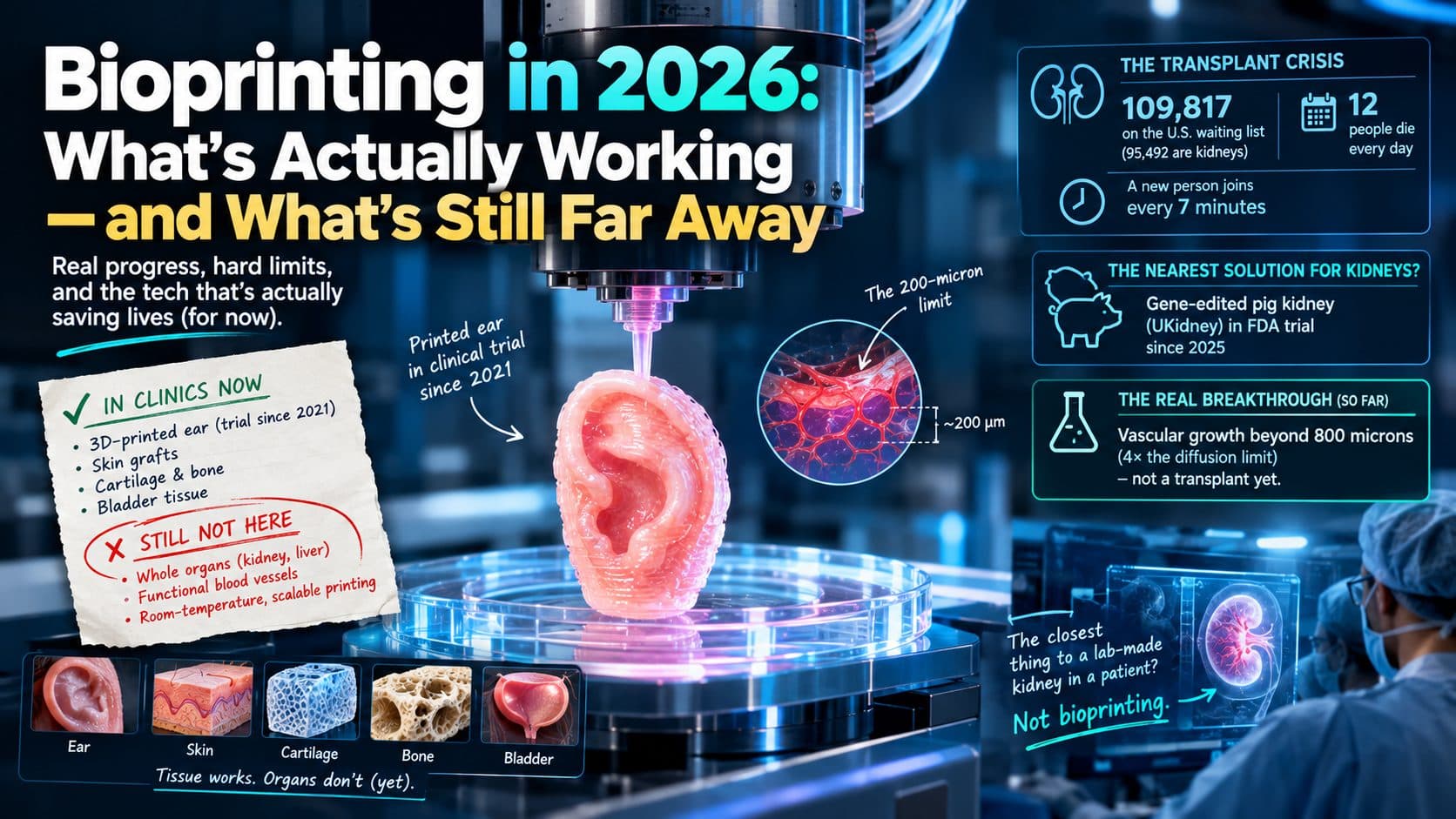
As of July 30, 2026, 109,817 people are on the U.S. transplant waiting list, and kidneys account for the overwhelming majority of that number at 95,492, according to OPTN data published on organdonor.gov. Twelve people on that list die every day. More than 49,000 transplants happened in 2025 — a record year — and the list still grew, because someone new joins roughly every seven minutes.
That gap is the entire pitch behind bioprinted organs: print a kidney on demand from a patient's own cells, skip the donor line and the rejection risk entirely.
It's a good pitch.
It's also not what's happening in clinics right now.
What's actually cleared for patients: tissue without a pulse
3DBio Therapeutics has been running a Phase 1/2a trial of AuriNovo, a bioprinted living-tissue ear implant, since 2021, enrolling 11 patients with microtia across sites in Los Angeles and San Antonio, with follow-up continuing through 2028. The implant is built from the patient's own auricular cartilage cells, 3D-scanned to match the existing ear and printed on the company's proprietary GMPrint hardware.
It works because cartilage doesn't need blood vessels.
That's the pattern across every bioprinted product that's made it into or through a real clinical trial: skin grafts, cartilage, bone, bladder tissue going back to Anthony Atala's work at Wake Forest in the early 2000s. Avascular or thin-diffusion tissue is printable and implantable today. A kidney is neither.
The 200-micron wall
Cells more than roughly 200 micrometers from a blood supply start dying from lack of oxygen — a hard biophysical limit, not an engineering preference. It's the reason a printed ear works at ear scale and a printed kidney doesn't, and it's the same number tissue engineers have been citing as the central obstacle to organ-scale bioprinting for more than a decade, according to a 2026 patent and literature landscape review from PatSnap covering the field.
The downstream numbers are just as blunt. A 2026 review in PMC on bioprinting for organ transplantation found that bioink performance varies by 15% to 30% between batches, undermining the reproducibility a clinical product needs, and that fewer than 5% of laboratory bioprinting innovations have advanced to human trials at all. Most reported organ-level work — bioprinted liver mini-tissues, kidney organoid arrays — sits at proof-of-concept, demonstrating that a structure can be built, not that it can survive and function inside a person.
The closest thing to a 2026 breakthrough
Researchers at University Medical Center Utrecht, working in Riccardo Levato's group, presented volumetric bioprinting results this year showing vascular outgrowth extending past 800 microns — four times the diffusion limit that's constrained the field. The method embeds porosity directly into the bioink formulation and uses light intensity, rather than pre-designed channels or surgical intervention, to control how the vasculature forms, letting it grow from within the printed material instead of being built in as plumbing.
It's a real result. It is not a transplant, a trial, or a timeline. Clinical translation of the approach remains, in the field's own framing, its most unanswered question — the gap between a vessel growing 800 microns in a dish and a kidney surviving inside a body is still the entire distance bioprinting has left to travel.
The organ that's actually in patients isn't bioprinted
While that gap stays open, a different technology has already put a living, whole replacement kidney into a human patient. United Therapeutics received FDA clearance in February 2025 to begin the first clinical trial of its gene-edited pig kidney, UKidney, and the first surgery in that trial was performed at NYU Langone Health in November 2025. Six patients with end-stage renal disease make up the initial cohort, and the trial is structured as a combined phase 1/2/3 study aimed at supporting an eventual Biologics License Application.
That's xenotransplantation, not tissue engineering — a genetically modified pig organ, not a printed one. But it's worth being precise about what "close" means in 2026: the nearest thing to solving the kidney shortage with a lab-produced whole organ is currently running through an FDA trial with real patients, and it got there by editing a pig's genome, not by printing cells layer by layer.
Bioprinted organoids have their own separate, more modest win. Patient-derived tumor organoids used for drug-sensitivity testing are the most clinically validated bioprinted application that exists today, with prospective studies backing their predictive value in specific cancers — irinotecan-based metastatic colorectal cancer and locally advanced rectal cancer chemoradiation, according to a 2026 review in PMC. That's a diagnostic tool, not a transplant. It's real, it's in use, and it's a different achievement entirely from growing a replacement organ.
So the honest 2026 answer splits three ways. Structural, avascular bioprinted tissue: in trials now, years from broad approval. Vascularized whole organs from a bioprinter: still preclinical, with the core physics problem only recently cracked in a lab dish. Whole-organ replacement via a non-bioprinted route: already in patients. None of those three timelines are the same technology, and conflating them is exactly the hype the shortage numbers don't have room for.
FAQ
Has any bioprinted organ actually been transplanted into a human patient?
Not a vascularized whole organ. What's in trials is structural or avascular tissue — 3DBio's bioprinted ear implant has been in a Phase 1/2a trial since 2021 with 11 patients enrolled. Kidneys, livers, and hearts printed from a patient's own cells have not reached human trials.
Why can't bioprinters just print a kidney the same way they print an ear?
Cells more than about 200 micrometers from a blood supply die from lack of oxygen. Cartilage and skin are thin enough to survive on diffusion alone; a kidney's tissue mass isn't, so it needs a functioning internal vascular network before it can be implanted — and building one that survives transplantation is still an unsolved problem.
What's the most promising vascularization research right now?
A 2026 volumetric bioprinting approach from University Medical Center Utrecht extended vascular outgrowth past 800 microns, four times the diffusion limit, by embedding porosity into the bioink itself rather than printing pre-designed channels. It hasn't been tested in a clinical setting.
If bioprinted organs aren't ready, is anything actually solving the organ shortage today?
Gene-edited pig organs are furthest along. United Therapeutics' UKidney trial performed its first transplant surgery at NYU Langone Health in November 2025, using a combined phase 1/2/3 design intended to support eventual FDA approval — years ahead of any bioprinted whole organ.
Are bioprinted organoids used in medicine today at all?
Yes, but not as transplants. Patient-derived tumor organoids are used for drug-sensitivity testing, and it's the most clinically validated bioprinted application that exists, with prospective evidence supporting its use in specific colorectal cancer treatment decisions.
FAQ
Not a vascularized whole organ. What's in trials is structural or avascular tissue, such as 3DBio's bioprinted ear implant, which has been in a Phase 1/2a trial since 2021 with 11 patients enrolled. Kidneys, livers, and hearts printed from a patient's own cells have not reached human trials.
Cells more than about 200 micrometers from a blood supply die from lack of oxygen. Cartilage and skin are thin enough to survive on diffusion alone, but a kidney's tissue mass isn't, so it needs a functioning internal vascular network before it can be implanted, and building one that survives transplantation is still an unsolved problem.
A 2026 volumetric bioprinting approach from University Medical Center Utrecht extended vascular outgrowth past 800 microns, four times the diffusion limit, by embedding porosity into the bioink itself rather than printing pre-designed channels. It hasn't been tested in a clinical setting.
Gene-edited pig organs are furthest along. United Therapeutics' UKidney trial performed its first transplant surgery at NYU Langone Health in November 2025, using a combined phase 1/2/3 design intended to support eventual FDA approval, years ahead of any bioprinted whole organ.
Yes, but not as transplants. Patient-derived tumor organoids are used for drug-sensitivity testing, and it is the most clinically validated bioprinted application that exists, with prospective evidence supporting its use in specific colorectal cancer treatment decisions.
GetCoreTech Staff
We write about the SaaS, AI, and infrastructure decisions builders actually have to make.
Comments
Log in or sign up to join the discussion.
Loading comments…