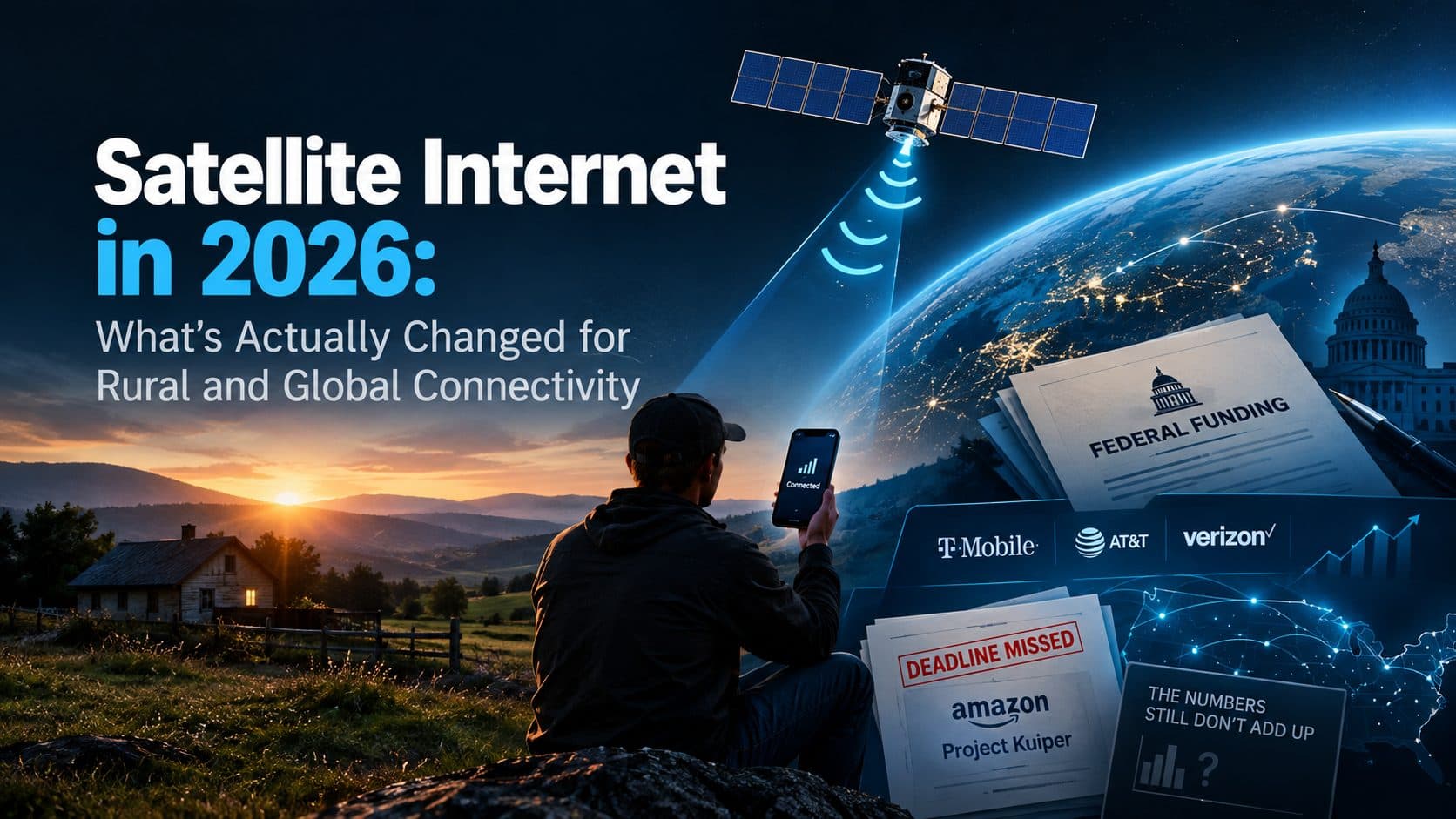
Amazon's satellite-internet arm just missed a binding federal deadline and lost spectrum priority as the penalty. US states are steering hundreds of millions of rural-broadband dollars toward satellite even though the latest Ookla data shows fewer than half of Starlink's own US customers hit the speed threshold that money requires. India's largest still-unclaimed satellite market remains stuck behind a security review that has nothing to do with orbital mechanics. What changed in 2026 isn't how fast satellite internet got — it's how much money, law, and diplomacy now rides on a performance case that isn't fully proven yet.
Direct-to-cell reached real scale, but only for the easy problem
Satellite-to-phone service stopped being a demo this year. T-Mobile's T-Satellite, built on SpaceX's Direct to Cell satellites, launched commercially in July 2025 with text messaging and added data in October. By mid-2026 the network had more than 650 dedicated satellites in orbit, live across 22 countries, reaching an estimated 400 million people for about $10 a month on top of an existing plan. That's real infrastructure, not a pilot. It's also, so far, the easy half of the promise. Texting tolerates a few seconds of delay; a phone call or a video stream doesn't. SpaceX still describes full voice and data, indistinguishable from a normal cell tower, as a 2027 target, and the network needs roughly 840 direct-to-cell satellites to reach global coverage — it had a bit over 650 as of mid-2026. AT&T and Verizon customers, meanwhile, are still waiting on comparable service after the two carriers agreed in May to pool satellite partnerships and spectrum with T-Mobile, an arrangement that suggests satellite coverage is turning into a baseline carrier feature rather than a T-Mobile exclusive — eventually.Amazon's constellation missed its own federal deadline
Amazon's satellite unit, renamed from Project Kuiper to Amazon Leo in November 2025, was legally required to have half its 3,232-satellite constellation — 1,616 satellites — in orbit by July 30, 2026. It had launched 331. Amazon told the FCC in January that the shortfall wasn't a manufacturing problem: the company said it was "producing satellites considerably faster than others can launch them," pointing to concurrent scheduling slips across all three of its heavy-lift launch contracts — Ariane 6, New Glenn, and ULA's Vulcan Centaur — compounded by New Glenn's launchpad explosion in late May. The FCC granted a waiver rather than a flat extension on June 5, and the mechanism it chose has teeth: every Amazon Leo satellite launched after the July 30 deadline loses spectrum priority until Amazon either reaches the 1,616-satellite mark or hits October 30, 2027, whichever comes first. In practice, that means Amazon must now demonstrate its satellites won't interfere with other operators — chiefly SpaceX — on spectrum it no longer has first claim to. Amazon still frames 2026 as a launch year for the consumer product: CEO Andy Jassy's shareholder letter targeted mid-2026 commercial availability, and an enterprise beta opened in April with Verizon, AT&T, Vodafone, JetBlue, and NASA as partners. But the FCC's own order is explicit that Amazon fell short of its "American leadership in space" milestone, and the spectrum penalty is designed specifically to keep that from becoming a one-time slip — it doesn't lift until Amazon builds its way out of it.Governments are betting on satellite faster than the performance data justifies it
The clearest rural-connectivity shift in 2026 isn't technical at all — it's a change in how the US government defines an acceptable broadband connection. In March 2025 the Commerce Department rewrote the $42.5 billion BEAD program's rules to be "technology-neutral," opening the door for satellite to compete with fiber on cost rather than losing automatically on capability. States responded fast: as of late 2025, Starlink was slated to serve roughly 478,000 BEAD-funded locations for $660.6 million, and Amazon Leo about 415,000 locations for $302.4 million — together, close to $1 billion in federal subsidy aimed at satellite. Ohio alone awarded Starlink $51.6 million to cover 31,000 rural homes, calling satellite the cheaper, faster-to-deploy option over new fiber construction. BEAD's law still requires 100/20 Mbps service with low latency and less than 48 hours of outage per year. Ookla's own measurements, reported by the Daily Yonder, found that only 44.7% of US Starlink customers actually hit that 100/20 Mbps mark in the fourth quarter of 2025 — a real improvement from 17.4% a year earlier, but still short of a majority. States are committing federal dollars to a service that, on the government's own performance bar, works for less than half its current US customers. That gap doesn't necessarily mean the bet is wrong — Starlink's numbers were climbing fast, and a rural household with no broadband option at all may still come out ahead on a connection that clears the threshold half the time. But it does mean the policy is running ahead of the proof, not behind it, which is a different kind of risk than the one BEAD was originally built to manage.The world's largest unclaimed satellite market is stuck on security, not spectrum
India illustrates why "global connectivity" and "technology readiness" have stopped being the same question. Starlink received its telecom operating license in June 2025 and a five-year space-sector authorization from India's INSPACe in July 2025, valid through 2030 — clearing, on paper, its last regulatory hurdles after a fight that had run since 2022. Commercial service still hasn't launched. In June 2026, Bloomberg reported that India had effectively frozen further approvals over concerns that Starlink terminals had been used during the Iran war — a security objection with nothing to do with signal strength or spectrum allocation. Progress resumed slowly from there: Starlink reapplied in August for authorization to bring its 30,000-satellite Gen 2 network, including direct-to-device capability, into India, and on September 9 — six days before this article — India's Digital Communications Commission approved most of the telecom regulator's recommendations on satellite spectrum pricing, a step described in Indian press as bringing commercial launch "nearer" rather than confirming it. Four years, a signed operating license, and a paid-for constellation later, the largest population still outside Starlink's commercial reach is waiting on a security and spectrum-pricing process that has nothing to do with what the satellites can technically do.China's constellations are entering the same markets satellite internet was supposed to help
Guowang, run by the state-owned China SatNet, and Qianfan, a commercially oriented rival also known as Thousand Sails, both aim at roughly 13,000–15,000 satellites by 2030. Combined, they had somewhere around 350 to 380 satellites in orbit as of mid-2026 — a fraction of Starlink's fleet, and slowed further by a seven-month pause in 2025 after some Qianfan satellites suffered thruster and gyroscope failures.Deployment resumed in April 2026, and Qianfan isn't waiting for scale before selling. It has signed trial service agreements in Brazil, Malaysia, Kazakhstan, and Turkey, and is reportedly in discussions with roughly 30 countries, explicitly targeting Brazil as a first major international commercial market — the same underserved, geopolitically non-aligned regions Starlink has spent years courting. A dedicated Qianfan direct-to-cell test satellite launched in June 2026, putting China on the same satellite-to-phone track SpaceX and Amazon are racing on.
The contest over rural and global connectivity is no longer just Starlink against Amazon Leo. It's increasingly two American constellations and two Chinese ones, competing for the same population of people who currently have no broadband option at all — which turns a rural-access problem into a foreign-policy one in markets where the choice of provider comes with a choice of geopolitical alignment attached.
Comments
Log in or sign up to join the discussion.
Loading comments…