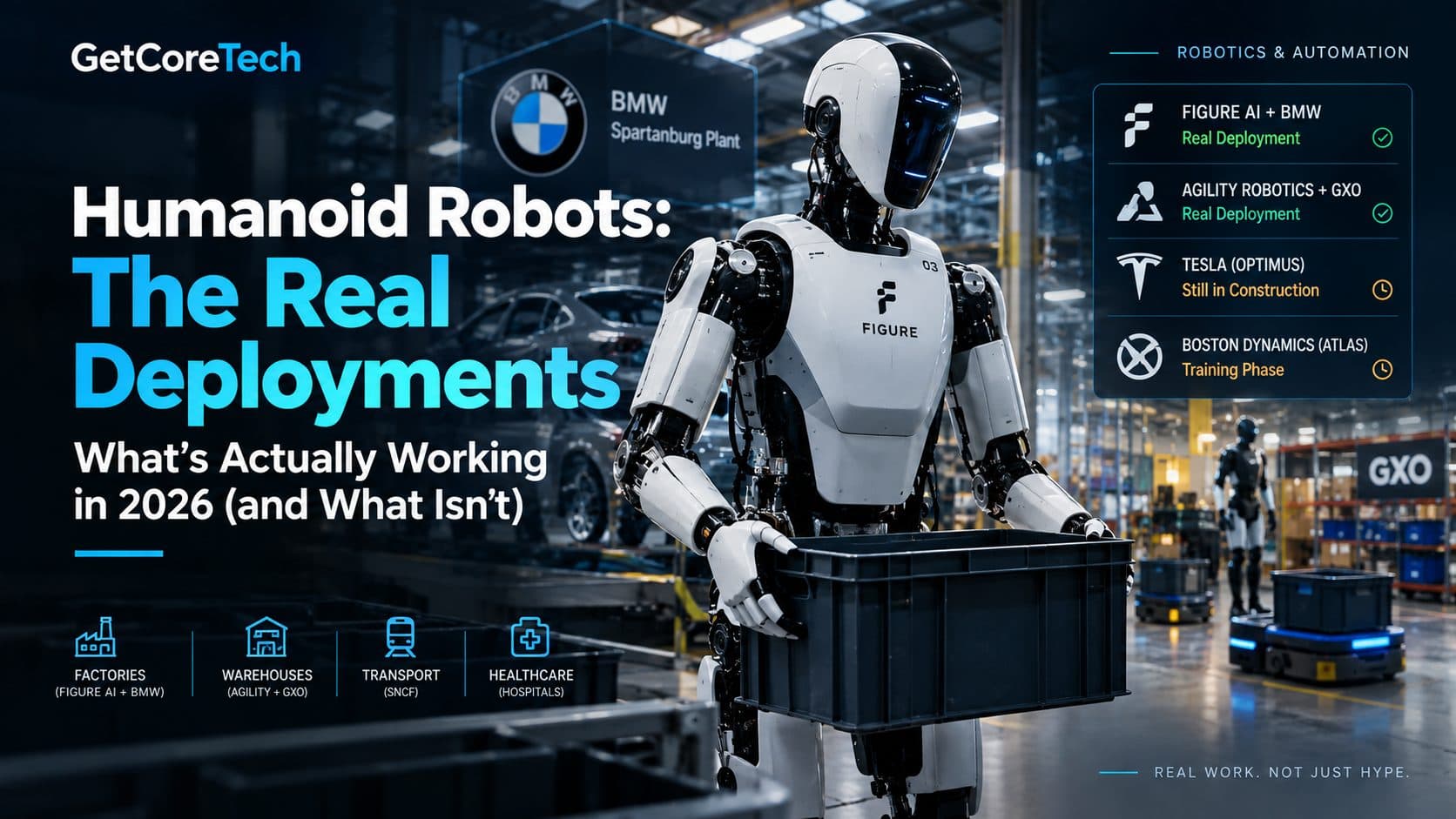
The humanoid robots doing sustained, measurable work on factory floors in 2026 are not the ones dominating headlines. Figure AI's units have moved more than 90,000 parts across an 11-month run at BMW's Spartanburg plant, and Agility Robotics' Digit has moved over 100,000 totes inside a single GXO warehouse — while Tesla's own SEC filings still list Optimus manufacturing capacity as "under construction," and Boston Dynamics' Atlas remains committed almost entirely to internal training ahead of a 2028 factory rollout. Real deployment has arrived, and it isn't happening where the attention is.
The Boring Robots Are the Ones Actually Working
BMW confirmed on June 25, 2026, that Figure AI's newer robot, Figure 03, was taking over a parts-sequencing job in the Spartanburg, South Carolina plant's logistics hall — picking components out of unsorted containers and sorting them into trolleys headed for the assembly line. That assignment followed an 11-month run by the earlier Figure 02, which loaded more than 90,000 sheet-metal parts across roughly 1,250 operating hours in the body shop, held a target cycle time of 84 seconds per part, and stayed above 99% placement accuracy per shift, according to figures BMW and Figure AI published jointly. The robots contributed to building more than 30,000 BMW X3s over that stretch. None of it replaced anyone — BMW moved Figure 03 to a new task instead of cutting body-shop headcount, and framed the whole run as proof the hardware could survive shift changes and model changeovers, not as a layoff plan. Agility Robotics' Digit has a similar track record with less automotive-industry name recognition attached to it. At GXO's SPANX fulfillment warehouse in Flowery Branch, Georgia, Digit has moved more than 100,000 totes since the companies signed a multi-year robots-as-a-service agreement in June 2024, pulling totes off autonomous mobile robots and stacking them onto conveyor belts through ordinary warehouse shifts. In November 2025, Digit became the first humanoid to pass an OSHA-recognized NRTL field safety audit at a live customer site — a regulatory checkbox that matters more for scaling than any demo video, since it's the kind of paperwork a warehouse operator actually needs before letting a robot work near people at volume. Toyota's Cambridge, Ontario plant ran a year-long Digit pilot unloading auto-parts totes onto its RAV4 line and is now expanding to seven or ten robots at that site. Mercado Libre signed on in December 2025 for its San Antonio fulfillment center, with Latin American sites planned next. None of these deployments involves more than a handful of robots working narrow, pre-defined tasks.Optimus and Atlas Are Still Mostly in Training
Tesla's most recent SEC filing tells a plainer story than any earnings-call soundbite. Its manufacturing-capacity table lists Model 3, Model Y, Cybertruck, and even the Cybercab as being in "Production" at specific annual capacities — and lists Optimus, at both the California and Texas sites, as still under "Construction." Elon Musk said in January 2026 that Optimus Gen 3 production had started at Fremont, and outside estimates of the internal fleet size that month ranged from roughly 300 to 1,000 units depending on the outlet. By Tesla's July 22 shareholder update, the company had decommissioned the Fremont Model S/X line to make room for a dedicated Optimus line, and said the first robots off it would spend their time in what it calls "Optimus Academy," collecting training data rather than doing productive factory work. Musk described early output as "quite slow" and the ramp rate as impossible to predict. Boston Dynamics' Atlas tells nearly the same story under a different logo. Hyundai, which owns roughly 80% of Boston Dynamics, announced at CES 2026 that its entire 2026 production run of the new, product-ready Atlas was already spoken for — split between Hyundai's own Robotics Metaplant Application Center in Georgia and a research fleet for Google DeepMind. Boston Dynamics has said additional customers won't come aboard until early 2027. Kia CEO Song Ho-sung confirmed separately that production-line deployment at Hyundai's actual car plant, Metaplant America in Savannah, doesn't start until 2028, with Kia's own Georgia plant following in 2029. In May 2026, Hyundai told investors it plans to eventually run more than 25,000 Atlas units across its own factories — a real commitment, but one aimed years out, not a count of robots on a line today. The 30,000-robots-a-year factory Hyundai keeps citing doesn't exist yet either — it's a planned facility, not current output.Unitree's Volume Lead Is a Different Kind of Deployment
By raw unit count, neither Figure nor Boston Dynamics nor Tesla is winning. Unitree's IPO prospectus put its 2025 humanoid shipments above 5,500 units, giving it roughly a third of a global market that CCID Media and China Electronics News estimated at about 17,000 units total. Unitree's G1 sells direct for $13,500, and that price explains most of the gap: the base G1 ships with no SDK access, meaning it can't run custom code or be reprogrammed for a specific job — it's a research and demonstration platform, not an industrial worker. Figure's and Agility's robots, by contrast, are leased to do one defined job repeatedly on an actual production floor. Counting Unitree's shipments alongside BMW's and GXO's live deployments treats two different products as one market. China's own targets point at a similar gap between commitment and completed work. In June 2026, the Ministry of Industry and Information Technology and the State-owned Assets Supervision and Administration Commission issued a joint directive ordering local governments and state-owned enterprises to put more than 10,000 commercial humanoid robots into use by the end of 2026, spanning manufacturing, logistics, retail, healthcare, and emergency response under what officials are calling a "Humanoid Robot-as-a-Service" model. Zhiyuan Robotics livestreamed one early result in April: its robots performing assembly-line work at a Longcheer Technology tablet factory. The directive is real and the target is specific, but it's a policy goal for the rest of the year, not a report on robots already working today.The First Strike Over Humanoid Robots
The clearest sign that deployment has stopped being theoretical is that it triggered a labor dispute. In July 2026, roughly 40,000 members of the Korean Metal Workers' Union at Hyundai staged a three-day partial walkout, downing tools for four hours per shift, demanding a written agreement that no robot enters a Hyundai plant without union sign-off first. The Wall Street Journal estimated the stoppage could cost around 5,000 cars and $135 million in lost revenue. Reporting described it as the first strike in the global auto industry triggered specifically by humanoid robot deployment plans, though Hyundai's separate wage and bonus talks were happening at the same time.
Hyundai disputes that framing. In a statement to Ars Technica on July 22, the company said robot deployment in Korean plants wasn't actually part of the labor talks, and that its only current commitment is the 2028 Atlas rollout at Metaplant America in Georgia — a US plant, not a Korean one. Whether that distinction holds up is beside the real point: a union representing tens of thousands of workers moved to lock in protections years before a single Atlas unit is scheduled to do a production job, which says as much about how seriously factory labor is taking these announcements as any deployment number does.
Comments
Log in or sign up to join the discussion.
Loading comments…