Low-Code in 2026: What It Can and Still Can't Replace
The $44.5 billion low-code figure is a 2023 Gartner forecast, not a 2026 finding. The real shift is analysts relabeling the category as AI-native tools compete for the same build-without-engineers budget.
GetCoreTech Staff Oct 3, 2026 · 8 min read
The $44.5 billion figure attached to nearly every "low-code in 2026" article circulating right now is a Gartner forecast published in May 2023, built on 2022 market data — not a 2026 finding, and most outlets citing it haven't checked. The real 2026 story, buried under that recycled number, is that Gartner has quietly started relabeling its own market category from "Enterprise Low-Code Application Platforms" to "AI-Augmented Low-Code Application Platforms" and stood up a separate "Enterprise Vibe Coding Platforms" category next to it — a sign the actual fight this year is about which tools own which slice of building software without hiring an engineer, not about market size.
A four-year-old prediction keeps getting republished as 2026 news
The $44.5 billion number traces back to a Gartner research note, "5 Low-Code Opportunities for Application Service Vendors," published in May 2023 and itself extrapolated from a December 2022 press release projecting the 2023 market at $26.9 billion, growing 19% annually through 2026. That's the entire chain. Nothing about it involved 2025 or 2026 data collection.
Dozens of "low-code statistics 2026" posts now cite that figure as though it were fresh, and they don't agree with each other on the surrounding details — one puts the market at $65 billion this year, another at $52 billion, another still recites the same $44.5 billion alongside a claim of 75% enterprise-app adoption that a different post attributes to a 70% figure from a different year's forecast. That's the tell of aggregator content copying a number forward without checking the source.
The forecast predates ChatGPT's enterprise rollout entirely.
That matters because the market it describes — visual builders competing on drag-and-drop speed — isn't the market that exists now. Two things have happened since 2023 that the recycled stat has nothing to say about: low-code platforms absorbed generative AI into their own build process, and a separate category of AI-native code generation tools showed up to compete for the same "build this without a full engineering team" budget from outside the low-code label entirely.
What actually shifted this year, according to people who looked
Forrester published "The AppGen And Low-Code Platforms Landscape, Q2 2026" in mid-2026, authored by Ken Parmelee with Chris Gardner, Kylie Cadogan, and Kara Hartig, evaluating 40 vendors across a market it now defines as platforms that use AI to generate applications, workflows, and agents for both professional and citizen developers. The report's central warning isn't about adoption — it's about what adoption is outrunning: "creation is outpacing control at scale," with application and agent sprawl growing faster than the governance, integration, and lifecycle tooling needed to manage it.
Gartner's own current market taxonomy backs that framing up in a smaller way. Its live category listing shows "Enterprise Low-Code Application Platforms" now annotated as "Transitioning to AI-Augmented Low-Code Application Platforms," with a distinct new "Enterprise Vibe Coding Platforms" category listed alongside it rather than folded in. An analyst firm doesn't rename a market category it's tracked for a decade unless it thinks the underlying thing changed.
Neither of those is a market-size claim. They're both claims about what the tools are for now, which is a more useful question than what the tools are worth.
What low-code still replaces cleanly
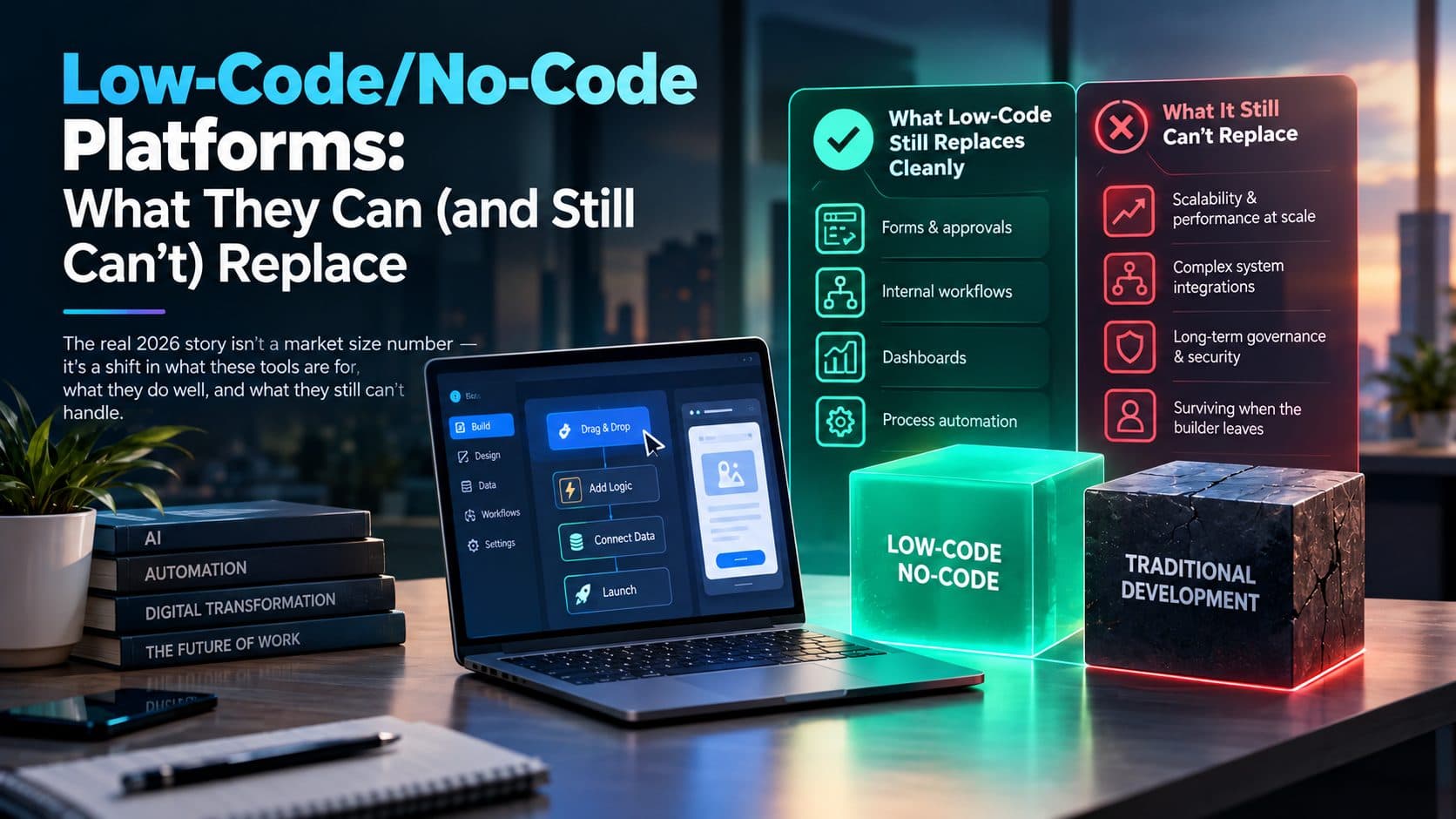
The use case that hasn't changed is departmental: forms, approval workflows, internal dashboards, and process automation built by someone who understands the business problem better than any engineer assigned to it would. KPMG's 2024 survey of 2,000 corporate decision-makers across EMEA, the US, and Asia-Pacific — still the largest study of its kind that current industry coverage leans on — found that 81% of surveyed companies consider low-code development strategically important, concentrated heavily in exactly this category of work rather than customer-facing or mission-critical systems.
That's a real, durable niche, and it's not shrinking. A citizen developer replacing a spreadsheet-and-email approval chain with a workflow app doesn't need architectural judgment, load-bearing performance, or anything an AI code-generation agent does meaningfully better — the visual builder's guardrails are a feature there, not a limitation, because they keep a non-engineer from making the kind of mistake that only shows up under production load.
Where that logic breaks is anything that has to scale unpredictably, integrate with more than a couple of systems, or survive the person who built it leaving the company.
The wall hasn't moved: governance, not capability
The specific complaint about low-code in 2020 — that it can't handle real business logic — has been substantially addressed by better platforms and now by AI-assisted generation inside them. The complaint that's stayed constant is governance. The same KPMG survey found that 73% of low-code planners, and 65% of active low-code users, had not defined governance rules for the applications they were building, even as those same companies rated the technology strategically important.
Forrester's Q2 2026 landscape doesn't cite that KPMG figure, but it lands on the identical structural point from newer data: distributed development removes engineering bottlenecks while dissolving the ownership boundaries that used to catch problems before they shipped. Two different research organizations, two years apart, measuring two different things, arriving at the same conclusion is a stronger signal than either study alone — it suggests the gap is structural to how citizen development works, not a symptom of any one platform generation.
The new pressure: AI-native code generation from the other side
Low-code's original pitch was speed without an engineering team. That pitch now has a direct competitor that wasn't in the picture when the pitch was written. Stack Overflow's 2026 Developer Survey found 84% of professional developers now use or plan to use AI coding tools, with 51% using them daily and named tools like Cursor and Claude Code appearing as everyday workflow choices rather than experiments — the same survey found trust in that output is falling even as usage rises, with 46% of respondents reporting distrust of AI-generated code's accuracy against 33% who trust it.
Here the sources genuinely disagree about what category this belongs in, and the disagreement is worth naming rather than smoothing over. Forrester's Q2 2026 AppGen and Low-Code Landscape treats AI-native generation as something converging into low-code platforms — application, workflow, and agent creation folding into one enterprise category. One quarter later, the same firm published a separate "Agentic Development Platforms Vendor Landscape, Q3 2026," explicitly distinguishing 25 tools that "use agentic AI to help teams build software" from natural-language low-code builders, on the grounds that differentiation is shifting toward orchestration and enterprise context rather than raw code generation. Forrester's own analysts split the market into two landscapes a quarter apart, which is a more honest signal than either report choosing a side — the boundary is unsettled because the tools themselves are still sorting out which problems they're actually solving.
What can and can't be replaced, plainly
Low-code reliably replaces the work it was built for: internal tools, workflow automation, and departmental applications where the builder's domain knowledge matters more than software engineering skill. It does not reliably replace anything that needs to scale unpredictably, integrate deeply across systems, or survive without the governance layer most companies still haven't built — that gap is now well-documented across two research cycles, not a hypothetical risk.
What's changed since the $44.5 billion forecast was written isn't the size of that gap. It's that low-code no longer has the "fast, custom software without an engineer" niche to itself, and the analysts covering the category are visibly still figuring out where the new boundary sits.
FAQ
Is the $44.5 billion low-code market figure accurate for 2026?
It's a real Gartner number, but it comes from a May 2023 research note built on 2022 market data, not from any 2026 measurement. Most articles citing it as current news are republishing a stale forecast rather than reporting new research, and the wide disagreement across "2026 statistics" roundups on adjacent figures — some citing $65 billion, others $52 billion — is a symptom of that.
What's the difference between low-code, AppGen, and "vibe coding" platforms?
Low-code refers to visual builders with some coding extension points; Forrester's newer "AppGen" category groups platforms that use AI to generate applications, workflows, and agents together; Gartner's "Enterprise Vibe Coding Platforms" is a separate, newer category for natural-language, AI-driven app generation. Even the analyst firms tracking these markets haven't settled on where the boundaries between them sit — Forrester itself split AI-native code generation into its own separate landscape report one quarter after treating it as part of the AppGen and low-code category.
What can low-code platforms reliably replace?
Departmental workflow apps, approval processes, forms, and internal automation — work where the builder's business knowledge matters more than engineering skill. KPMG's 2024 survey of 2,000 corporate decision-makers found 81% consider low-code strategically important, concentrated in this kind of internal, non-mission-critical work.
What can't low-code replace?
Systems that need to scale unpredictably, integrate deeply across platforms, or operate without a governance layer. KPMG found 73% of low-code planners hadn't defined governance rules for what they were building; Forrester's Q2 2026 AppGen and Low-Code Platforms Landscape found the same structural gap in newer data, describing application sprawl as growing faster than the oversight needed to manage it.
Is AI-native code generation going to replace low-code platforms?
It's actively competing for the same "build custom software fast without a full engineering team" use case that used to belong to low-code alone. Stack Overflow's 2026 Developer Survey found 84% of developers now use or plan to use AI coding tools, though trust in the output is falling as usage rises — 46% report distrust of accuracy versus 33% who trust it — so the competition is real but the tools aren't yet fully proven either.
FAQ
It is a real Gartner number, but it comes from a May 2023 research note built on 2022 market data, not from any 2026 measurement. Most articles citing it as current news are republishing a stale forecast, and the wide disagreement across "2026 statistics" roundups on adjacent figures, with some citing $65 billion and others $52 billion, is a symptom of that.
Low-code refers to visual builders with some coding extension points. Forrester's newer "AppGen" category groups platforms that use AI to generate applications, workflows, and agents together, while Gartner's "Enterprise Vibe Coding Platforms" is a separate, newer category for natural-language, AI-driven app generation. Even the analyst firms haven't settled where the boundaries sit, since Forrester split AI-native code generation into its own landscape report one quarter after treating it as part of AppGen and low-code.
Departmental workflow apps, approval processes, forms, and internal automation, where the builder's business knowledge matters more than engineering skill. KPMG's 2024 survey of 2,000 corporate decision-makers found 81% consider low-code strategically important, concentrated in this kind of internal, non-mission-critical work.
Systems that need to scale unpredictably, integrate deeply across platforms, or operate without a governance layer. KPMG found 73% of low-code planners hadn't defined governance rules for what they were building, and Forrester's Q2 2026 landscape describes application sprawl growing faster than the oversight needed to manage it.
It is actively competing for the same "build custom software fast without a full engineering team" use case that used to belong to low-code alone. Stack Overflow's 2026 Developer Survey found 84% of developers use or plan to use AI coding tools, though trust in the output is falling as usage rises, with 46% reporting distrust of accuracy versus 33% who trust it.
GetCoreTech Staff
We write about the SaaS, AI, and infrastructure decisions builders actually have to make.
Comments
Log in or sign up to join the discussion.
Loading comments…