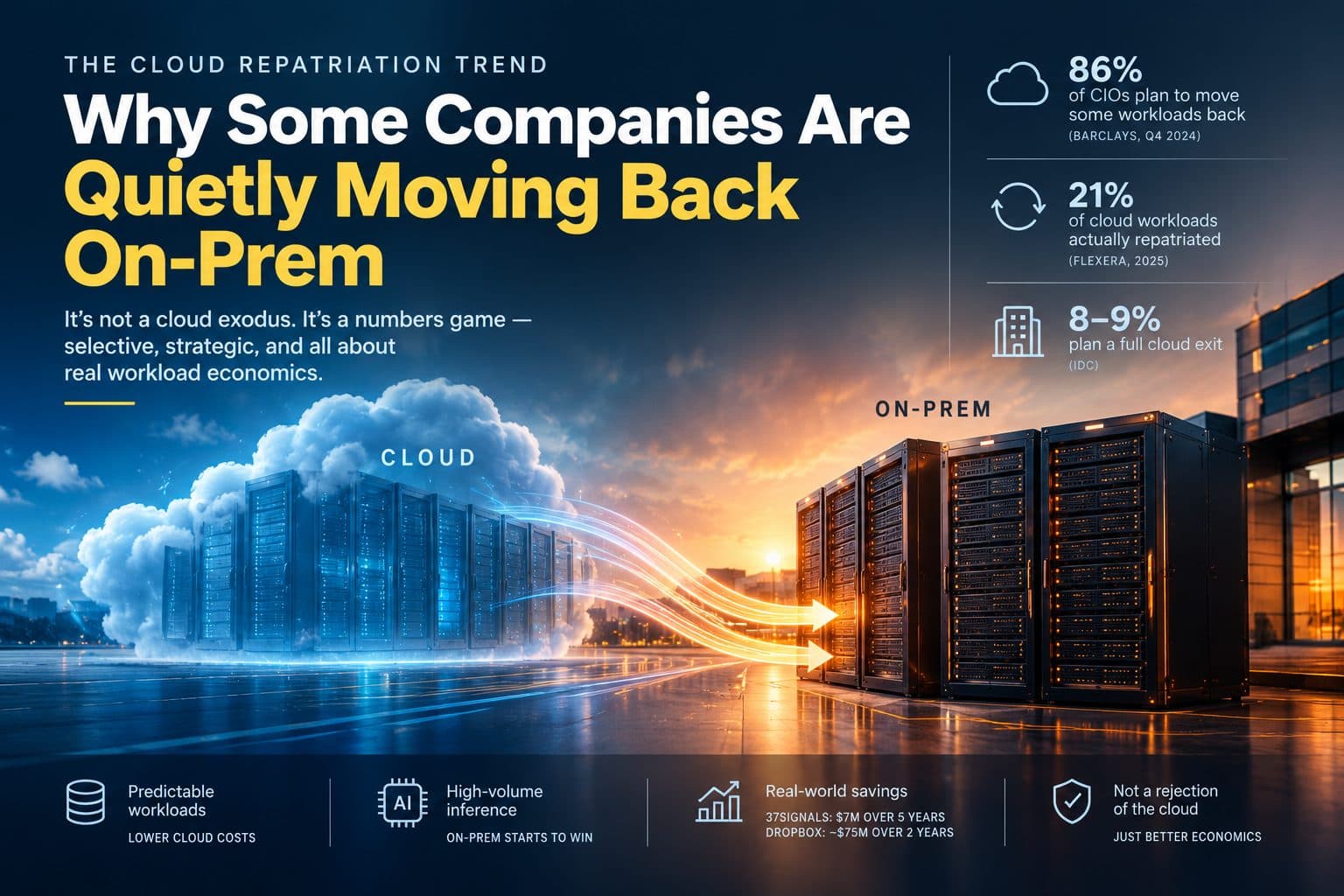
The Cloud Repatriation Trend: Why Some Companies Are Quietly Moving Back On-Prem
The industry's favorite repatriation statistic — that 86% of CIOs are pulling workloads back from the cloud — doesn't mean what most coverage says it means. Barclays' Q4 2024 CIO survey found 86% of respondents planned to move some workloads back to private cloud or on-premises infrastructure, the highest rate the firm has ever recorded — but that number counts a company moving a single database the same as one exiting the cloud entirely. The real trend is narrower, quieter, and about specific workload economics — not a cloud exodus.The stat everyone cites, and what it actually measures
Start with what companies report having actually moved, not what they say they're considering. Flexera's 2025 State of the Cloud Report, based on responses from 759 cloud decision-makers, found that only 21% of cloud workloads and data have been repatriated to date. Even that figure comes with a catch: the report notes that while roughly a fifth of workloads moved back on-premises over the past year, the overall footprint of workloads running in the cloud still grew. Repatriation is happening, but it's a leak in a bucket that's still filling faster than it's draining. The gap between "planning to move something" and "actually moved a meaningful share of infrastructure" is where most of the misleading headlines live. IDC's research puts the share of enterprises planning a full workload exit at just 8% to 9%, with the large majority instead pursuing selective redistribution between cloud and on-premises. Meanwhile the market those companies are supposedly fleeing keeps expanding: Gartner forecast worldwide end-user spending on public cloud services would hit $723.4 billion in 2025, up from $595.7 billion in 2024, with cloud infrastructure and platform spending specifically on pace for 24.2% growth to $301 billion. That's not the spending pattern of a market in retreat.Where the real movement is happening
None of this means repatriation is fake. It means it's concentrated in one category of workload: predictable, steady-state compute that doesn't benefit from elastic pricing, and increasingly, AI inference running at a high enough volume that per-instance cloud pricing stops making sense. The clearest public numbers still come from 37signals, the company behind Basecamp and HEY, because most companies making this move won't put a dollar figure on it. 37signals spent $600,000 on servers and expects to save $7 million over five years compared to staying on AWS, with annual infrastructure costs dropping from $2.3 million to $840,000. Dropbox's move is older but larger in scale — the company shifted infrastructure off AWS and saved close to $75 million over two years, while keeping some workloads in the cloud rather than exiting completely. Neither company treated this as an ideological rejection of cloud computing. Both treated it as a spreadsheet problem: workloads running at consistent, high utilization stop benefiting from pay-as-you-go pricing, and the premium you're paying for elasticity you're not using becomes visible. AI workloads are pushing the same math further. Continuous GPU inference at scale can cost well into six figures a year on a single reserved cloud instance, and vendors selling on-prem GPU hardware now advertise payback periods measured in months for customers running inference constantly rather than in bursts. The threshold isn't universal. Bursty, unpredictable AI workloads still belong in the cloud, where you only pay for what you use — it's the always-on, high-volume workloads where the on-prem math starts to win.Why so few companies talk about it
Here's a detail worth sitting with: nearly every trend piece written about this shift over the past two years cites the same two examples — 37signals and Dropbox. For a supposedly mainstream movement, that's a strikingly short list of named companies willing to put numbers behind it. The obvious explanation is that most companies doing this aren't publishing case studies. That has a straightforward business logic behind it. A company still running the bulk of its infrastructure on AWS or Azure has every reason to keep its remaining cloud footprint looking as large as possible in a vendor's eyes — the discounts and committed-use pricing already negotiated depend on being read as a growing account, not a shrinking one. Publicly detailing a repatriation project undercuts that position on every other workload still left in the cloud. There's a reputational angle too. A public repatriation announcement can read, to a board or in the press, as an admission that an earlier all-in cloud migration was the wrong call — expensive to have made and awkward to reverse in public. 37signals could talk about it loudly partly because its leadership had already built a public identity around being contrarian about cloud costs. Most procurement teams have no equivalent incentive to volunteer that story, and plenty of reasons not to.What this settles into
The destination for most of this isn't a server closet down the hall. Modern repatriation more often lands on lower-cost cloud providers, colocation facilities, or hybrid setups that combine several infrastructure sources, not a full return to traditional in-house data centers. Gartner's own projection is that 90% of organizations will have adopted a hybrid infrastructure model by 2027 — arguably the more honest name for where this is heading. Not cloud-first, and not on-prem-first, but a workload-by-workload decision made quietly, on a spreadsheet, and rarely announced.
Read the 86% figure and its relatives for what they actually measure: intent to move something, which is a far lower bar than a reversal of cloud-first strategy. The companies making real moves are doing it selectively, for specific workloads, on specific math — and mostly not telling anyone until a CTO with nothing to lose decides to publish the invoice.
Comments
Log in or sign up to join the discussion.
Loading comments…