The ad tech case followed the same script, just more recently. Judge Leonie Brinkema of the Eastern District of Virginia had already found in April 2025 that Google illegally tied its publisher ad server (DoubleClick for Publishers) to its AdX exchange. On September 2, 2026 — just days before this article was written — she issued her remedies order, and it was unambiguous on the core question: the divestiture of AdX, the open-sourcing of DFP's final auction logic, and the contingent divestiture of what's called "DFP Remainder" were all "REJECTED," in the court's own capitalization, according to the order reviewed by PPC Land and Concurrences. Brinkema accepted most of the parties' proposed behavioral remedies instead, though the specifics remain sealed while the parties negotiate redactions; a jointly proposed final judgment is due by October 2, 2026. Google, unsurprisingly, called it a win. Its VP of regulatory affairs, Lee-Anne Mulholland, told TechCrunch the company was "very pleased the Court rejected the DOJ's proposal to break apart tools that help small businesses reach new customers and grow."
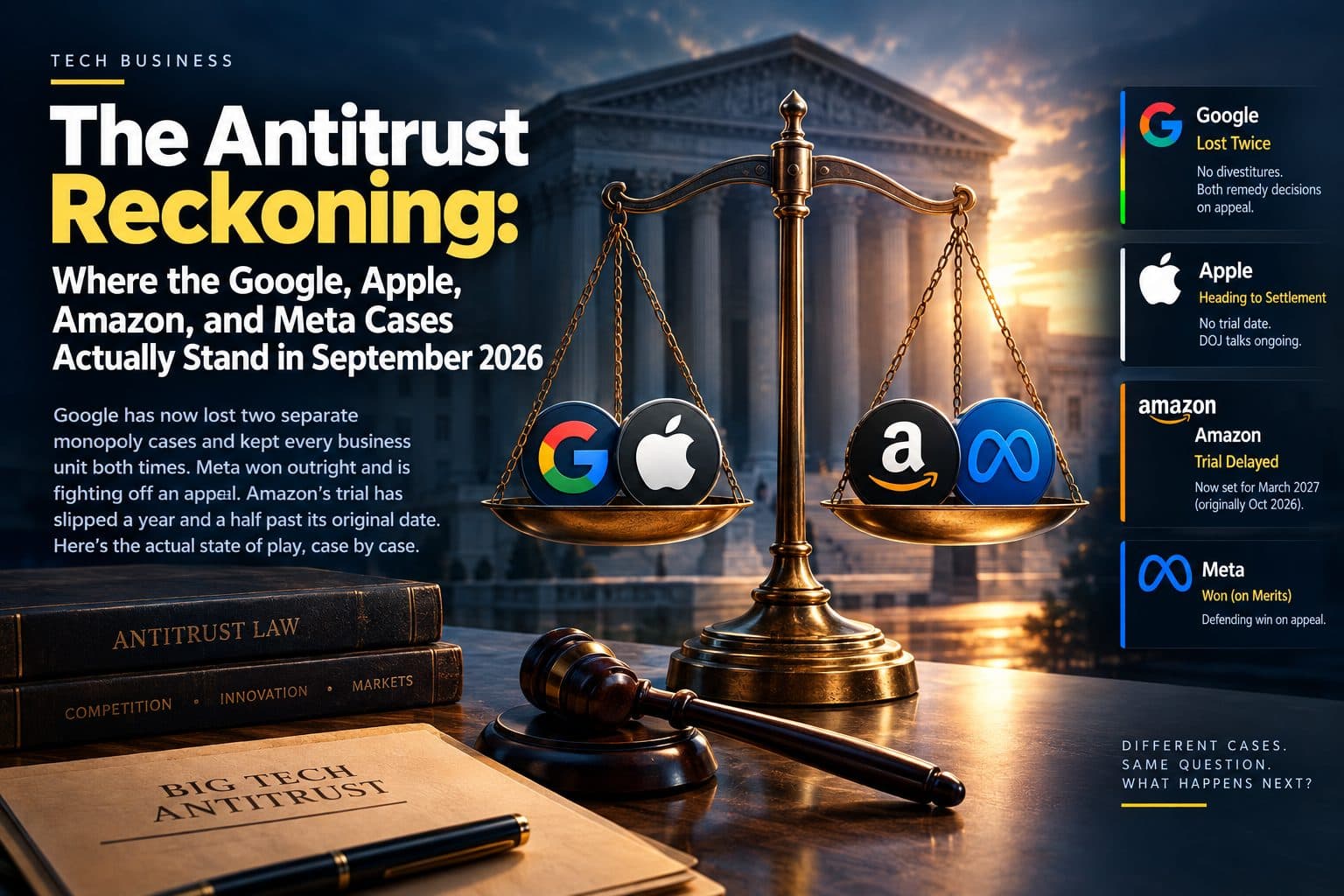
Google now has two liability findings against it and zero structural remedies imposed. Both remedy decisions are wrapped in ongoing or expected appeals.
Apple: heading toward a settlement, not a trial
Apple's position looks structurally different from the other three, because it may never get to a verdict at all. The DOJ's core monopolization suit, filed in March 2024 and alleging Apple illegally maintains its smartphone dominance through restrictions on third-party developers, survived Apple's motion to dismiss in June 2025. No trial date has ever been set. Instead, Bloomberg reported in July 2026 that Apple and the DOJ are in "early" settlement discussions, with Apple having made "multiple offers this year" to close out the case. Nothing is finalized, and settlement talks can and do collapse — but it's a materially different trajectory than Google's, where both sides fought remedies through full trials. Apple does have a nearer-term date on the calendar, though it's a separate matter: a private consumer class action over App Store commissions, In re: Apple iPhone Antitrust Litigation, is set for trial in the Northern District of California in February 2026.Amazon: the case that keeps sliding
The FTC's monopolization suit against Amazon, filed in September 2023 alongside 17 state attorneys general, was originally set for an October 2026 trial. It has since been delayed twice more. In June 2025, the court pushed the date to February 9, 2027. Then, following the effects of the record-length federal government shutdown that paused the case from October 1 to November 18, 2025, the FTC and Amazon jointly asked to push it again — this time to March 29, 2027 — according to a joint status report covered by MLex and Law360. Fact discovery, which was originally supposed to close in October 2024, now won't wrap until January 2026. The FTC's central allegation is that Amazon uses anti-discounting rules and pricing algorithms to prevent sellers from offering lower prices elsewhere, and it has asked for remedies that could include divesting parts of Amazon's business — the same structural ask that's failed twice against Google so far. A separate, privately brought consumer case over Marketplace pricing, De Coster v. Amazon, is on an even longer runway, with a trial date of June 14, 2027; a federal judge certified that class in August 2025.Meta: the one company that's already won
Meta is the outlier — it's the only one of the four that has beaten its case outright, at least for now. After a six-week bench trial that wrapped in May 2025, Judge James Boasberg ruled on November 18, 2025 that the FTC had failed to prove Meta currently holds a monopoly in personal social networking, regardless of whether it held that power back when it acquired Instagram in 2012 and WhatsApp in 2014. Boasberg's opinion leaned heavily on evidence that TikTok and YouTube now compete directly for the same user attention Meta's apps chase, writing that "Meta is not a monopolist insulated from competition," according to his ruling as reported by CNBC and the Associated Press. The FTC isn't done. It filed a notice of appeal on January 20, 2026, and the case — now FTC v. Meta Platforms, No. 26-5028 — is before the D.C. Circuit. Twenty-eight states plus the District of Columbia filed an amicus brief in May 2026 backing the FTC's position that Boasberg applied the wrong legal standard for monopoly power. Meta filed its response in August 2026, urging the appeals court to leave the ruling intact. No date for oral argument has been set.The actual throughline
Put the four cases side by side and a pattern holds across every one that's reached a decision: judges have been willing to find that a company broke the law, but consistently unwilling to order a breakup as the fix. Behavioral remedies — data sharing, bans on exclusive contracts, choice screens — are what courts are actually ordering, when they order anything at all. Meanwhile, the case furthest from any structural remedy is the one where the company won on the merits (Meta), and the case with the longest odds of ever reaching a verdict is the one heading toward settlement (Apple). Amazon's trial keeps receding into the future. None of that supports the "breakup era" framing that's followed this wave of cases since it began — the more accurate 2026 headline is that Big Tech is being told to change some behavior, not to sell anything.
Comments
Log in or sign up to join the discussion.
Loading comments…