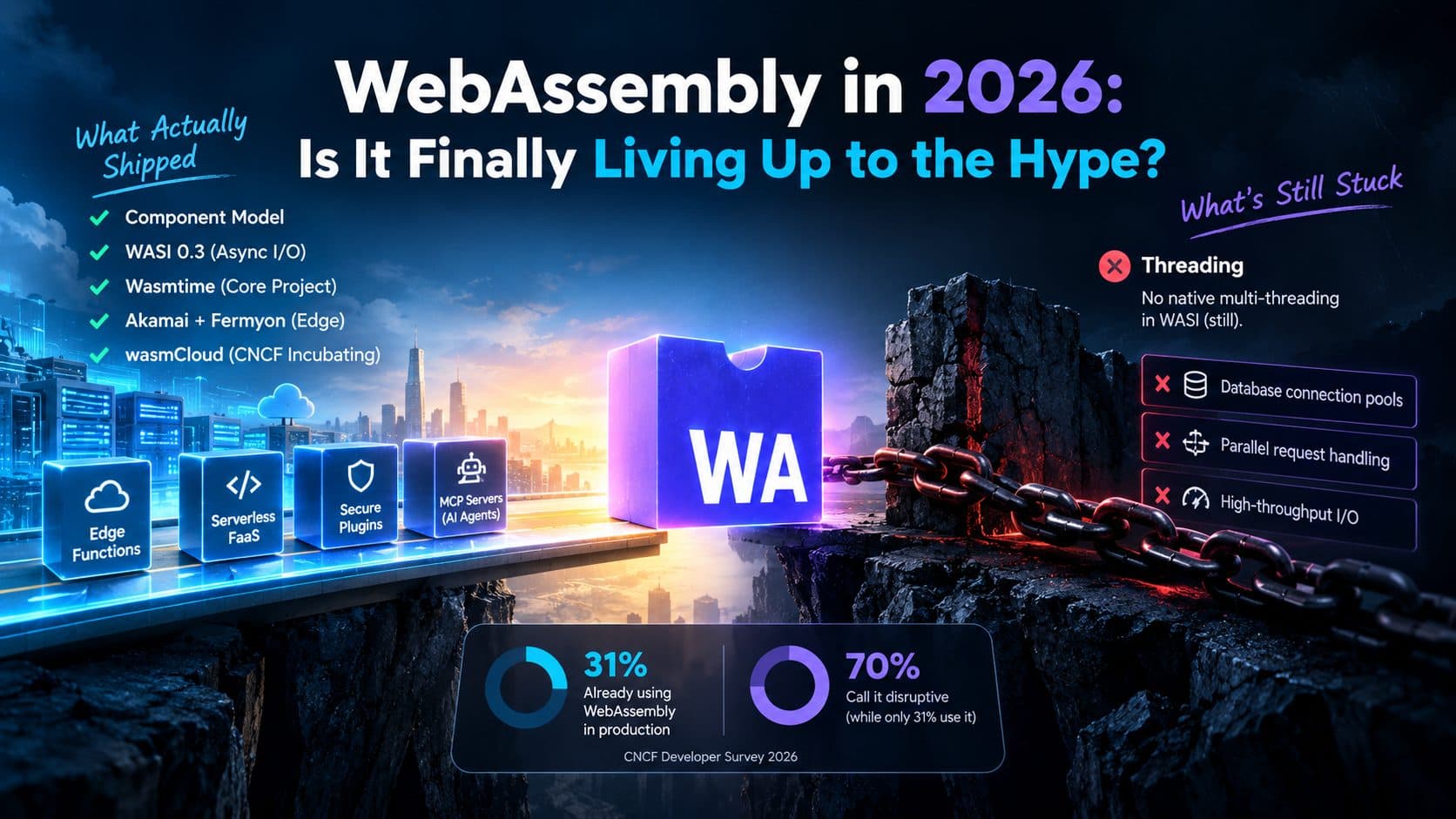
WebAssembly didn't have one 2026 — it had two. On the server, the Component Model stopped being a conference slide: WASI 0.3 shipped with native async I/O in February, Wasmtime earned Core Project status from the Bytecode Alliance, and Akamai bought Fermyon outright to run Spin across its edge network. But CNCF's own developer survey found only 31% of cloud-native developers actually use WebAssembly in production, even as 70% call it disruptive — and the gap traces back to the same wall that's blocked server-side Wasm for three years: threading still doesn't work.
The number that matters isn't the adoption figure
CNCF's WebAssembly microsurvey, analyzed by The New Stack in January, found 31% of cloud-native developers already using WebAssembly in projects, with another 37% planning to adopt it within a year. Seventy percent called it a disruptive emerging technology.
That's a workforce that believes in the technology at more than double the rate it's actually shipping it.
Belief-adoption gaps that wide usually point to something specific blocking the people who want in, rather than a pitch that's simply wrong. Three years of "almost ready" coverage has also trained a lot of engineers to wait for a clear signal before investing real migration time, and 2026 is the first year that signal partly arrived — which makes the gap partly a lag effect, not just a blocker effect. Sorting out how much of the 39-point spread is caution versus how much is the threading wall covered below is the honest version of "is it living up to the hype," and the answer differs depending on which half of the stack is being asked.
What actually shipped: the interoperability problem got solved
The Component Model was WebAssembly's real bottleneck for years, not raw performance. Composing modules written in different languages meant hand-writing FFI bindings and managing memory manually, which is the kind of integration tax that kills adoption no matter how fast the underlying code runs.
WASI 0.3, which the Bytecode Alliance shipped in February, closed a second gap. Previous WASI versions were synchronous, so an HTTP request inside a Wasm component blocked the thread until it resolved. WASI 0.3 introduced native future and stream types, letting a host runtime suspend a waiting component and schedule other work instead — the kind of async primitive server frameworks have taken for granted for a decade.
Wasmtime earned Core Project status from the Bytecode Alliance this year, and according to a May report from cloud infrastructure outlet Techbytes, its v43.0.0 release already advertises support for the WASI P3 snapshot dated March 2026. Tooling caught up alongside the spec: DWARF debugging support matured and the LLDB debugger now lets developers step through standalone Wasm runtimes from inside VS Code instead of a browser's dev tools.
The clearest sign this moved from spec to production is the acquisition activity, not the version numbers. Akamai acquired Fermyon outright and deployed its Spin runtime across its edge network, and wasmCloud reached CNCF incubator status with a 2.5 release that ships WASI P3 support on by default, according to cloud-native infrastructure site CloudRPS. That's a real company restructuring its edge product around this stack, not a demo.
Where the wins are real — and where a new one showed up
Edge functions, serverless FaaS, and secure plugin systems are where the production deployments actually sit. The cold-start advantage is genuine in that context, and the capability-based security model — a Wasm module can't touch the filesystem or open a socket unless a host explicitly grants it — is exactly what multi-tenant, untrusted-code platforms need.
A newer use case showed up this year with less warning. MCP servers are starting to adopt WebAssembly as the execution format for AI agent tool capabilities, according to Java Code Geeks' April survey of the ecosystem, applying the same capability-sandboxing model that made Wasm attractive for browser plugins to a different problem: an AI agent invoking a tool in an untrusted environment needs the same containment guarantees a browser extension does.
Whether that becomes a major adoption vector or stays a niche is genuinely unclear this early — it's the first new category of momentum WebAssembly has picked up in years that isn't just a faster version of the old browser-performance pitch. Portability across architectures is doing quiet work here too: the same compiled Wasm binary runs unchanged on x86_64 and ARM, which matters for AI tooling meant to execute the same sandboxed capability across whatever hardware a given deployment happens to run on.
Where it's still stuck, and it's the same wall as last year
Threading. That single missing piece is the whole reason WebAssembly isn't running general-purpose backends in 2026.
WASI still has no native multi-threading support. According to platform engineering outlet Landskill's July analysis, that gap keeps database connection pools, parallel request handling, and high-throughput I/O out of reach — which covers most of what a transactional microservice actually has to do all day. Migrating a Spring or Quarkus workload to WebAssembly today means betting on a threading proposal with no confirmed ship date, and the JVM toolchains that would carry that migration are themselves still pre-Component-Model or in beta: Kotlin/Wasm's server target and comparable tooling haven't caught up to what the spec now allows.
Nobody serious is running general-purpose microservices on WebAssembly at meaningful scale this year. The deployments that work are edge and CDN platforms, serverless functions, and plugin systems, not transactional business logic — and not the Kubernetes-replacement story some of the 2023-era pitches implied.
Browser WebAssembly already finished its arc
This is the quieter half of the story, mostly because it stopped being interesting to argue about. WebAssembly usage on the open web grew from roughly 4.5% to 5.5% of sites year over year in 2025, according to Chrome Platform Status data cited in a February 2026 ecosystem review — real growth, but not the exponential curve early boosters expected, and concentrated heavily in specific verticals like gaming, CAD, and video editing rather than spread evenly across the general web.
That's not a failure. It's what a mature, unglamorous technology looks like once the hype cycle has already moved on to arguing about something else.
So — is it living up to the hype?
It depends on which hype. If the promise was "WebAssembly replaces containers for general-purpose backend compute," the honest answer in 2026 is still no, and threading is the specific, nameable reason why — not spec immaturity in general, not tooling in the abstract, one missing primitive. If the promise was narrower — a fast, portable, securely sandboxed execution format for edge functions, plugin systems, and now AI agent tooling — that promise has been delivered, and the CNCF numbers suggest the market hasn't fully priced it in yet.
The technology didn't fail to live up to the hype. The hype was just never specific about which WebAssembly it meant.
Comments