The Tech Layoff Paradox: Cutting Staff, Hiring for AI
Companies are cutting broad headcount while aggressively hiring for AI roles. Data shows these are two separate trends, not direct substitution.
The GetCoreTech Team Sep 13, 2026 · 9 min read
The Tech Layoff Paradox: Why Companies Are Cutting Staff and Hiring for AI at the Same Time
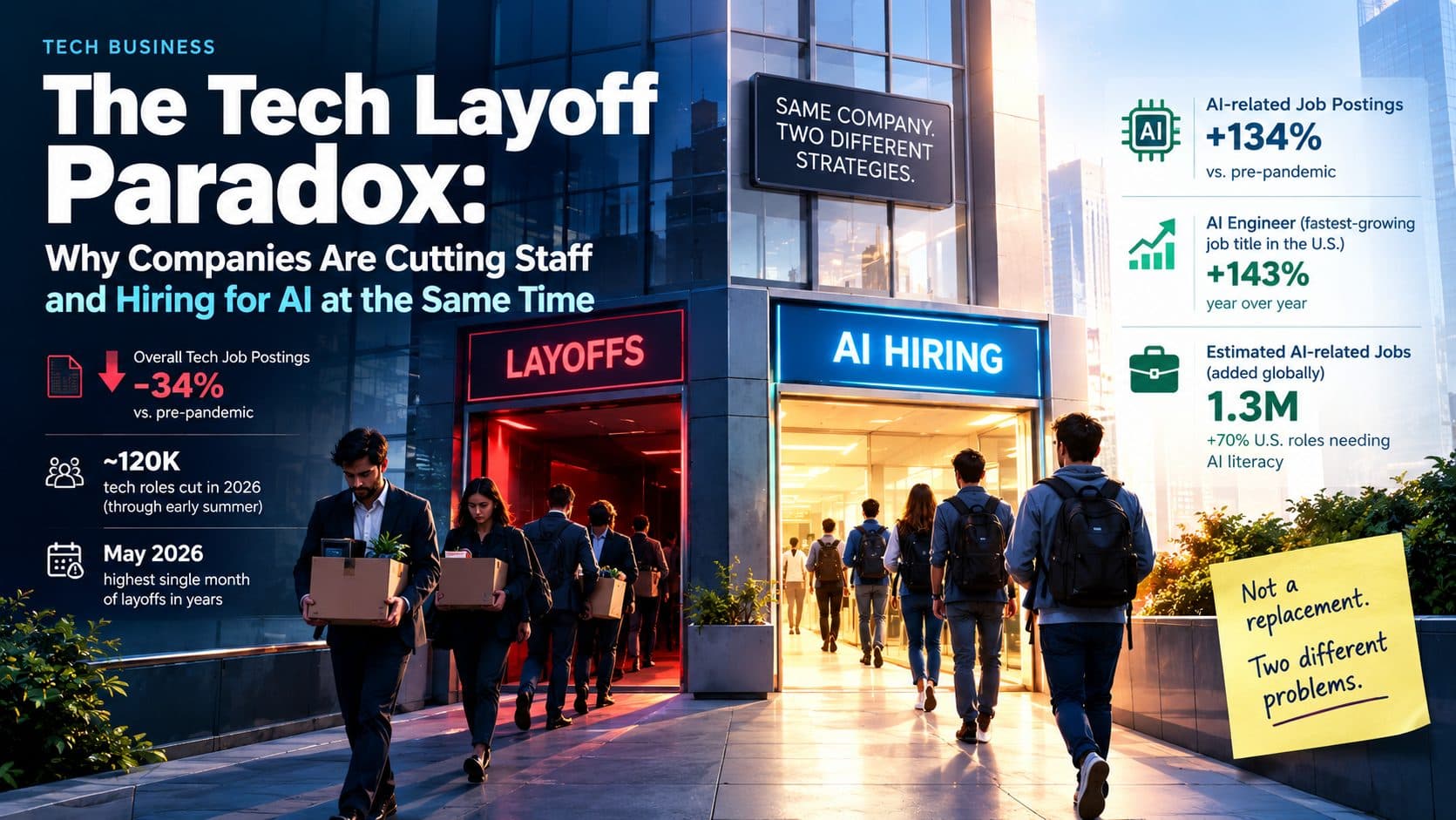
Companies are simultaneously running two hiring strategies that look contradictory but aren't: cutting broad headcount while aggressively hiring for a narrow set of AI-related roles. Indeed Hiring Lab's data shows AI-related job postings running 134% above their February 2020 baseline as of late 2025, even as overall tech job postings sat roughly 34% below that same baseline. The paradox isn't that AI is simultaneously destroying and creating jobs in equal measure across the board — Stanford research and even OpenAI's own CEO suggest the more accurate story is that AI is doing much less of the displacing than headlines imply, while doing quite a lot of the narrow, visible hiring.
The Numbers Behind the Confusion
Roughly 120,000 tech roles were cut in 2026 through early summer, according to the tracker Layoffs.fyi, with tech layoffs hitting their highest single month in years in May and AI cited as the most common reason, per outplacement firm Challenger, Gray & Christmas. At the same time, LinkedIn's Jobs on the Rise report ranked AI engineer the fastest-growing job title in the U.S., with postings up 143% year over year, and the World Economic Forum, citing LinkedIn data, reported AI has already added an estimated 1.3 million jobs alongside a 70% year-over-year jump in U.S. roles requiring AI literacy. Indeed's AI Tracker — the share of job postings mentioning AI-related terms — hit 4.2% in December 2025, an all-time high, concentrated heavily in specific functions: nearly 45% of data-and-analytics postings now mention AI, against about 15% in marketing and 9% in human resources.
These two trends are not occurring at different companies. Block cut roughly 4,000 jobs in February 2026 — nearly half its workforce, down to under 6,000 from more than 10,000.
A significantly smaller team, using the tools we're building, can do more and do it better.
Jack Dorsey, CEO of Block
Atlassian's 2026 restructuring cut roles concentrated in content creation, customer support, quality assurance, and project management, while simultaneously announcing plans to hire around 800 new positions in AI engineering, machine learning operations, and AI safety — a net headcount reduction, but a deliberate reshaping of what the workforce actually does. Salesforce's February 2026 layoffs of fewer than 1,000 employees touched marketing, product management, and data analytics — including parts of its own Agentforce AI unit, illustrating that even AI-focused teams aren't immune to the broader restructuring happening around them.
The Explanation Most Headlines Skip: It's Two Different Things, Not One
The instinct is to read this as direct substitution — AI is replacing the workers being laid off with the AI specialists being hired. The actual research complicates that story in an important way. A National Bureau of Economic Research survey of thousands of C-suite executives across the U.S., U.K., Germany, and Australia found that nearly 90% said AI had had no measurable impact on their company's overall employment levels over the past three years.
There's some AI washing where people are blaming AI for layoffs that they would otherwise do, and then there's some real displacement by AI of different kinds of jobs.
Sam Altman, OpenAI CEO, at the India AI Impact Summit, February 2026
That's an unusual admission from the head of the company whose product is the most commonly cited justification for those layoffs.
The skepticism has data behind it beyond Altman's comment. Of the 108,435 U.S. job cuts announced in January 2026 — the highest single month since 2009 — AI was explicitly cited in only about 7,600 cases, roughly 7% of the total. Deutsche Bank analysts have separately flagged what they call AI redundancy washing as a significant pattern in 2026: companies attributing workforce reductions to AI adoption when the more accurate explanation is pandemic-era overhiring correcting itself, softer demand, or investor pressure to show cost discipline. None of this means AI has had zero labor market effect — it means the layoff side of the paradox is only partly an AI story, while the hiring side is a much more genuinely AI-driven phenomenon.
Where the Real Effect Actually Shows Up
The most rigorous evidence on AI's actual employment effect comes from Stanford's Digital Economy Lab, whose Canaries in the Coal Mine? research, led by economist Erik Brynjolfsson and updated in August 2026 using ADP payroll data covering millions of U.S. workers through mid-2026, reaches a specific and narrower conclusion than the "AI is replacing everyone" narrative: there is no evidence of widespread, economy-wide job displacement from AI. What the data does show is a sharp, concentrated effect on one group — early-career workers, ages 22 to 25, in the most AI-exposed occupations, whose employment now sits about 19% below where it would be had it kept pace with less-exposed peers of the same age, up from a 15% gap a year earlier. Critically, the study finds this decline is driven primarily by reduced hiring rather than increased firing — companies aren't laying off large numbers of junior employees because of AI so much as they're not hiring as many replacements when junior employees leave or roles open up, particularly in work that leans on codified knowledge AI can now reproduce rather than the tacit, judgment-based knowledge that comes with experience.
That distinction reframes the paradox usefully: the layoffs making headlines are often broad restructurings with AI cited as partial justification, while the more specific, measurable AI effect is a quiet, structural narrowing of the entry-level hiring funnel — a phenomenon that doesn't generate a dramatic layoff announcement but shows up clearly in payroll data over time.
The Piece That Isn't a Paradox at All
The hiring side of the equation is more straightforwardly AI-driven, and it's arguably the more important half of the paradox going forward. Indeed's January 2026 labor market update describes the current environment bluntly as low-hire, low-fire, with overall job postings flat or declining while employers concentrate what limited hiring they're doing on roles and skills tied to AI. AI-related job postings sat 134% above their pre-pandemic (February 2020) baseline as of late 2025, even as overall tech postings remained roughly 34% below that same baseline — effectively two separate labor markets moving in opposite directions inside the same sector.
The demand is also diffusing beyond dedicated "AI engineer" titles. AI-related skill requirements are increasingly showing up embedded in product manager, backend engineer, and business analyst postings that don't carry an AI-specific title at all — a product manager expected to evaluate LLM outputs, or a backend engineer expected to integrate inference APIs, without either being classified as an AI hire in the way layoff-versus-hiring headlines tend to count.
What This Means for Someone Navigating the Job Market Right Now
Don't read a company's layoff announcement and its AI hiring announcement as necessarily the same story. The NBER and Deutsche Bank data suggest a meaningful share of layoffs attributed to AI are better explained by overhiring correction or margin pressure — while the separate hiring push into AI-adjacent roles is a distinct, generally more genuine trend.
If you're early-career, the data says the funnel narrowing is real and specific to you. Stanford's research shows the measurable AI employment effect concentrates in workers ages 22–25 in AI-exposed, codified-knowledge-heavy roles, driven mainly by reduced hiring rather than firing — meaning the risk shows up as fewer entry points, not necessarily existing job loss.
AI skill exposure matters more than an AI job title. With AI-related terms appearing in a growing share of product management, analyst, and engineering postings that aren't formally AI roles, developing relevant AI fluency inside an existing specialty may be more useful than chasing a dedicated AI title.
Treat AI-driven layoff framing in press releases with mild skepticism, not dismissal. Both things are true simultaneously in 2026: some AI-cited layoffs are genuine restructuring around real productivity tools, and some are, in OpenAI's own CEO's words, AI being used as cover for cuts that would have happened anyway.
FAQ
Q: Are companies really replacing laid-off workers with AI? A: Only partially, and less directly than headlines suggest. A National Bureau of Economic Research survey found nearly 90% of surveyed C-suite executives said AI had no measurable impact on their company's overall employment over the past three years, and only about 7% of January 2026's record U.S. job cuts explicitly cited AI as the reason. The clearer, better-documented AI effect is on hiring rather than firing — specifically a narrowing of entry-level hiring in AI-exposed occupations.
Q: What is AI washing in the context of layoffs? A: A term used by OpenAI CEO Sam Altman and flagged separately by Deutsche Bank analysts to describe companies attributing layoffs to AI adoption when the actual drivers are more mundane — pandemic-era overhiring correcting itself, softer demand, or investor pressure — because framing cuts as AI-driven efficiency reads better publicly than admitting to overhiring.
Q: Which workers are most affected by AI in the employment data? A: According to Stanford Digital Economy Lab's research using ADP payroll data, the clearest, most measurable effect is on early-career workers ages 22–25 in AI-exposed occupations, whose employment sits about 19% below where it would be had it tracked with less-exposed peers of the same age. Experienced workers in the same occupations show no comparable decline, and the effect is concentrated in roles relying on codified knowledge rather than the tacit expertise built through years of experience.
Q: Is the AI hiring boom real, or is it also overstated? A: The hiring side has more consistent supporting data than the layoff-attribution side. Indeed Hiring Lab found AI-related job postings running 134% above pre-pandemic levels in late 2025 even as overall tech postings sat about 34% below that baseline, and LinkedIn ranked AI engineer the fastest-growing U.S. job title, with postings up 143% year over year.
Q: Why would a company cut staff and hire for AI at the same time if AI isn't fully replacing those workers? A: The two decisions are often driven by different underlying causes rather than one causing the other. Broad layoffs frequently reflect cost-cutting, restructuring, or correcting pandemic-era overhiring, while AI-specific hiring reflects a genuine, separate strategic bet on building AI capability — both can happen in the same company in the same quarter without one directly explaining the other.
Q: Does this mean AI isn't actually affecting jobs at all? A: No — the research points to a real but narrower effect than the "AI is replacing everyone" narrative suggests. AI is measurably suppressing entry-level hiring in AI-exposed occupations and is clearly driving demand for specific new roles and skills, even while broad, economy-wide job displacement has not shown up in the data as of mid-2026.
FAQ
Only partially, and less directly than headlines suggest. A National Bureau of Economic Research survey found nearly 90% of surveyed C-suite executives said AI had no measurable impact on their company's overall employment over the past three years, and only about 7% of January 2026's record U.S. job cuts explicitly cited AI as the reason. The clearer, better-documented AI effect is on hiring rather than firing — specifically a narrowing of entry-level hiring in AI-exposed occupations.
A term used by OpenAI CEO Sam Altman and flagged separately by Deutsche Bank analysts to describe companies attributing layoffs to AI adoption when the actual drivers are more mundane — pandemic-era overhiring correcting itself, softer demand, or investor pressure — because "we're becoming more efficient with AI" reads better publicly than "we overhired and are now cutting costs."
According to Stanford Digital Economy Lab's research using ADP payroll data, the clearest, most measurable effect is on early-career workers ages 22–25 in AI-exposed occupations, whose employment sits about 19% below where it would be had it tracked with less-exposed peers of the same age. Experienced workers in the same occupations show no comparable decline, and the effect is concentrated in roles relying on "codified knowledge" rather than the tacit expertise built through years of experience.
The hiring side has more consistent supporting data than the layoff-attribution side. Indeed Hiring Lab found AI-related job postings running 134% above pre-pandemic levels in late 2025 even as overall tech postings sat about 34% below that baseline, and LinkedIn ranked AI engineer the fastest-growing U.S. job title, with postings up 143% year over year.
The two decisions are often driven by different underlying causes rather than one causing the other. Broad layoffs frequently reflect cost-cutting, restructuring, or correcting pandemic-era overhiring, while AI-specific hiring reflects a genuine, separate strategic bet on building AI capability — both can happen in the same company in the same quarter without one directly explaining the other.
No — the research points to a real but narrower effect than the "AI is replacing everyone" narrative suggests. AI is measurably suppressing entry-level hiring in AI-exposed occupations and is clearly driving demand for specific new roles and skills, even while broad, economy-wide job displacement has not shown up in the data as of mid-2026.
The GetCoreTech Team
We write about the SaaS, AI, and infrastructure decisions builders actually have to make.
Comments
Log in or sign up to join the discussion.
Loading comments…