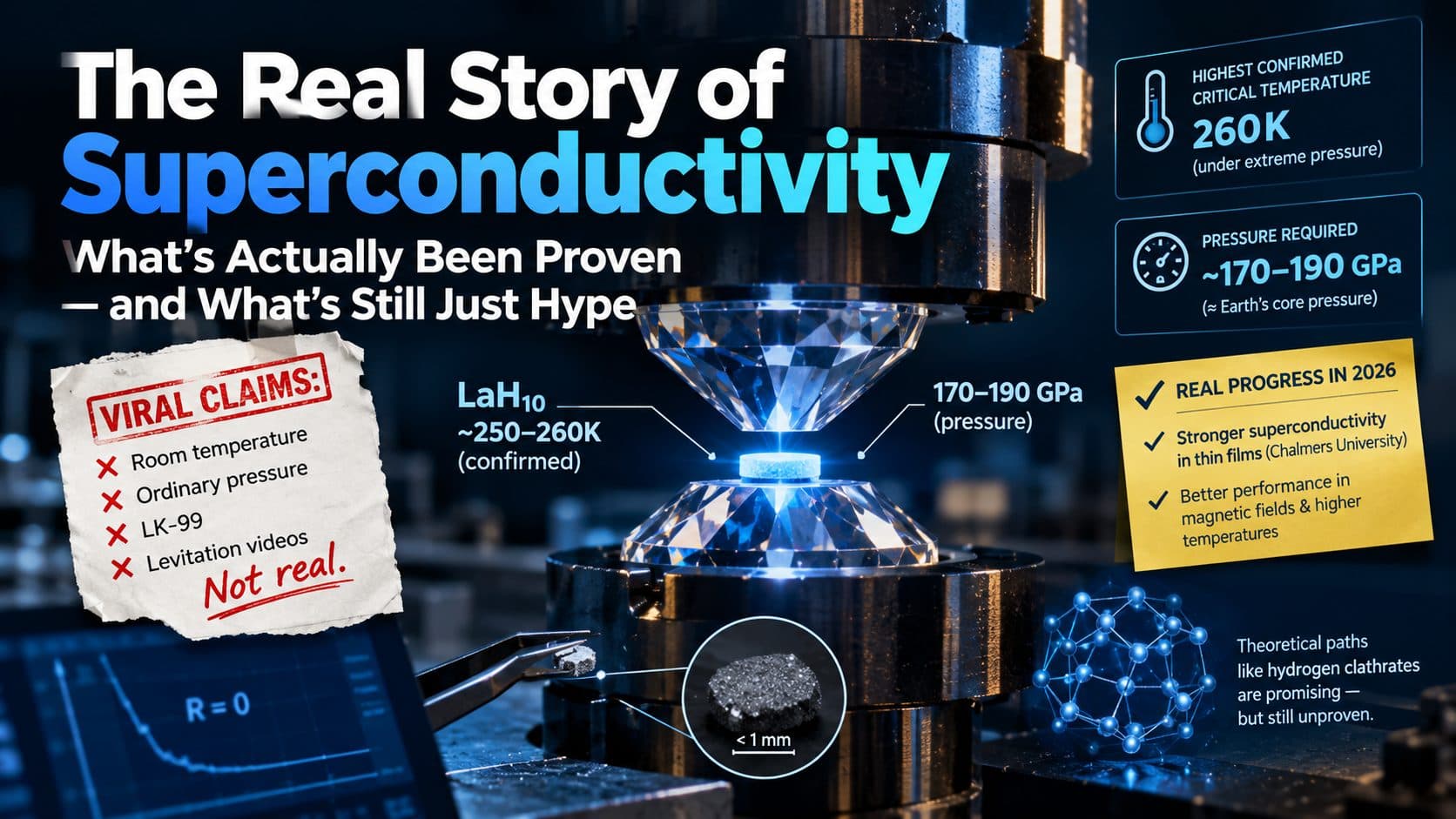
The most credible superconductivity news of 2026 has nothing to do with room temperature. The record for the highest confirmed critical temperature still sits at 260K under nearly 200 gigapascals of pressure — colder and far more extreme than any of the viral ambient-pressure claims that keep going around, and none of those claims have survived independent testing. That gap between what gets confirmed and what gets shared is the actual story, and it hasn't closed in three years.
The Field Wrote Its Own Rules After LK-99
In July 2023, a small Korean lab posted preprints claiming a copper-doped lead apatite called LK-99 superconducted at room temperature and ordinary air pressure. The claim spread across social media within hours, and labs across multiple countries dropped what they were doing to test it. By September of that year, independent groups had traced every reported anomaly — the apparent magnetic levitation, the resistivity drop near 380K — back to a Cu₂S impurity phase in the samples, not to superconductivity at all. The material's ferromagnetic behavior had mimicked the Meissner effect closely enough to fool a casual read of the data, but not a rigorous one.
The "superconductor" was an impurity, not a discovery.
That episode reshaped how the field treats new claims. Condensed matter researchers now expect five things before a claim gets taken seriously: zero resistance measured above 273K with four-probe electrical testing, the Meissner effect confirmed via SQUID magnetometry, a specific heat anomaly at the transition temperature, independent replication by at least three separate groups within six months, and stability at ordinary atmospheric pressure for at least 24 hours. No material has cleared all five as of this year. A single resistivity drop or a video of something floating above a magnet no longer counts as evidence on its own — it counts as a hypothesis that needs the other four boxes checked.
The Actual Record Requires Almost 2 Million Atmospheres of Pressure
Set the ambient-pressure claims aside and the confirmed frontier looks completely different. The highest independently verified critical temperature belongs to LaH₁₀, a lanthanum superhydride that researchers at George Washington University and the Max Planck Institute for Chemistry separately measured superconducting near 250-260K — a temperature you'd need a chilly winter day to reach, not a lab coat. Getting there required squeezing the material to roughly 170-190 gigapascals inside a diamond anvil cell, pressure on the order of what exists near Earth's core. A separate, unconfirmed 2020 preprint reported an onset as high as 556K in a related hydride system under lower pressure, but no outside lab has reproduced it, and it has sat in that unverified state for years.
The pressure problem isn't a minor engineering inconvenience researchers will eventually solve with a bigger machine. Diamond anvil cells that reach these pressures confine the sample to a space smaller than the width of a human hair, which rules out building anything from the material at a scale larger than a laboratory demonstration. Most of these hydrides also decompose within seconds of the pressure being released. The theoretical case for ambient-pressure high-temperature superconductivity is real — electron-doped hydrogen cage structures called clathrates are one actively studied path — but "theoretically viable" and "synthesized and confirmed" remain two very different sentences, and every headline that blurs them is skipping the part that actually matters.
What Real Progress Looked Like This Year
The advance most worth paying attention to in 2026 didn't come with a room-temperature claim attached, which may be exactly why it got less attention than it deserved. A team at Chalmers University of Technology in Sweden, led by physicist Floriana Lombardi, published a study in Nature Communications in June describing a way to boost superconductivity in ultrathin films of a copper-oxide material by re-engineering the substrate underneath it rather than the material itself. By treating the substrate in a vacuum at high temperature before growing the superconducting layer on top, the researchers created a nanoscale pattern of ridges that guided how the film's atoms settled — and the resulting films stayed superconducting at higher temperatures and under stronger magnetic fields than unmodified versions of the same material.
Nothing about this claims room temperature. It doesn't need to. Superconductors already used in commercial applications lose their usefulness the moment a strong magnetic field is nearby, which rules out many of the exact energy and quantum-computing uses that would benefit most. A technique that lets an existing, already-confirmed superconductor tolerate stronger fields at higher temperatures is a real, incremental step toward those applications — the kind of unglamorous progress that never trends, because it doesn't come with a levitating magnet video.
Why the Ambient-Pressure Claims Keep Collapsing
The pattern has a name at this point, and it belongs to physicist Ranga Dias. In 2020, his team at the University of Rochester published a Nature paper claiming room-temperature superconductivity in a carbonaceous sulfur hydride under extreme pressure. Nature retracted it in 2022 over undocumented data. Dias's group came back in 2023 with a second claim — a nitrogen-doped lutetium hydride, this time at near-ambient pressure — and that one was retracted too. A University of Rochester investigation commissioned at the National Science Foundation's request spent over a year examining his work and concluded, in a 124-page report later disclosed through a lawsuit, that Dias had committed data falsification, fabrication, and plagiarism, including in an NSF grant application. Five of his papers have now been retracted. He left the University of Rochester in November 2024.
The Dias case and the LK-99 case are different failures with the same shape: an extraordinary claim, a viral spread that outran the verification process by weeks, and a slow, unglamorous unwinding once other labs actually tried to replicate the work. Neither started as fraud from a scientific-consensus standpoint — LK-99's authors likely believed their own measurement, and Dias's earliest defenders included two internal Rochester reviews that initially found no misconduct. That's arguably the more useful lesson than "some people lie": even sincere anomalous readings need the full validation stack before they're worth acting on, because false positives in this field have historically outnumbered confirmed ones by a wide margin.
Room-temperature superconductivity would be worth billions of dollars and a genuine overhaul of how power grids, MRI machines, and quantum computers work. That's precisely why it keeps attracting claims that don't hold up — the incentive to be first is enormous, and the actual bar for proof is slow, expensive, and far less exciting than a video of a wafer twitching above a magnet.
Comments