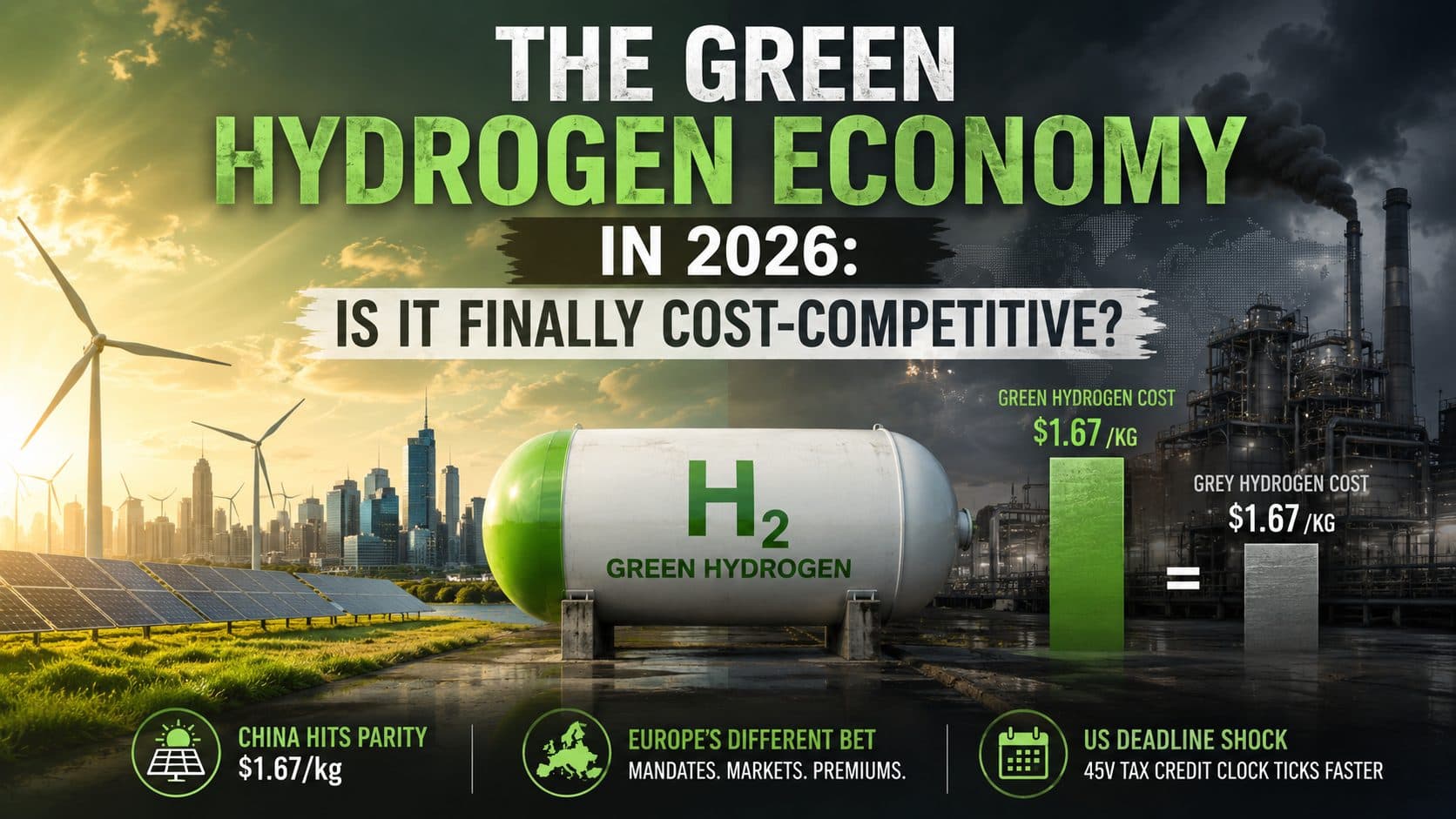
For the first time, a green hydrogen producer has hit the same price as the fossil fuel it's meant to replace — and it happened in China, at plants built specifically for that outcome. Costs at China's best-sited, self-supplied electrolysis plants fell to roughly 11.2 yuan ($1.67) per kilogram in August 2026, matching domestic grey hydrogen made from coal, according to Fuel Cells Works. Almost everywhere else, the fossil-fuel gap is still measured in multiples, not cents, and in the United States the main subsidy built to close that gap just lost five years off its clock.
China's Parity Claim Is Real — But It's Not the National Number
The 11.2-yuan figure is real, but it describes a specific kind of project: an electrolyzer plant co-located with its own dedicated solar or wind supply, in a region like Inner Mongolia or Ningxia where renewable electricity is cheap and abundant. A separate 2026 industry report from Tianxia Gongchang Research puts the national average green hydrogen cost at 15 to 25 yuan per kilogram, against a grey hydrogen benchmark of 8 to 10 yuan — a gap of 1.5 to 3 times, not zero. Beijing's own policy timeline backs up that distinction. Bloomberg reported in March 2026 that China is preparing a pilot program aiming to bring the average end-user hydrogen price below 25 yuan ($3.6) per kilogram — by 2030, not now.
So the honest read isn't "China solved green hydrogen." It's that China's electrolyzer manufacturing base — which the International Energy Agency's Global Hydrogen Review 2025 puts at nearly 60% of global capacity, alongside 65% of installed and financially committed electrolysis capacity worldwide — has pushed the best-case cost curve down far enough that a handful of favorably sited projects have crossed the line. The rest of the country, and the rest of the world, hasn't.
Europe Didn't Close the Gap. It Found a Way Around It.
Unsubsidized, Europe's numbers still look rough. A Bruegel analysis of the EU's own Hydrogen Bank data put the production-cost premium for renewable hydrogen over fossil-based hydrogen at €4 to €6 per kilogram. That's the number critics usually cite to argue the whole model is unworkable.
It's also not what buyers are actually paying to close it.
In the EU Hydrogen Bank's first competitive auction, winning bids cleared at an average premium of about €0.40 per kilogram — against a subsidy ceiling of €4.50 — because European law now requires certain industrial buyers to use renewable hydrogen regardless of price, and that mandate lets producers capture a real market premium on top of the subsidy top-up. A second auction round saw requested premiums fall further, staying under €0.70 per kilogram, per reporting from Global Hydrogen Hub. That's a genuinely different mechanism than "green hydrogen costs 3x more" — it's a market where demand is legally guaranteed, so the subsidy only has to cover a shrinking sliver of the true cost gap rather than the whole thing. The catch is scale: these auctions have funded a combined few million tonnes of hydrogen output over a decade, not the tens of millions of tonnes the sector once projected for 2030.
The US Bet Just Lost Five Years
The American approach never relied on demand mandates. It relied on Section 45V, the Inflation Reduction Act's Clean Hydrogen Production Tax Credit, which pays up to $3.185 per kilogram in 2025 for hydrogen produced with lifecycle emissions under 0.45 kilograms of CO2-equivalent, according to a Congressional Research Service summary. That's enough, on paper, to erase the entire cost gap between green and grey hydrogen in most U.S. regions.
Then Congress changed the deadline. The One Big Beautiful Bill Act, signed in July 2025, moved the 45V construction-start requirement up by five years — from the end of 2032 to the end of 2027 — according to Taxpayers for Common Sense. Miss that start date, and the credit disappears regardless of when the plant is finished. For a technology where permitting, financing, and electrolyzer procurement routinely stretch past two years before a single shovel goes into the ground, that's not a distant deadline. It's now.
The fallout showed up almost immediately. In February 2025, Air Products cancelled three U.S. projects, including a 35-metric-ton-per-day green liquid hydrogen plant in Massena, New York, and said directly in its own announcement that the decision followed regulatory changes making the site's existing hydroelectric power supply ineligible for the 45V credit. That single project alone had been budgeted at $500 million.
The retreat didn't stop at green hydrogen specifically. In June 2026, Air Products cancelled its Louisiana Clean Energy Complex — a $2.9 billion natural-gas-and-carbon-capture hydrogen project that had a more secure subsidy path than most electrolysis plants — after its lead offtake customer, Yara International, walked away and construction costs roughly doubled, per reporting from GreentechLead. That project wasn't killed by the 45V deadline. It was killed by ordinary project economics failing to hold up even with subsidies in place, which says something the tax-credit story alone doesn't: shortening the subsidy window is one problem, but it isn't the only one making these projects hard to finance.
Retreat, Not Just Delay
Australia offers the clearest example of a company simply walking away rather than waiting out the cost curve. In July 2025, BP told its partners it would exit the Asian Renewable Energy Hub — a proposed 26-gigawatt wind-and-solar project designed to produce 1.6 million tonnes of green hydrogen a year — to redirect capital toward oil and gas, according to the company's own statement reported by pv-magazine. BP had held a majority stake since 2022 and once called the project a "cornerstone" of its energy transition strategy.
The IEA's own pipeline data shows this isn't an isolated case. Projected low-emissions hydrogen production by 2030 now stands at 37 million tonnes a year, down from the 49 million tonnes the agency itself estimated just one year earlier — and more than half of the announced electrolyzer capacity in the pipeline is now expected to slip past its target start dates or never reach one. At the same time, capital spending on the projects that are still moving forward keeps rising: the IEA tracked $4.3 billion in 2024, an 80% jump from 2023, with 2025 spending on pace to approach $8 billion. Money isn't leaving the sector. It's concentrating in fewer, better-positioned projects while the marginal ones get cut.
What "Cost-Competitive" Actually Means Right Now
Put the pieces together and the 2026 picture isn't a global cost breakthrough. It's a market splitting into two very different stories. In China's cheapest renewable regions and in Europe's mandate-backed auction winners, green hydrogen has found real, narrow paths to compete with fossil alternatives — one through raw electrolyzer and electricity costs, the other through legally guaranteed demand. Everywhere else, including most of the United States, unsubsidized green hydrogen still costs meaningfully more than the fossil version, low-emissions hydrogen remains under 1% of global hydrogen production according to the IEA, and the policy tools meant to bridge that gap are, in the U.S. case, actively shrinking rather than growing.
Whether 2026 marks the start of the transition or just its most selective phase depends entirely on which of those two paths — cheap electricity and manufacturing scale, or legally mandated demand — turns out to travel outside the regions that built it.
Comments