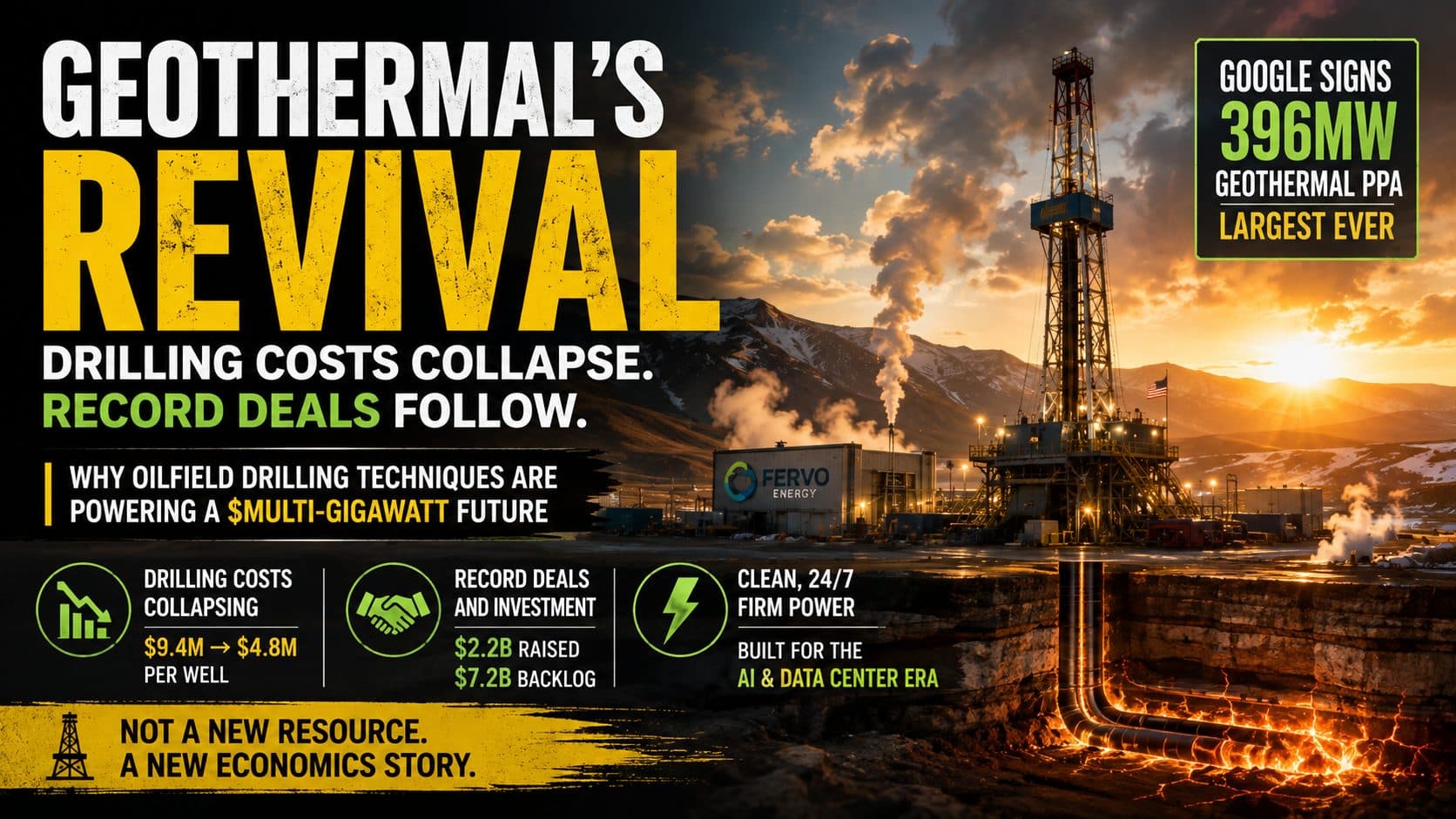
Geothermal's revival is not about the resource getting bigger or cleaner — the heat under Utah was always there. It's about drilling costs collapsing fast enough that Google signed the largest enhanced-geothermal power deal in history for it, while a competing next-generation design that skipped oilfield drilling techniques is running at roughly a quarter of its target output. The split between those two outcomes is the actual story: what's reviving geothermal isn't the technology category broadly, it's specifically the approach that borrowed directly from oil and gas drilling.
The drilling numbers that made this investable
Fervo Energy's first commercial pilot, in Nevada, took 70 days to drill a single well to 11,220 feet. By the time the company moved to Cape Station in southwest Utah, that average had fallen to 21 days for wells reaching 14,483 feet — deeper and hotter rock, drilled three times faster. Fervo's own drilling-results announcement put a dollar figure on that learning curve: costs across the first four horizontal wells at Cape fell from $9.4 million to $4.8 million per well.
That curve kept bending. In a July 2026 announcement, Fervo said its ninth well using a third-generation design, nicknamed Sawtooth 7, reached 19,448 feet with a 7,500-foot horizontal lateral in 21 days — a drilling pace 143% faster than the company's very first Cape Station well. Cost per kilowatt of capacity followed: Phase I priced out around $7,000/kW, Phase II is targeting $5,500/kW, and Fervo has stated a longer-term goal of $3,000/kW.
Fervo isn't at the Department of Energy's $45-per-megawatt-hour target yet.
That figure, cited by the Information Technology and Innovation Foundation as the benchmark for enhanced geothermal to compete unsubsidized with other firm power, is still out ahead of where Fervo's cost curve currently sits. The company is closing that gap faster than most of the sector expected two years ago.
Why the money followed the drilling curve, not the other way around
Google's rationale is what turns a drilling-efficiency story into an investment story. Data centers need power that runs continuously, and solar and wind don't do that without storage; grid interconnection queues for new generation now stretch years in many regions. Enhanced geothermal, unlike solar or wind, produces around the clock and doesn't depend on the interconnection backlog the same way once a site is drilled.
On September 1, 2026, Fervo and Google signed a 396-megawatt power purchase agreement tied to Cape Station — described by both companies as the largest enhanced-geothermal PPA ever signed, with first power expected in 2028. Google holds an option to expand its offtake to roughly 1 gigawatt by mid-2030, and a separate, non-binding framework agreement covers up to 3 gigawatts of Fervo capacity through 2033. The deal builds on an earlier 115-megawatt agreement the two companies signed in 2024, so this isn't a first contact between a hyperscaler and a geothermal developer — it's an escalation from a company that already had years of performance data to check.
Fervo went public in May 2026, raising about $2.2 billion in gross proceeds, and reported 658 megawatts of binding PPAs representing roughly $7.2 billion in potential revenue backlog as of its most recent SEC filing. Fervo isn't the only company drawing this kind of capital toward drilling-derived geothermal. Sage Geosystems, which also adapts oilfield drilling and stimulation equipment for what it calls "pressure geothermal," closed a $97 million Series B round in January 2026 co-led by geothermal operator Ormat Technologies, on top of an existing 150-megawatt power deal with Meta signed in 2024.
Not every next-gen approach is working
Eavor Technologies pursued a different design — a closed-loop system with no fracturing, no injected fluids, and no reliance on naturally occurring rock permeability, built specifically to sidestep the induced-seismicity risk that fracturing-based systems carry. A January 2026 analysis found that after the company's first commercial project in Germany exceeded its original €200–350 million cost estimate, it was operating at roughly 25% of the implied capacity of a single subsurface loop and about 6% of the electrical output targeted for the project's first phase.
That gap matters for the thesis, not just as a caveat tacked onto the end. Eavor built its entire pitch around avoiding the fracturing and horizontal-drilling techniques Fervo and Sage lean on. The design that borrowed the least from oil-and-gas drilling is the one struggling most to hit its numbers, while the designs borrowing the most — horizontal wells, staged fracturing, oilfield well design iterated well over well — are the ones with signed gigawatt-scale contracts behind them.
The fracturing-based approach isn't free of its own problems. Induced seismicity remains an active regulatory concern for EGS projects broadly, monitored through seismicity protocols developed after early stimulation projects triggered detectable earthquakes, and stimulation still requires meaningful water volumes per well. Cost, not physics, is currently the harder constraint. Congressional Research Service analysis lists high drilling and stimulation costs, alongside seismicity and water use, among the primary technical barriers still facing commercial EGS deployment.
What the resource math actually supports
The underlying potential is large enough that drilling cost, not resource scarcity, is the real bottleneck. A Center for Climate and Energy Solutions report estimates U.S. next-generation geothermal potential at 3.4 to 5.5 terawatts — more than double the country's existing total generation capacity — based on updated high-resolution heat-flow modeling showing that most states can reach high-temperature rock within about 3.75 miles of the surface.
That number has sat in geological surveys for years without moving markets. What changed is that Fervo can now point to a documented, well-over-well cost curve instead of a resource estimate, and Google was willing to sign the largest contract in the sector's history against that curve rather than against the geology alone.
Comments