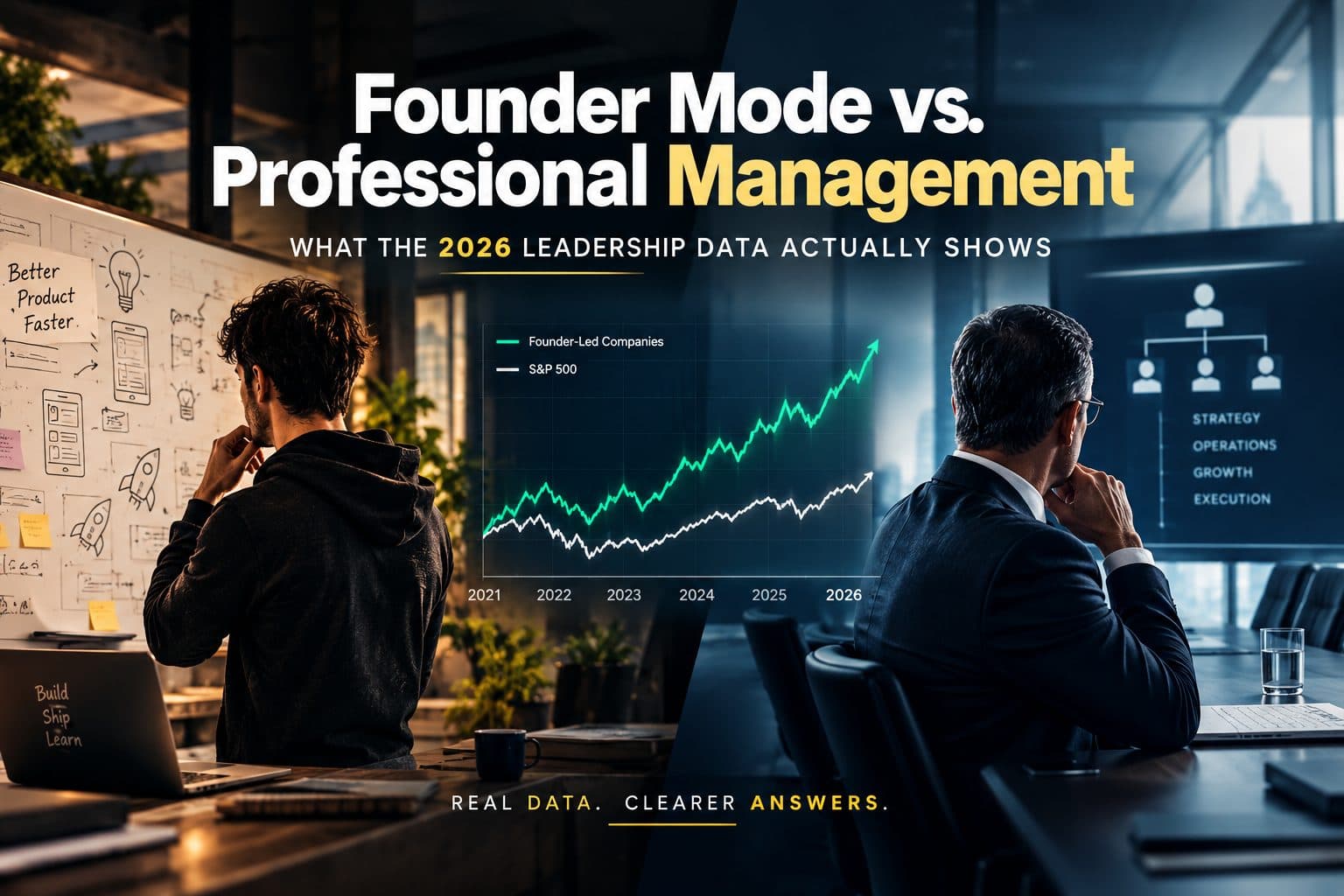
Founder Mode vs. Professional CEOs: What Data Shows
Boards brought founders back at Workday, Hootsuite, and Bumble for AI-era leadership. The five-year stock data tells a more complicated story than that.
The GetCoreTech Team Sep 13, 2026 · 7 min read
Founder Mode vs. Professional Management: What the 2026 Leadership Data Actually Shows
In 2026, boards at Workday, Hootsuite, and Bumble each pulled their founders back into the CEO seat, and each cited the same reason: professional managers weren't moving fast enough on AI. But the actual five-year stock data on founder-led companies tells a more complicated story than "bring the founder back" — only 47% of founder-led public companies beat the S&P 500 over the last five years, and the real performance gap shows up not between founders and professional managers, but between companies where the founder stayed and companies where the founder left.
The 2026 return wave, and why boards say it's about AI
Workday announced on February 9, 2026 that co-founder Aneel Bhusri was returning as CEO, replacing Carl Eschenbach after roughly three years in the role, with Eschenbach stepping down from the board entirely and staying on only as a strategic adviser, according to Bloomberg's coverage of the announcement. By the time of the change, reporting from SaaStr's SaaStrAI noted Workday's stock was down about 15% for the year and sitting more than 40% below its 2024 peak, even as subscription revenue kept growing at a decelerating rate. Bhusri's public framing was explicit: this is an AI-scale transformation, not an incremental one, and it needs the person who built the original product logic back in charge.
Two months later, Hootsuite followed a similar script. GeekWire reported that founder Ryan Holmes returned as interim CEO in April 2026, taking over from Irina Novoselsky, who had led the company for three years and, by her own account on LinkedIn, had restored it to profitability, built a new enterprise sales engine, and closed the Talkwalker acquisition. The professional-management scorecard looked reasonably solid. The board changed leadership anyway.
Bumble had already set the pattern the year before, with Whitney Wolfe Herd returning as CEO in 2025 after stepping back for more than a year to push a product repositioning that industry coverage described as further-reaching than any update in the company's history. A recruiting-industry analysis of the 2026 executive-search market summed up the investor logic behind all three moves: product-native founders who built the original user experience are seen as better positioned to reimagine it around AI than professional managers hired to operate within an already-established model.
That's a coherent theory. It's also, so far, a theory built on three high-profile cases chosen because they're dramatic — exactly the kind of anecdote-driven reasoning a data-grounded look at this debate needs to check rather than repeat.
What the actual performance data says
The most recent large-sample look at founder-led public companies comes from a Motley Fool analysis published in March 2026, which tracked 26 founder-led companies across two time windows. Over the ten-year stretch from February 2016 to February 2026, 8 of 13 founder-led stocks with a full decade of data beat the S&P 500. The more recent five-year window — February 2021 to February 2026, which absorbed the 2022 bear market, rate hikes, and the AI-driven rotation in markets — was harder on everyone: only 47% of the founder-led stocks examined beat the index over that stretch.
That's the inconvenient part of the 2026 data for anyone reaching for a clean founder-mode-wins headline. Founder-led doesn't currently mean market-beating most of the time, once the window narrows to the period boards are actually making these calls in.
The sharper signal in the same analysis sits elsewhere. Comparing founder-led companies to companies where the founder-CEO had departed within that same window, founder-led firms averaged 15.4% annual returns versus 6.9% for companies the founder had left — and only one of seven stocks in the founder-departed group beat the S&P 500 over five years, making founder-led companies roughly 3.5 times more likely to outperform the market than their founder-departed peers. The data, in other words, doesn't cleanly support "founder-led beats professional-led." It more specifically supports "losing the founder correlates with a real performance air pocket" — a narrower, more defensible claim, and arguably the actual justification behind the Workday and Hootsuite moves, whether or not the boards framed it that way publicly.
The older research behind the mechanism
The 2026 numbers sit on top of a longer academic record. A Bain & Company study tracking 1990 through 2014 found that founder-led S&P 500 companies generated returns 3.1 times higher than the rest of the index over that period. A separate paper from Ohio State University dug into why, finding that founder-CEOs spend more on R&D, invest more heavily in the business, and make more disciplined acquisitions than professional CEOs — outperforming a benchmark by 4.4% after controlling for industry, company size, and CEO characteristics.
A 2016 study from Purdue's Krannert School of Management examined a large panel of S&P 500 leadership: 1,453 companies and 2,354 distinct CEOs between 1993 and 2003, of whom 333 were original founders and 2,021 were professional managers who joined after founding. Its headline finding was specific to innovation: a one-standard-deviation increase in innovation output raised firm value by 8.4% under a founder CEO, versus just 2.2% under a professional CEO. The market, in other words, doesn't just reward founder-led innovation more — it appears to trust it more, which is a distinct and more interesting claim than founders-innovate-more on its own.
Where founder mode actually breaks down
The nuance the founder-mode hype cycle tends to skip over is in a 2024 ghSMART study, still the most detailed behavioral dataset on this question. Researchers there analyzed more than 1,400 data points from deep assessments of 50 successful founder CEOs against 58 non-founder CEOs at private-equity-backed companies, alongside qualitative interviews with founders, investors, and CEO successors. The finding wasn't that founders are simply better leaders. It was that founder CEOs are spikier than their professional counterparts — their strengths are more pronounced, but so are their weaknesses.
That's the real counterweight to the 2026 return narrative. A founder brought back for AI-era product conviction is also, by this data, statistically more likely to bring back whatever behavioral liability moved them away from day-to-day operations in the first place. Boards betting on founder mode in 2026 aren't buying a strictly better leader — they're buying a different risk profile, one with a fatter right tail and a fatter left tail than a professional CEO search would typically produce.
The actual takeaway
None of this supports a blanket rule in either direction, and the data doesn't ask for one. The specific, checkable pattern in 2026 is narrower: founder-led performance is real but weaker in the most recent five-year window than the ten-year and twenty-five-year numbers suggest, the founder-departure penalty is the more consistent finding across datasets, and the behavioral cost of founder mode — the spikier profile — is well documented rather than hypothetical. A board reaching for a founder in 2026 because of an AI moment is making a bet the numbers can partly justify. It is not making a bet the numbers guarantee.
FAQ
Q: Do founder-led companies actually outperform the stock market? A: It depends on the window. Over ten years (2016–2026), a Motley Fool analysis found 8 of 13 founder-led stocks beat the S&P 500. Over the more recent five-year window (2021–2026), only 47% did, showing the outperformance isn't as consistent right now as older studies covering 1990–2014 and 1993–2003 suggested.
Q: What happens to a company's stock performance after a founder leaves? A: The clearest 2026 data point isn't about founders outperforming — it's about departures underperforming. Companies where the founder-CEO left averaged 6.9% annual returns versus 15.4% for founder-led peers over the same five-year window, and only one of seven founder-departed stocks beat the market.
Q: Why did Workday, Hootsuite, and Bumble all bring founders back as CEO in 2025–2026? A: In each case, boards and investors framed the AI transition as requiring the person who built the original product logic, rather than a professional manager hired to operate an already-established model. Workday's Bhusri returned amid a steep share decline; Hootsuite's Holmes returned despite the outgoing CEO having restored profitability; Bumble's Wolfe Herd returned to drive a major product repositioning.
Q: Are founder CEOs simply better leaders than professional managers? A: No — the data doesn't support that framing. A 2024 ghSMART study of 50 founder CEOs and 58 non-founder CEOs found founder CEOs are spikier: their strengths are more pronounced, but so are their weaknesses, compared with professional managers.
Q: What's the actual mechanism behind founder-led outperformance when it happens? A: Research points to R&D spending and innovation. An Ohio State University study found founder-CEOs invest more and make more disciplined acquisitions, outperforming a benchmark by 4.4% after controlling for industry and size. A Purdue study found the market rewards innovation more richly under founder CEOs — an 8.4% firm-value gain per standard-deviation increase in innovation output, versus 2.2% under professional CEOs.
FAQ
It depends on the window. Over ten years (2016–2026), a Motley Fool analysis found 8 of 13 founder-led stocks beat the S&P 500. Over the more recent five-year window (2021–2026), only 47% did, showing the outperformance isn't as consistent right now as older studies covering 1990–2014 and 1993–2003 suggested.
The clearest 2026 data point isn't about founders outperforming — it's about departures underperforming. Companies where the founder-CEO left averaged 6.9% annual returns versus 15.4% for founder-led peers over the same five-year window, and only one of seven founder-departed stocks beat the market.
In each case, boards and investors framed the AI transition as requiring the person who built the original product logic, rather than a professional manager hired to operate an already-established model. Workday's Bhusri returned amid a steep share decline; Hootsuite's Holmes returned despite the outgoing CEO having restored profitability; Bumble's Wolfe Herd returned to drive a major product repositioning.
No — the data doesn't support that framing. A 2024 ghSMART study of 50 founder CEOs and 58 non-founder CEOs found founder CEOs are "spikier": their strengths are more pronounced, but so are their weaknesses, compared with professional managers.
Research points to R&D spending and innovation. An Ohio State University study found founder-CEOs invest more and make more disciplined acquisitions, outperforming a benchmark by 4.4% after controlling for industry and size. A Purdue study found the market rewards innovation more richly under founder CEOs — an 8.4% firm-value gain per standard-deviation increase in innovation output, versus 2.2% under professional CEOs.
The GetCoreTech Team
We write about the SaaS, AI, and infrastructure decisions builders actually have to make.
Comments
Log in or sign up to join the discussion.
Loading comments…