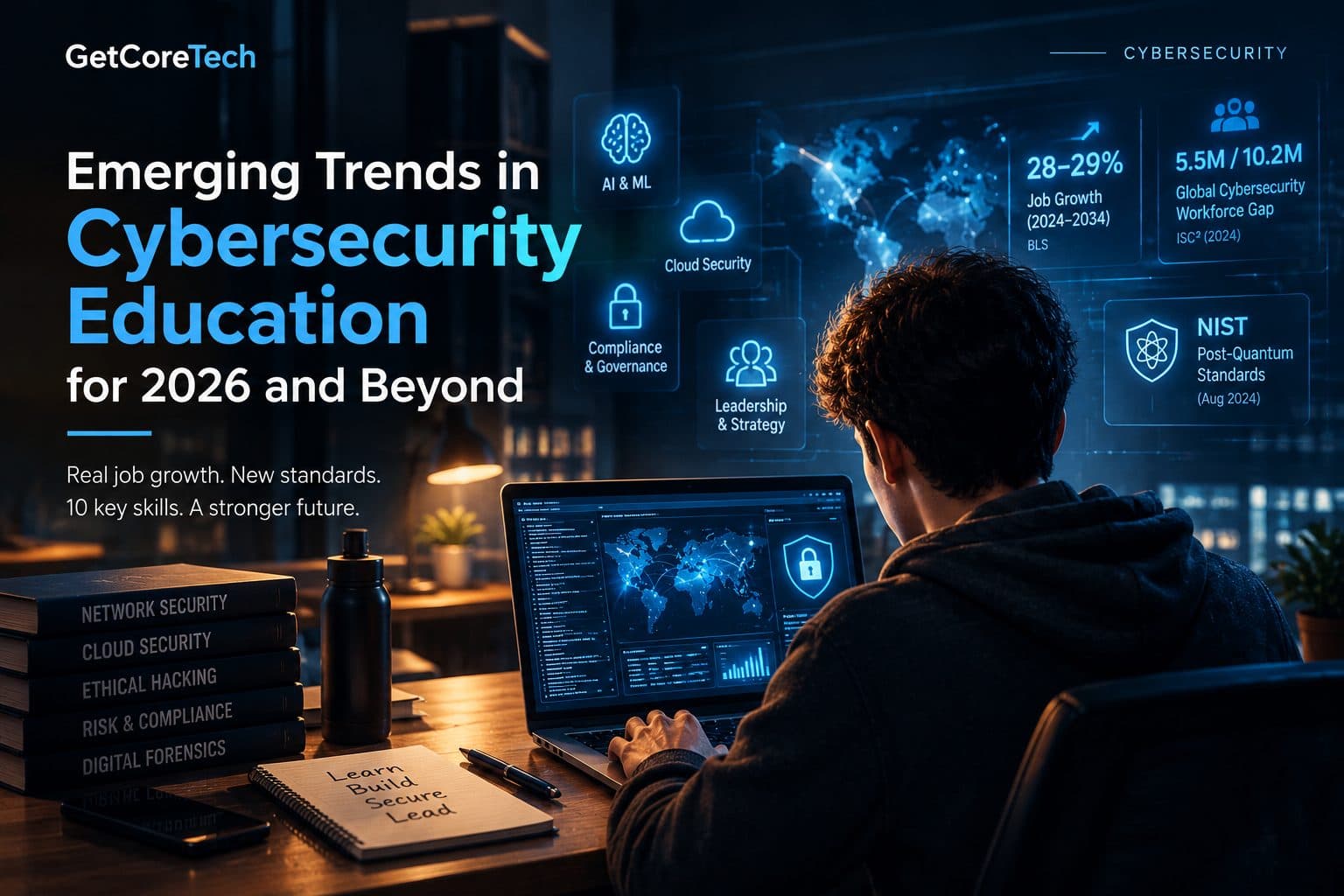
Emerging Trends in Cybersecurity Education for 2026 and Beyond
Cybersecurity education is being reshaped by a specific, measurable gap: the U.S. Bureau of Labor Statistics projects 28-29% employment growth for information security analysts between 2024 and 2034 — several times faster than the average occupation — while ISC2's 2024 workforce study put the global cybersecurity workforce at 5.5 million against an estimated need of 10.2 million. Training programs are responding by shifting from theory-heavy coursework toward practical, specialized, leadership-oriented curricula built around ten specific skill areas.1. AI Literacy on Both Sides of the Fight
Cybersecurity programs increasingly teach AI from two directions at once: how to use machine learning for threat detection and automated response, and how attackers are using the same tools for AI-generated phishing, deepfakes, and adaptive malware that changes its own behavior to evade detection. Understanding both sides is now treated as a baseline requirement rather than an elective specialty.2. Cloud Security as a Core, Not an Elective
With most organizations now operating primarily on AWS, Azure, or Google Cloud under a shared-responsibility security model, cloud-specific skills — identity and access management, container security, and DevSecOps practices — have moved from optional add-on courses into core curricula. Certifications like the Certified Cloud Security Professional (CCSP) have grown accordingly, reflecting sustained employer demand for cloud-specific security leadership.3. Hands-On Labs Replace Theory-First Teaching
Virtual labs, Capture-the-Flag competitions, and red team versus blue team exercises are now standard rather than supplementary. Programs built around the MITRE ATT&CK framework — a real-world catalogue of documented attacker tactics and techniques — give students practice against realistic scenarios rather than abstract textbook descriptions, which employers consistently value more than credentials alone.4. Compliance and Governance as Required Knowledge
Security is no longer purely technical. Students now study frameworks like HIPAA, GDPR, and the NIST Cybersecurity Framework as core material, not electives, because organizations increasingly need staff who can navigate the legal and regulatory dimensions of a breach, not just the technical response.5. Leadership and Strategy Training
Certifications like CISM (Certified Information Security Manager) reflect a broader shift: organizations want professionals who can translate technical risk into terms executives and boards can act on, manage budgets, and lead crisis response — not only configure firewalls.6. Flexible, Online, and Hybrid Delivery
Accredited online degrees, hybrid programs, and micro-credential courses have expanded access significantly, letting working professionals upskill without leaving their jobs. This flexibility is a meaningful factor in closing the workforce gap referenced above, since it lowers the barrier for career-changers to enter the field.7. Ethical Hacking and Offensive Security
Programs increasingly train students to think like attackers through penetration testing and vulnerability assessment, often aligned with Certified Ethical Hacker (CEH) methodology. The logic is straightforward: finding weaknesses before criminals do requires understanding how criminals actually operate.8. Digital Forensics and Incident Investigation
When an incident happens, proper evidence collection, log analysis, and chain-of-custody procedures determine whether an organization can actually understand what happened and pursue legal recourse. Digital forensics has grown from a niche specialty into a more commonly taught skill set.9. Zero Trust Architecture
Zero Trust — the principle that no user or device is automatically trusted, even inside the network perimeter — has moved from an emerging concept to mainstream curriculum, guided substantially by NIST's published Zero Trust architecture principles. Identity-first security and continuous authentication are now commonly taught alongside traditional network security.10. Post-Quantum Cryptography: No Longer Theoretical
This is the area where the original framing of "quantum computing" as a distant trend is now outdated. NIST finalized its first three post-quantum cryptography standards — FIPS 203, 204, and 205 — in August 2024, meaning organizations now have real standards to migrate toward, not a hypothetical future requirement. Cybersecurity programs are increasingly teaching post-quantum migration planning as a practical, near-term skill rather than speculative theory.The Certifications Still Worth Knowing
CISSP, CompTIA Security+, CISM, and CEH remain the most widely recognized credentials, and certification bodies have been updating exam content to reflect cloud security, AI risk, and DevSecOps rather than staying static. Performance-based testing — requiring candidates to demonstrate a skill rather than just answer multiple-choice questions — has also become more common across these programs.
Comments
Log in or sign up to join the discussion.
Loading comments…