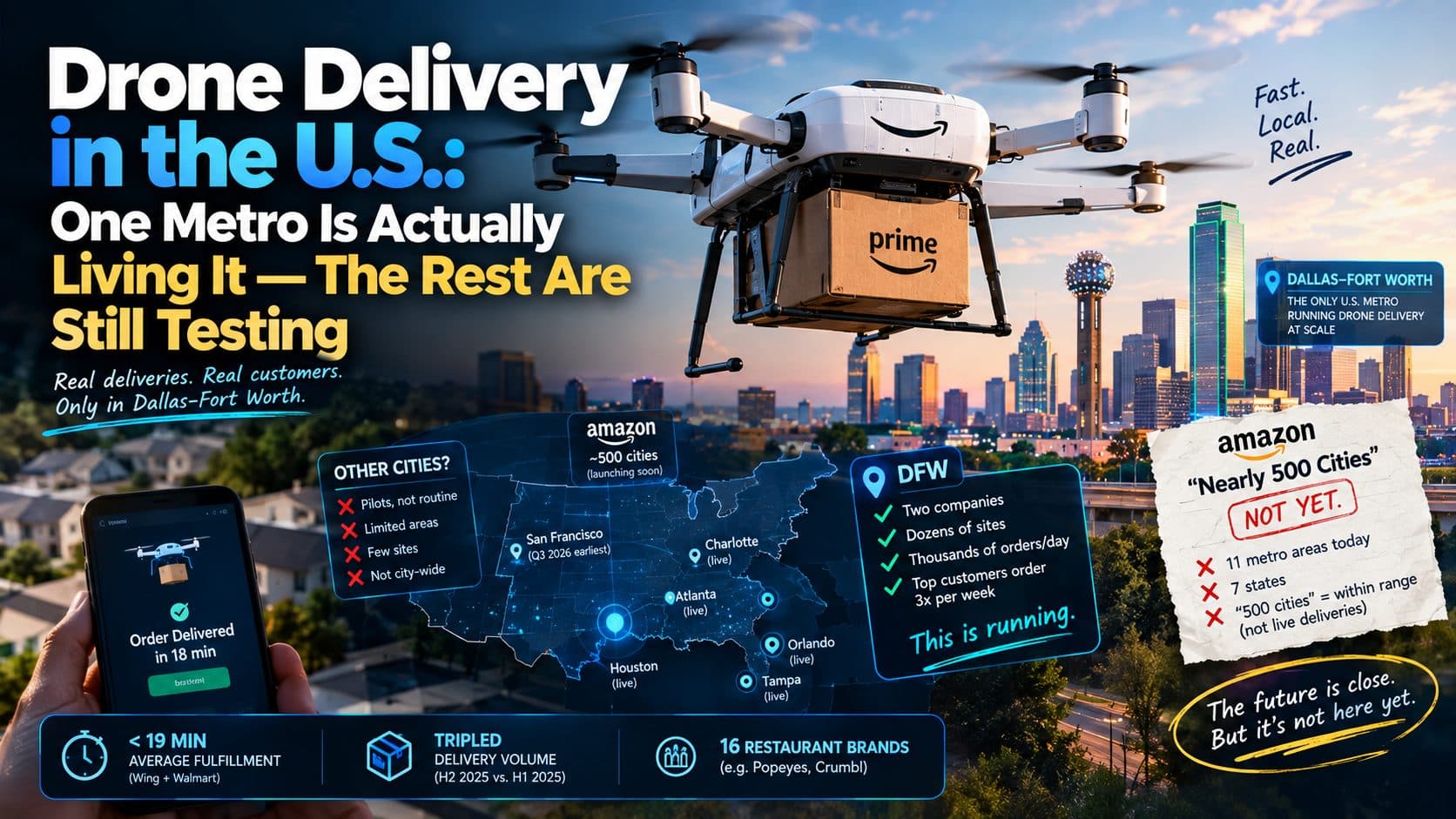
Dallas-Fort Worth is the one U.S. metro where drone delivery has stopped being a pilot and become a habit — dozens of sites, thousands of orders a day, and a top tier of customers ordering three times a week. Almost everywhere else, including Amazon's own marquee "nearly 500 cities" claim, is still expansion-in-progress: real flights happening in a handful of neighborhoods, not the routine, city-wide service the headline number implies.
What "running" actually means here
Piloting is a company flying a few hundred test deliveries in one zip code to prove the concept works. Running is a service dense enough that ordering a drone delivery is no different from ordering a rideshare — available across most of a metro, fast enough to be reliable, and used repeatedly rather than once out of curiosity. By that bar, almost every "we're in X cities" press release collapses the two together, because a single new store launch counts as the same "city" as a market with 20 operating sites.
Dallas-Fort Worth is the only U.S. metro that clears the second bar today.
The one metro that's actually there
Zipline and Wing both run dense, overlapping networks across the Dallas-Fort Worth Metroplex, and the numbers describe habitual use, not novelty. Wing's own data from a January 2026 expansion announcement shows delivery volume tripling in the second half of 2025 compared with the first half in Dallas-Fort Worth and Atlanta, with the top quarter of customers ordering three times a week. Zipline separately opened its 20th Dallas-Fort Worth Walmart site in March 2026, part of a network that now also delivers from 16 restaurant brands including Popeyes and Crumbl, with an average flight time of three minutes.
Wing CEO Adam Woodworth put it plainly in a June 2026 announcement: "This is real drone delivery at scale." Average fulfillment across the partnership runs under 19 minutes.
That density is the differentiator. Most markets have one company running a handful of stores; Dallas-Fort Worth has two companies running dozens of sites that overlap, which is what turns a novelty flight into infrastructure people plan around.
The tier just behind: live, but thinner
Houston, Atlanta, Charlotte, Orlando, and Tampa are genuinely operating markets, not vaporware — Wing and Walmart went live in Houston in January 2026 as that year's first new market, and Atlanta and Charlotte have been running since mid-to-late 2025. But the same Wing data shows a consistent pattern: a market announced in June 2026 typically doesn't go live until three to six months later, and even after launch, coverage starts at a handful of stores rather than the metro-wide density Dallas-Fort Worth reached over several years. San Francisco Bay Area service, announced alongside four other markets in June 2026, wasn't expected to see its first delivery until Q3 2026 at the earliest — and Wing itself has flagged the Bay Area's airspace as a harder operating environment that could cap volume per site well below what Dallas-Fort Worth achieves.
These are real, live services. They're also, almost without exception, one to two years behind the density that makes Dallas-Fort Worth different.
Amazon's "nearly 500 cities" claim, decoded
Amazon announced in August 2026 that Prime Air would expand to nearly 500 U.S. cities and towns by the end of the year — a sixfold jump from its current footprint. Read past the headline number and the current footprint is 11 metro areas across seven states, each site covering roughly 175 square miles, with the widely-cited "500" figure counting every town within reach of those sites, not 500 places where a drone has actually delivered a package yet. Chicago, Atlanta, Cleveland, Syracuse, and Boise were all still listed as "launching soon" at the time of the announcement, not live.
Amazon's program has also run into the kind of friction that pilots don't generate at scale. A pair of its drones struck a crane in Tolleson, Arizona in October, triggering separate inquiries from the National Transportation Safety Board and the FAA. A Prime Air drone severed an internet cable in Waco, Texas the following month, prompting a separate FAA probe, and the U.K.'s Air Accidents Investigation Branch opened its own inquiry after a Prime Air drone crashed in Darlington, England.
None of that means Prime Air isn't real — Amazon holds FAA Part 135 certification, the same oversight tier used for commercial air carriers, and says it's already made hundreds of thousands of deliveries this year. It means the "500 cities" figure describes a rollout target, not a current map of where the service actually runs today.
None of this waited for the rule that's supposed to enable it
The regulatory framework meant to make all of this routine still doesn't exist. FAA Part 108, the standing rule for beyond-visual-line-of-sight drone flight, was due in March 2026 under a presidential executive order and has sat under review at the White House's Office of Information and Regulatory Affairs since July 10, 2026, past its original deadline.
Every drone delivery described above is happening under existing waivers or, in Amazon's case, Part 135 air-carrier certification — not under the framework that industry has spent two years describing as the thing that will finally let this scale. The broader U.S. drone industry crossed 65 million total flights by August 2026, according to flight-logging platform AirData, across 850,000 registered aircraft. The infrastructure is being built case by case, market by market, ahead of the regulation rather than because of it.
That's the real story behind "which cities have it running." It isn't a national rollout with a start date. It's Dallas-Fort Worth, running at genuine scale, a second tier of cities catching up one Walmart parking lot at a time, and a headline number from Amazon that describes where the drones are aimed, not where they've landed.
Comments