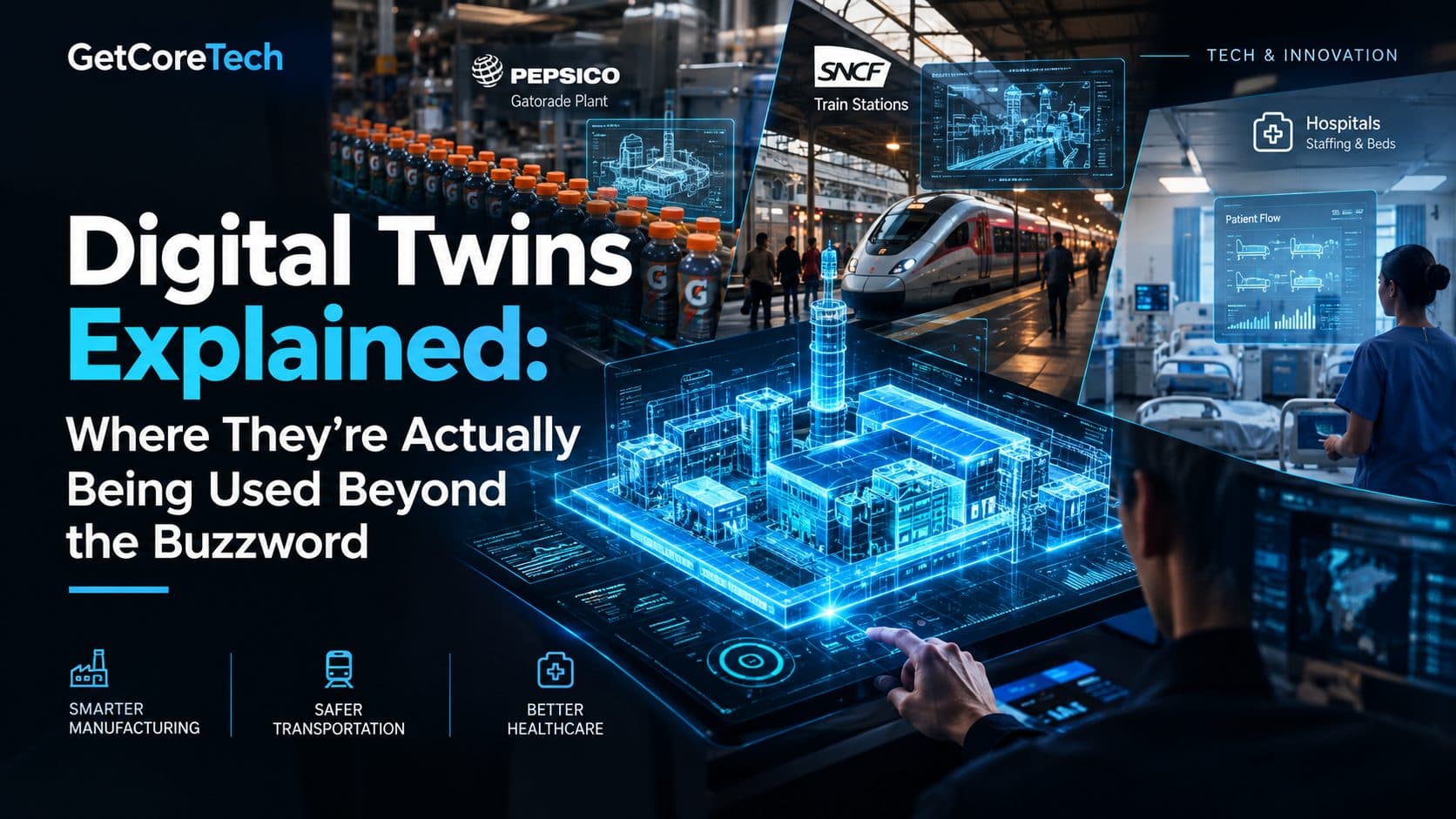
Digital twins aren't stuck on a concept slide anymore — they're running right now inside a Gatorade plant, a French train station, and hospital scheduling offices, and none of it looks like the sweeping virtual-city vision usually attached to the term. Siemens and NVIDIA's work with PepsiCo identified up to 90% of potential plant-design issues before construction even started; SNCF Gares&Connexions cut maintenance response time in half across a real rail network; hospital operations teams are testing staffing and bed-allocation changes the same way, before making them for real. All three are solving the same kind of problem — narrow, unglamorous scheduling and maintenance decisions — not building the sci-fi mirror-world the pitch decks promise.
Three deployments, not one buzzword
At CES 2026, PepsiCo announced a multi-year collaboration with Siemens and NVIDIA to rebuild how it plans plants and warehouses. Instead of expanding physically, PepsiCo is converting existing U.S. facilities into high-fidelity 3D models using Siemens' Digital Twin Composer, built on NVIDIA Omniverse. The company reported a 20% throughput increase at one U.S. Gatorade plant within three months of deployment, along with an estimated 10-15% reduction in capital expenditure from validating layout changes virtually instead of building them first. Siemens said the platform caught up to 90% of potential issues before any physical construction began.
France's SNCF Gares&Connexions runs a different version of the same idea across a network of 3,000 train stations. Working with NVIDIA and digital twin platform Akila, the operator built live models of stations in Monaco and Marseille that pull in crowd movement, airflow, and IoT sensor data to run emergency-response and maintenance scenarios before they happen for real. NVIDIA's case study on the deployment reports a 100% on-time preventive maintenance completion rate, a 50% cut in both downtime and issue response time, and a 20% drop in energy consumption at the stations running the system.
Hospitals are applying the same logic to a much less visual problem: bed assignment and staffing. An April 2026 report in the Journal of Medical Internet Research, written by Mark Crawford, describes how administrators are using live models of hospital operations to test staffing levels and scheduling changes before rolling them out on the floor. GE HealthCare has built a comparable platform for hospital systems that simulates patient flow and resource use so leaders can run "what if we get a seasonal surge" scenarios against real capacity data instead of guessing.
The common thread the buzzword hides
None of it requires a headset.
Strip away the marketing language and each system does the same three things: pull live data from sensors or records, run a model of a real decision before it's made, and feed the result back into an actual operational choice — where to put a conveyor, when to send a maintenance crew, how many beds to hold open. PepsiCo is testing machine and pallet-route placement. SNCF is testing what happens when a crowd surge hits a station during a live event. Hospitals are testing whether a new staffing pattern would have absorbed last winter's admissions spike. That's the whole category, once the metaverse language gets removed — a way to run an expensive real-world decision cheaply first.
Where the buzzword still outruns the reality
The gap between that quiet operational reality and the industry's own numbers is wide enough to notice. A 2025 Manufacturing IT/OT Trend Report found more than 40% of manufacturers were still in the pilot phase of digital twin adoption rather than running twins in production. Adoption also splits sharply by sector: research firm PatSnap's 2026 landscape analysis found more than 70% of aerospace, automotive, electronics, and energy-utility manufacturers piloting or deploying digital twins, against 30-50% in food, pharma, and chemicals, and under 30% in textiles and light manufacturing.
Even the market-size figures used to sell the category disagree with each other by tens of billions of dollars. Grand View Research puts the 2026 global digital twin market at $49.47 billion; the Market Research Future puts the same year at $53.6 billion; Research Nester's 2025 baseline is $23.59 billion. A category that different research firms can't agree on within the same twelve months isn't a mature, settled market yet — it's still being defined by whoever's selling the report.
That's the gap between the slide that sells the technology and the shop floor running it.
The risk that doesn't make it into the pitch deck
Wiring a live, bidirectional data feed between a factory floor or hospital network and a simulation platform doesn't just create decision-making value — it creates a new connection point for attackers to reach systems that used to be physically isolated. Dragos's Annual OT Cybersecurity Year in Review, published in February 2026, tracked 3,300 industrial organizations hit by ransomware in 2025, up from 1,693 the year before, with manufacturing absorbing the largest share by a wide margin. PwC's 2026 Global Digital Trust Insights survey of 3,887 executives found 47% cite a lack of qualified personnel as their top challenge in securing the OT and IIoT systems that now feed real-time data into these twins. The SANS Institute's 2026 report found only 12% of cybersecurity specialists have substantial OT experience — meaning most of the people responsible for defending these connected systems don't actually understand the industrial equipment sitting behind them.
That combination — more live connections into physical infrastructure, plus a workforce that mostly doesn't understand the industrial side of what it's defending — is the trade-off nobody puts in the case study. The throughput and downtime numbers are real. So is the expanded attack surface that produced them.
What this actually means for builders and operators
The examples that are working share a pattern: a narrow, well-instrumented question with clean data behind it — a plant's throughput, a station's maintenance schedule, a hospital's bed count — not an attempt to model an entire organization at once. The 40% still stuck piloting are, by most accounts, trying to answer a much bigger question with much messier data. If a specific operational decision is repeated often enough to be worth modeling, and the sensor or record data behind it is already reliable, a digital twin is solving a real problem right now. If the pitch is a virtual replica of the whole business, that's still mostly a slide.
Comments