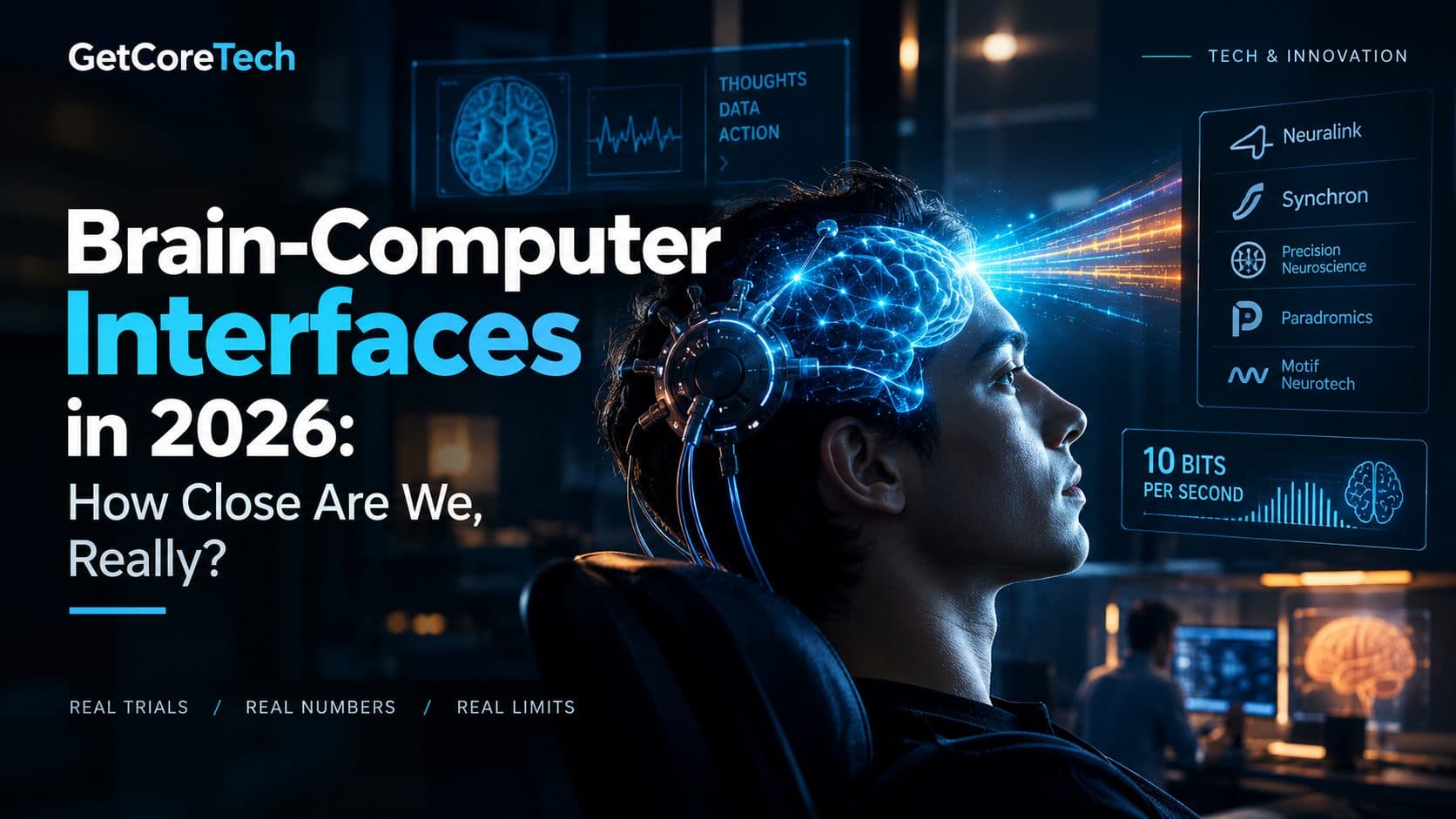
The best brain-computer interfaces in human trials move information out of a person's head at roughly 10 bits per second, and the Caltech study that pinned that number down argues the ceiling belongs to the brain rather than to the hardware. At least five companies now have implants in living patients and five US states regulate neural data, but no permanently implanted BCI is approved for sale anywhere in the US — and the company closest to asking for that approval has not yet started the trial it needs to ask.
The field stopped being one company's story
Neuralink still supplies most of the numbers people quote. Elon Musk said in January 2026 that the company had enrolled 21 patients worldwide, up from 12 the previous September, across sites in the US, UK, Canada, and the UAE. In May the company performed its first transdural implant at University Health Network in Toronto, threading electrodes through the dura rather than removing it — the surgical change underpinning the automated, higher-volume procedure Musk announced at the end of 2025.
Those counts come from company posts on X rather than a registry, which is worth holding loosely when comparing companies.
Synchron takes a different route into the skull, running its Stentrode up through the jugular vein and parking it in a blood vessel against the motor cortex. Its COMMAND study enrolled six patients under the first Investigational Device Exemption the FDA ever granted for a permanently implanted BCI, and reported a clean safety record. A $200 million Series D closed in November 2025, led by Double Point Ventures, was raised specifically to fund the pivotal trial that would let Synchron file the first premarket approval application for an implanted BCI. As of June 2026 the company was still preparing that trial, not enrolling in it.
Precision Neuroscience went around the problem instead of through it, clearing its Layer 7 array under the FDA's 510(k) pathway in April 2025 — real marketing clearance, capped at 30 days of implantation, aimed at brain mapping during surgery rather than at daily life. In January 2026 it announced a partnership to embed Layer 7 into Medtronic's StealthStation, the navigation system already sitting in most major neurosurgical operating rooms.
The genuinely new entrant is Paradromics. University of Michigan surgeons implanted its Connexus device in a woman with motor neuron disease on 17 June 2026, the first patient in an FDA-approved feasibility study that will follow her for six years. On 26 August the FDA issued a letter letting the study add ordinary laptops, tablets, and phones as compatible devices without approving each one individually — an unglamorous change that decides whether a patient's implant works with the hardware already in their house. A second patient has been identified, and the first has reached closed-loop operation.
Motif Neurotech received an IDE in April 2026 for something different again: a blueberry-sized stimulator that sits in the skull above the dura and targets treatment-resistant depression rather than paralysis.
Everyone is racing on a bandwidth number that isn't the binding one
Paradromics describes Connexus as the highest data-rate BCI platform in the field, citing a preprint showing more than 200 bits per second of information transfer in preclinical models. Neuralink's newer devices triple channel count. Synchron's next-generation program is explicitly a "high-channel whole-brain interface." Channel density is the axis the industry competes on.
Jieyu Zheng and Markus Meister, working at Caltech, published a paper in Neuron in December 2024 arguing that axis runs into a wall. Applying information theory across a century of behavioral literature — typing, reading, Rubik's Cubes, video games — they calculated human information throughput at about 10 bits per second, while the sensory systems feeding that process take in data at around a billion bits per second. Caltech's own summary of the work draws the conclusion directly: a brain communicating through a neural interface would communicate at the same 10 bits per second.
More channels buy accuracy, not speed.
That distinction gets collapsed constantly, and it matters commercially. A device capable of 200 bits per second of transfer is not a person capable of producing 200 bits per second of intent. The extra capacity is spent on decoding the same slow signal more reliably — fewer misreads, less calibration drift, better performance on a bad day — which is genuinely valuable and is not the same as a faster mind.
The honest counterweight is that the 10-bit figure is a behavioral measurement, not a law of physics, and it doesn't cover every application equally. Speech decoding, where the target is a motor plan for articulation rather than a deliberate symbol choice, may sit on a different curve. Restoring vision, which Neuralink is pursuing under a separate Breakthrough designation, is an inbound problem rather than an outbound one, and the sensory pathway is the fast one. What the Caltech work forecloses is narrower than "BCIs won't get better" and more specific: adding electrodes will not produce a person who thinks at machine speed, and every pitch built on that promise is selling past the evidence.
Nothing permanent is approved for sale, and nobody has agreed to pay for it
An Investigational Device Exemption lets a company implant people for research. A Breakthrough Device designation shortens review timelines. Neither is permission to sell anything, and every Neuralink, Synchron, and Paradromics patient is enrolled under one of those research arrangements. Precision's clearance is the exception that proves how narrow the exception is: a marketed product used for up to 30 days during surgery is a different object than an implant a patient takes home for six years.
The less-discussed obstacle sits past approval. No Medicare coverage determination exists for implantable BCIs. Even after a first PMA clears, a hospital deciding whether to offer the procedure faces a reimbursement question with no answer yet, which is the kind of thing that turns a two-year commercial timeline into a five-year one.
The market forecasts disagree by more than an order of magnitude
Five research firms published a 2026 figure for the global BCI market. Fortune Business Insights puts it at $295.5 million. Market Research Future says $1.48 billion. Coherent Market Insights says $2.75 billion. Market Data Forecast says $3.25 billion. Towards Healthcare says $3.75 billion.
Same year, same industry, a nearly 13-fold spread between the low and high estimates.
Grand View Research makes the underlying problem visible by answering a slightly different question: it sizes the total addressable market for invasive BCIs at $168.27 billion for 2025, a number roughly 500 times the low-end figure above, because "everyone who might eventually benefit" and "revenue booked this year" are not the same measurement.
The spread is a symptom of an industry that barely sells anything yet. With almost no commercial revenue to count, an estimate depends entirely on what the analyst folds in — EEG meditation headbands, research grants, clinical neurodiagnostic equipment, venture funding, or only implant procedures. Change the definition and the total moves by an order of magnitude. Any single "$X billion by 2026" headline is better read as a disclosure of what that firm chose to include.
Lawmakers are regulating the consumer product, not the implant
Vermont became the fifth US state with a neural-data statute when Governor Phil Scott signed H.814 on 18 May 2026, joining Colorado, California, Montana, and Connecticut. Connecticut's amendment to its Data Privacy Act and Vermont's law both took effect on 1 July 2026. The approaches don't match: Connecticut covers only central nervous system activity, Montana wrote a standalone law amending its Genetic Information Privacy Act and requires a warrant before law enforcement can access neural data, and Vermont's Senate stripped the consent requirement and the private right of action before passage, leaving something closer to a study bill than an enforcement regime. At the federal level, the MIND Act was introduced in 2025 and has not passed.
Almost none of this touches surgical implants. The target is consumer neurotechnology — EEG headbands, sleep-tracking earbuds, meditation wearables — and on the evidence, the target deserves it. The Neurorights Foundation audited 30 consumer neurotech companies in April 2024 and found that 96.7% reserved the right to share neural data with third parties, fewer than 20% mentioned encrypting it, and 16.7% committed to notifying users of a breach.
Clinical implant data, collected in a hospital under a research protocol, was already the best-protected neural data in the country. The laws now on the books mostly protect the brain data people are already generating from their couch.
What "close" actually means
Two different distances get collapsed into one question, and they are not closing at the same rate.
Restoring communication and device control to people with paralysis, ALS, or late-stage motor neuron disease is close. Synchron's pivotal trial is funded and designed, Paradromics has a patient in closed-loop operation with a six-year follow-up ahead of her, and Neuralink is solving surgical throughput rather than feasibility. A first PMA within a few years is a reasonable expectation, with reimbursement rather than approval as the likelier bottleneck.
A high-bandwidth merge between mind and machine is a much longer trip, and the obstacle isn't electrode count or surgical technique. It's that conscious thought appears to run at about 10 bits per second no matter what you attach to it, and no current research points to a route around that without decoding signals the person isn't deliberately producing — which is a different product, with a different set of consent problems, than anything now in trials.
Whichever of those two things someone means, the 2026 answer is the same: real, working, medically meaningful for a small and growing group of patients, and further from a shelf than the funding rounds suggest.
Comments