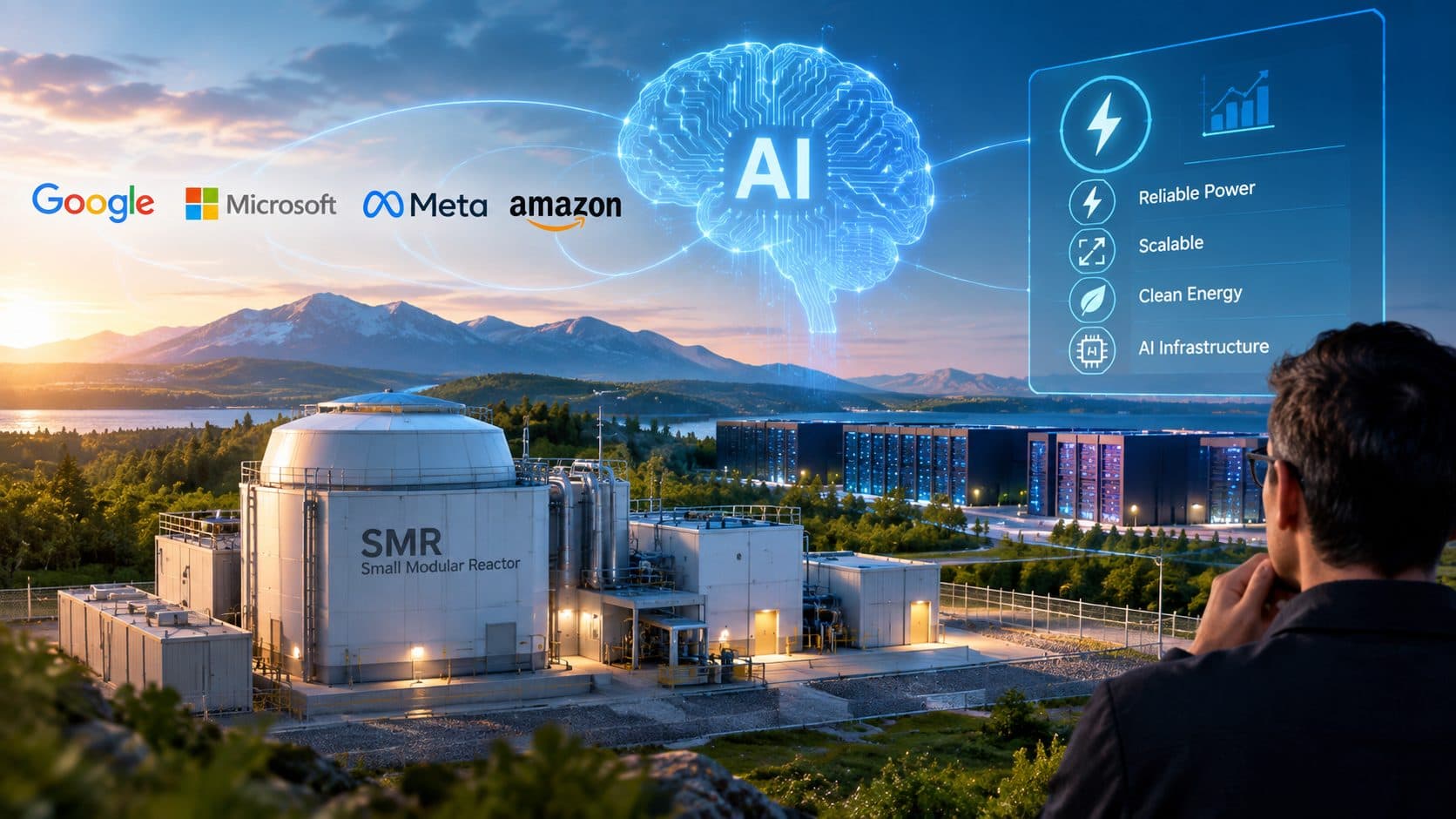
Big Tech's small modular reactor deals add up to a rounding error against what these companies actually spend on data centers, and the one flagship project that broke ground in 2026 won't generate a watt before 2030. Nuclear may still matter for AI power by the mid-2030s — but not on the timeline the press releases imply, and not at the scale currently being announced.
The Money Doesn't Match the Announcements
Amazon and Google both told investors on their February 2026 earnings calls that they expected to spend up to $200 billion and $185 billion, respectively, on data centers this year. Set that against the largest single nuclear investment either company has made public: a $650 million fundraising round that TerraPower, the reactor company Bill Gates started, closed in 2025 with backing from Nvidia's venture arm. One cost estimate puts a single 345-megawatt Natrium plant at $9.4 billion to build. That $650 million round wouldn't cover a tenth of it.
Nuclear commitments are a fraction of one percent of what these four companies plan to spend on data centers this year.
The legal language behind the deals is looser than most coverage suggests, too. Amazon's 2024 agreement with Energy Northwest only funds "the initial feasibility phase" of a reactor project, in exchange for the right — not an obligation — to buy power from the first four modules if they're ever built and the electricity turns out to be worth the price. Google's Kairos Power agreement is structured the same way: an option to purchase power under a future contract, not a signed commitment to take it.
The One Project Under Construction Isn't Technically an SMR
TerraPower broke ground on its Natrium reactor near Kemmerer, Wyoming, in April 2026, after the Nuclear Regulatory Commission issued the first construction permit for a new US reactor design in more than four decades. That's real regulatory movement, not vaporware. But Natrium runs at 345 megawatts, with a molten-salt storage system that can push peak output to roughly 500 megawatts — both above the sub-300-megawatt line that actually defines a small modular reactor. The plant crews are pouring concrete for in Wyoming right now isn't the compact, factory-built design Big Tech's press releases describe. It's a larger, custom-built advanced reactor that happens to share a Department of Energy funding program with SMRs.
Meta's January 2026 agreement with TerraPower calls for as many as eight Natrium units by 2035, with the first two due "as early as 2032," according to Nuclear Newswire, the trade publication run by the American Nuclear Society. That's a genuine contract for real megawatts. It's just not fast megawatts.
Nobody's AI Power Bill Is Getting Paid by Uranium This Decade
The Kemmerer plant is targeting completion around 2030 or 2031, per the Department of Energy's own project timeline. Meanwhile, the actual gap in US grid capacity is being filled by gas. Pacifico Energy secured a permit in January 2026 for 7.65 gigawatts of gas-fired generation in Texas — the largest single power-plant permit ever granted in the US — specifically to serve data center demand. Meta itself is separately building a 5-gigawatt data center in Louisiana with no nuclear component attached.
The numbers explain why. According to the Energy Institute's Statistical Review of World Energy 2026, US nuclear generation actually fell slightly, from 831.5 terawatt-hours in 2020 to 826.1 terawatt-hours in 2025 — even as data center electricity demand grew from 172.8 to 312.6 terawatt-hours over the same five years. Every bit of that growth was absorbed by gas and renewables, not nuclear, because there wasn't any new nuclear capacity to absorb it with.
A single 300-megawatt reactor running flawlessly, every hour of every day, produces about 2.6 terawatt-hours a year — roughly what US data center demand grows by every ten days at its current pace.
The Bet Could Still Pay Off, Just Not on AI's Clock
None of this means the nuclear push is empty theater. Deloitte's April 2025 analysis projected that nuclear could supply up to 10 percent of US data center electricity demand by 2035, and Wood Mackenzie tracked a global SMR project pipeline of 47 gigawatts as of the first quarter of 2026, more than half of it sited in the US. TerraPower's HALEU fuel supply deal with Framatome and the NRC's new licensing pathway for non-light-water reactors are real infrastructure, not marketing copy — the kind of groundwork that takes a decade to lay regardless of who's paying for it.
The disagreement isn't over whether nuclear works. It's over what the current spending actually buys. Critics, including a July 2026 analysis in the Bulletin of the Atomic Scientists, argue the deals function mainly as public relations — a way for companies with expired 2030 net-zero pledges to keep using the word "carbon-free" in press releases while gas plants do the actual work of powering their data centers today. A more generous reading is that hyperscalers are placing decade-scale bets on infrastructure that runs for sixty years, and $650 million now is simply an early, proportionate stake in a technology that won't need to compete on 2026 economics until the 2030s. Both readings can be true for the same set of announcements. What isn't true is that any of this nuclear capacity is solving the power problem AI data centers have right now.
Comments