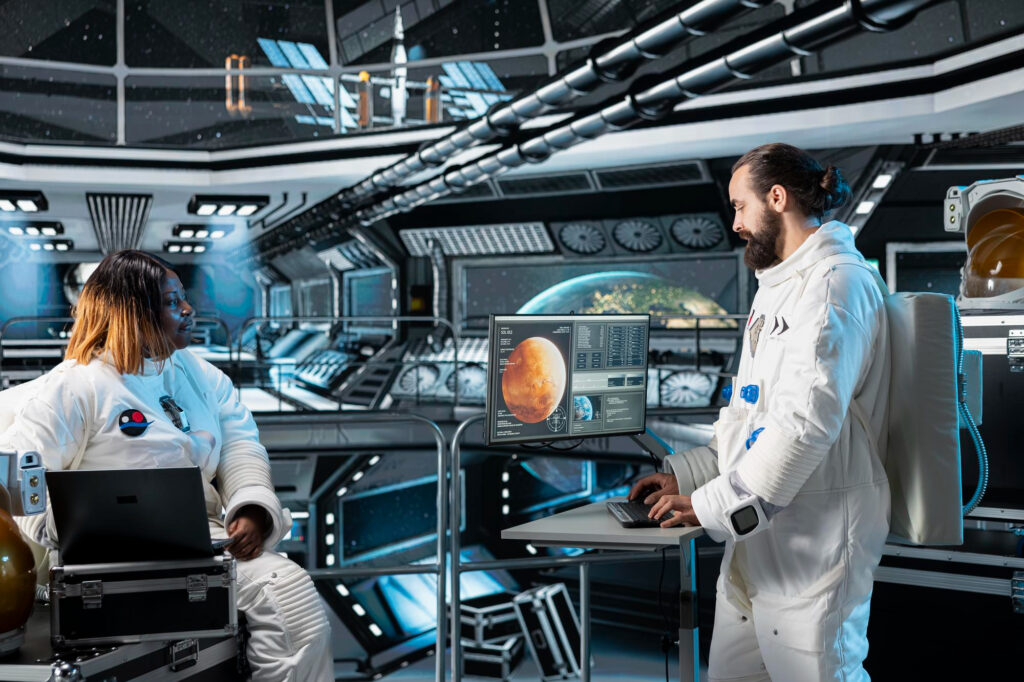
Space stations have long captured the imagination of humanity. From the early sketches in science fiction to the International Space Station (ISS) orbiting Earth today, the idea of humans living and working in space has evolved dramatically. In the 21st century, technological advances, private sector investment, and international collaboration are turning science fiction into reality. Future space stations promise not only to support research but also to serve as platforms for tourism, manufacturing, and exploration beyond Earth.
Also Read: Your Guide to the Dawn of the Spatial Computing Revolution
This article dives deep into the current state, emerging technologies, challenges, and future possibilities of space stations, providing a comprehensive guide to understanding how humanity is preparing for life in orbit.
What Is a Space Station?
A space station is an orbiting laboratory and habitat that allows humans to live and work in microgravity for extended periods. Unlike satellites or spacecraft, space stations are designed for long-term occupancy. They are equipped with:
- Living quarters
- Laboratories for research
- Life-support systems
- Solar power systems for energy
Modern space stations provide a controlled environment that enables humans to survive and thrive while orbiting Earth, studying outer space, and testing new technologies.
Learn more about space stations from NASA
The Evolution of Space Stations
1. Early Concepts and Single-Module Stations
The concept of space stations emerged in the 20th century. The Salyut program by the Soviet Union (1971–1986) was the first series of stations that allowed humans to live in orbit. These were small, single-module stations intended primarily for research and testing human endurance in space.
2. Skylab and Long-Duration Experiments
The United States launched Skylab in 1973. Skylab introduced laboratories for solar observations, biological studies, and Earth monitoring. Astronauts spent weeks in orbit, conducting experiments that paved the way for future long-term missions.
3. Mir: Modular Expansion
Launched in 1986, Mir was a modular station that allowed additional segments to be added over time. It hosted over 100 cosmonauts and astronauts during its operational lifetime, serving as a platform for international collaboration and long-duration research.
4. The International Space Station (ISS)
The ISS, operational since 2000, is the most famous space station today. It is a collaboration between NASA, ESA, Roscosmos, JAXA, and CSA. The ISS hosts astronauts continuously, enabling:
- Microgravity experiments
- Earth and space observation
- Technology testing for future missions
Explore the ISS
Why Space Stations Are Vital in the 21st Century
1. Scientific Research in Microgravity
Microgravity allows scientists to study phenomena that are impossible on Earth. Examples include:
- Protein crystallization for new drugs
- Human physiology studies in space
- Fluid and combustion behavior in zero gravity
2. Technology Development and Testing
Space stations are perfect environments to test robotics, life-support systems, and space travel technologies before sending them to Mars or other planets.
3. Earth Observation
Space stations monitor climate, weather patterns, ocean currents, and natural disasters in real-time, providing critical data for environmental science.
4. Commercial Opportunities
Private companies are now using space stations for tourism, microgravity manufacturing, and satellite servicing. This opens new avenues for space economy.
5. International Collaboration
Future space stations promote global cooperation in research, technology development, and exploration, fostering peace and knowledge-sharing.
Key Technologies Behind Modern Space Stations
1. Life Support Systems
Life-support systems maintain breathable air, water recycling, temperature, and pressure regulation. Advanced systems on the ISS recycle water and oxygen, minimizing the need for resupply missions.
2. Energy Solutions
Solar arrays supply electricity, while advanced batteries store energy during periods when sunlight is unavailable.
3. Modular Construction
Stations are built from modules launched separately. Modular design allows expansion, repair, and upgrades over time.
4. Robotics
Robotic arms like Canadarm2 perform maintenance, move cargo, and support astronauts during spacewalks.
5. AI and Automation
Artificial intelligence monitors operations, predicts system failures, and assists astronauts in daily tasks. Learn more about AI in space
Emerging Concepts for Future Space Stations
1. Large Modular Habitats
Future stations may be orbital cities housing hundreds of people. These habitats will support long-term research, tourism, and industrial activities.
2. Rotating Stations for Artificial Gravity
One major challenge in space is muscle and bone loss due to microgravity. Rotating stations using centrifugal force can create artificial gravity, improving astronaut health.
3. Inflatable Space Modules
NASA and private companies like Bigelow Aerospace are developing inflatable modules. These modules expand in space, providing more living space while reducing launch costs. Learn more about Bigelow modules
4. Lunar and Martian Orbit Stations
Stations orbiting the Moon or Mars will act as hubs for planetary exploration, refueling, and logistics.
Private Sector Driving Innovation
Private companies are now key players in building and operating space stations.
1. Axiom Space
Aiming to build the first commercial space station, Axiom Space will initially attach modules to the ISS and later operate independently. Learn more
2. Blue Origin
Jeff Bezos’ company focuses on reusable rockets and space habitats, aiming to make human life in space sustainable. Learn more
3. SpaceX
SpaceX provides transportation, logistics, and supply services for current and future stations, including the Dragon capsule. Learn more
4. Nanoracks
This company specializes in commercial research opportunities on the ISS, including small experiments and manufacturing in microgravity. Learn more
Future Benefits of Space Stations
1. Accelerated Scientific Discovery
Larger, more advanced stations will allow a higher volume of research and long-term studies that are impossible on Earth.
2. Space Tourism
Commercial stations may host civilians, offering unique experiences in orbit.
3. Microgravity Manufacturing
Materials like ultra-pure semiconductors, fiber optics, and biological products can be produced more efficiently in space.
4. Planetary Exploration
Stations in lunar and Martian orbit will reduce risk and cost for astronauts on exploration missions.
5. Global Collaboration
International partnerships ensure shared benefits, knowledge transfer, and peaceful use of space.
Challenges Facing Future Space Stations
1. High Costs
Building and launching modules remains expensive. Reusable rockets and private investment help mitigate costs but do not eliminate financial challenges.
2. Safety and Risk
Radiation exposure, micrometeoroids, and technical failures pose constant threats. Advanced shielding and AI monitoring systems are essential.
3. Human Health
Long-term microgravity affects bones, muscles, and mental well-being. Artificial gravity, exercise, and medical monitoring help address these issues.
4. Logistics and Sustainability
Resupply missions, waste management, and energy supply must be carefully planned to ensure long-term station operation.
Space Stations and the 21st-Century Economy
The rise of commercial space stations is transforming space into an economic frontier:
- Tourism: Companies like SpaceX and Blue Origin are planning orbital and suborbital trips.
- Manufacturing: Microgravity manufacturing could produce high-value materials.
- Research Services: Private labs on stations offer unique research opportunities.
- Satellite Maintenance: Future stations may repair, refuel, or upgrade satellites in orbit.
Learn more about commercial space economy
Future Outlook
The 21st century promises space stations that are:
- Bigger: Capable of housing hundreds of people
- Smarter: Using AI and robotics for daily operations
- Sustainable: Recycling resources and reducing resupply dependence
- Commercial: Supporting tourism, research, and manufacturing
- Exploratory: Acting as bases for Moon, Mars, and deep-space missions
Within the next few decades, orbital habitats may become as common as research labs on Earth. Humanity is on the brink of living permanently in space, turning science fiction visions into reality.
Final Thoughts
From Salyut to the ISS and beyond, space stations are evolving rapidly. Advanced AI, robotics, modular and inflatable structures, and private investment are driving this evolution. Future space stations in the 21st century will support research, commerce, tourism, and exploration, fundamentally changing human life in orbit.
The dream of living and working in space is no longer confined to science fiction. It is becoming a reality, and the 21st century is the era when humanity truly begins to expand its presence beyond Earth.
Future space stations promise a world where humans live, work, and innovate in orbit—blurring the line between imagination and reality.
FAQ: From Science Fiction to Reality: Future Space Stations in the 21st Century
1. What is a space station, and how is it different from a spacecraft?
A space station is a permanent or semi-permanent orbiting platform designed for humans to live and work in space for extended periods. Unlike spacecraft, which are typically used for travel to and from space, space stations remain in orbit and serve as laboratories, observation posts, and living environments. They include life-support systems, laboratories, solar panels, and modular habitats, allowing continuous scientific research, technological testing, and even commercial activities.
2. Why are space stations important in the 21st century?
Space stations are essential because they provide a controlled environment in microgravity, which is impossible to replicate on Earth. They support:
- Scientific experiments in physics, biology, and materials science
- Testing of new space technologies like robotics and life-support systems
- Earth observation for climate monitoring and disaster management
- Platforms for private companies to conduct research, manufacturing, and space tourism
By enabling these activities, space stations help advance both human knowledge and the global economy.
3. How do modern space stations maintain life in orbit?
Modern stations like the ISS use advanced life-support systems to ensure astronauts have air, water, and food. These systems include:
- Air circulation and CO2 removal
- Water recycling from humidity and urine
- Temperature and pressure regulation
- Waste management systems
These technologies allow humans to stay in orbit for months or even years, providing crucial data for long-term space missions.
4. What technologies are crucial for future space stations?
Future space stations rely on cutting-edge technology to operate efficiently and safely:
- Modular construction allows expansion and repairs
- Robotic arms perform maintenance and cargo handling
- Artificial intelligence (AI) monitors systems and assists astronauts
- Inflatable modules increase living space without adding launch weight
- Solar panels and energy storage provide sustainable power
Together, these technologies make stations more capable, safe, and sustainable.
5. How is AI transforming the operation of space stations?
AI in space stations helps automate monitoring, maintenance, and research tasks. It can:
- Detect system failures before they become critical
- Schedule experiments and manage resources efficiently
- Analyze data from experiments in real-time
- Reduce human workload, allowing astronauts to focus on more complex tasks
AI also plays a role in autonomous navigation and robotic operations, which will be vital for future lunar or Martian stations.
6. What role do private companies play in future space stations?
Private companies are becoming central to the space station ecosystem:
- Axiom Space plans the first commercial orbital station
- Blue Origin focuses on reusable rockets and space habitats
- SpaceX provides transportation and resupply services
- Nanoracks supports commercial research and microgravity manufacturing
Private investment accelerates innovation, reduces costs, and opens space to tourism and industrial applications.
7. What are the major challenges of building and operating space stations?
Despite technological advances, space stations face several challenges:
- High cost of launches and construction
- Safety risks, including radiation, micrometeoroids, and technical failures
- Human health issues due to microgravity, such as bone and muscle loss
- Logistical difficulties in resupply and waste management
- Sustainability, requiring efficient recycling of air, water, and materials
Addressing these challenges is crucial for the success of long-term habitation in orbit.
8. How will future space stations support planetary exploration?
Stations in lunar or Martian orbit will serve as platforms for:
- Launching missions to the surface safely and efficiently
- Storing and refueling spacecraft
- Conducting long-duration scientific research in preparation for planetary settlements
These stations reduce the risk and cost of deep-space exploration by acting as hubs for astronauts and equipment.
9. What are the potential economic benefits of space stations?
Future stations will drive a new space economy through:
- Space tourism, offering civilians unique orbital experiences
- Microgravity manufacturing, producing high-value materials
- Commercial research, supporting pharmaceutical and technological experiments
- Satellite maintenance and refueling
These activities can generate revenue while also advancing science and technology.
10. How close are we to turning science fiction into reality?
We are closer than ever to achieving the space habitats once imagined in science fiction. With the ISS operating successfully for over two decades, and private companies like Axiom Space, SpaceX, and Blue Origin developing commercial stations, the foundation is set for orbital cities, tourism hubs, and research laboratories. Technologies like AI, robotics, modular construction, and inflatable habitats are enabling long-term human presence in space, making science fiction ideas achievable within the 21st century.